
HBOT Conversations:
Dr. Paul Harch & 8,101 Genes
He is the author of The Oxygen Revolution and is considered an International expert and pioneer in the field of Hyperbaric Oxygen Therapy (HBOT). His informative, and comprehensive guide on HBOT has helped countless souls better understand what HBOT is and how it directly affects the body at the genetic level.
This episode on 8,101 genes is the eighth in a nine episode series that will be released weekly with Dr. Harch.
Watch the Podcast
In episode 8 of 9, host Edward di Girolamo speaks with world renowned HBOT expert, Dr. Paul G. Harch, about aging and the 8,101 genes HBOT affects.
di Girolamo starts this conversation with Dr. Harch bringing up the 8,101 genes that are activated by Hyperbaric Oxygen Therapy. The discussion leads to talk of Big Pharma, telomeres, reparative gene process, patents, and successful business models for HBOT clinics.
Dr. Harch explains that Hyperbaric Oxygen Therapy affects 8,101 of our genes, and it’s doing so on a different level for the ones that are overactive and abnormal in the disease process. He speaks of a 2004 lecture he gave to A4M about the effects of HBOT on longevity; and asks, “Where is senescence and aging based?”, answering with, “It’s in our DNA”. Dr. Harch dives in to how HBOT turns on our genes to grow new tissue and stimulates cellular repair and regeneration. di Girolamo agrees and brings up a different past lecture from Dr. Harch where Harch referred to Hyperbaric Oxygen Therapy as the ‘Fountain of Youth‘.
This series ends with Dr. Harch discussing a Buffalo VA study, and how the study subjects (comprised of older veterans) literally came alive and started propositioning nurses after Hyperbaric Oxygen Therapy treatments. He explained this is why no follow-up study was ever done because they weren’t expecting such and didn’t know what to do. Makes sense…. studies have shown success in HBOT treating erectile dysfunction.
If you are searching for the Fountain of Youth and ready to activate 8,101 genes in your body —- find a Hyperbaric Oxygen Therapy clinic near you.
Subscribe Now, It’s Free!
Guest
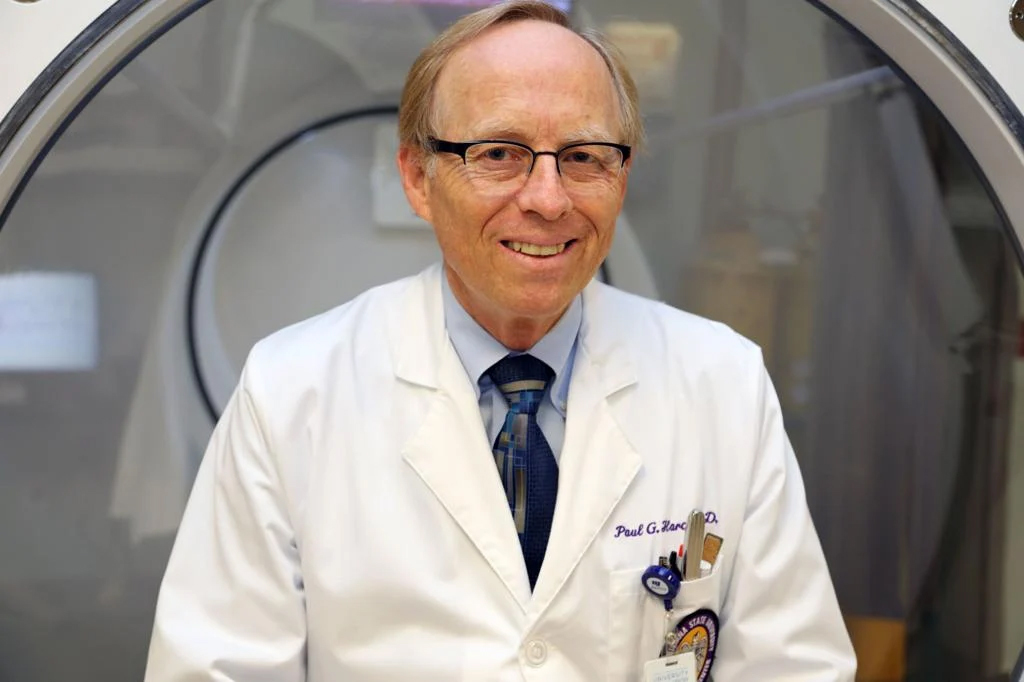
Dr. Paul G. Harch, MD
Dr. Harch initiated and continues to be a private practice that has resulted in the largest case experience in neurological hyperbaric medicine in the world. In this practice, he adapted the concepts of conventional hyperbaric oxygen therapy to wounds in the central nervous system, which spawned the subsequent academic and research practice. Harch HBOT is the best place to receive oxygen therapy treatments, and patients have traveled from more than 50 countries to be treated by Dr. Harch himself.
Harch HBOT – Hyperbaric Oxygen Therapy Clinic
5216 Lapalco Blvd.
Marrero, LA
504-309-4948
hbot@hbot.com
https://hbot.com/
Recent HBOT News
Hyperbaric oxygen therapy restored traumatic stress-induced dysregulation of fear memory and related neurochemical abnormalities.
Individuals with posttraumatic stress disorder (PTSD) are characterized by fear memory problems and hypocortisolemia of which traumatic stress-induced monoaminergic disruption over infralimbic (IL) cortex is considered the key mechanism. Hyperbaric oxygen therapy (HBOT) has recently proven its utility in treating several mental disorders but remains unexplored for PTSD. The present study aimed to examine the effects of 5-day HBO paradigm on traumatic stress (single prolonged stress, SPS, an animal model of PTSD)-induced dysregulation of fear memory/anxiety profiles and related abnormalities in IL monoamines and plasma corticosterone.
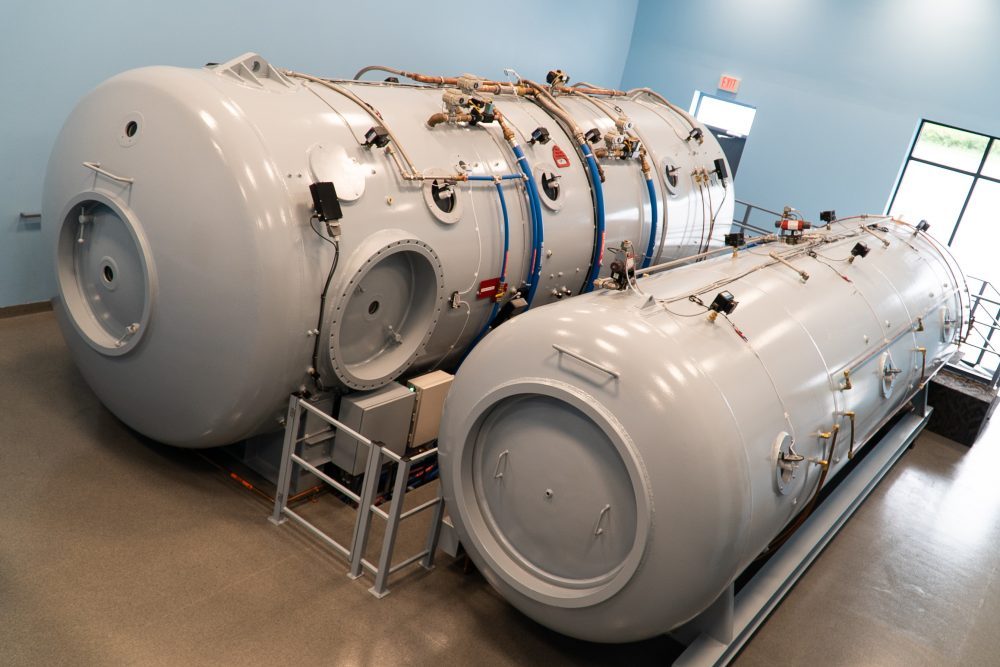
Hyperbaric oxygen therapy is an effective adjunctive treatment for severe perianal Crohn’s disease
Abstract: BACKGROUND: Perianal involvement occurs in about 30% of children with Crohn's disease (CD). Treatment of perianal CD requires a multidisciplinary approach with a combination of immunomodulatory therapy, antibiotics and surgery. Hyperbaric oxygen...
Hyperbaric oxygen promotes neural stem cell proliferation by activating vascular endothelial growth factor/extracellular signal-regulated kinase signaling after traumatic brain injury.
Hyperbaric oxygen (HBO) therapy and neural stem cell (NSC) transplantation can improve traumatic brain injury (TBI) clinically. This study aimed to investigate the mechanism of HBO promoting NSC proliferation and neurological recovery after TBI. Twenty-four Sprague-Dawley rats were divided randomly into three groups: a sham group, a TBI group (constructed using Feeney’s free-fall method), and an HBO-treated TBI group. Neurological function was evaluated by Neurological Severity Scores on days 1, 3, and 7, and we found that TBI-induced poor neurological function was improved by HBO. On day 7 after TBI, we observed that TBI promoted NSC proliferation, migration to the lesion area, and the levels of vascular endothelial growth factor (VEGF), VEGFR2, Raf-1, MEK1/2, and phospho-extracellular signal-regulated kinase (ERK) 1/2 protein, which were further boosted by HBO, from immunohistochemistry, immunofluorescence, and Western blot experiments. In vitro, cell injury was applied to NSCs isolated from neonatal Sprague-Dawley rats by the Cell Injury Controller II system. Moreover, data from the BrdU Kit and Western blot showed that in-vitro HBO significantly accelerated NSC proliferation and the levels of proteins related to cell cycle and the VEGF/ERK pathway after cell injury, which was suppressed by the VEGFR2 inhibitor. Taken together, this study indicated that HBO may promote NSC proliferation by activating VEGF/ERK signaling and play a crucial role in neuroprotection after TBI.