
HBOT Conversations:
Dr. Paul Harch & 8,101 Genes
He is the author of The Oxygen Revolution and is considered an International expert and pioneer in the field of Hyperbaric Oxygen Therapy (HBOT). His informative, and comprehensive guide on HBOT has helped countless souls better understand what HBOT is and how it directly affects the body at the genetic level.
This episode on 8,101 genes is the eighth in a nine episode series that will be released weekly with Dr. Harch.
Watch the Podcast
In episode 8 of 9, host Edward di Girolamo speaks with world renowned HBOT expert, Dr. Paul G. Harch, about aging and the 8,101 genes HBOT affects.
di Girolamo starts this conversation with Dr. Harch bringing up the 8,101 genes that are activated by Hyperbaric Oxygen Therapy. The discussion leads to talk of Big Pharma, telomeres, reparative gene process, patents, and successful business models for HBOT clinics.
Dr. Harch explains that Hyperbaric Oxygen Therapy affects 8,101 of our genes, and it’s doing so on a different level for the ones that are overactive and abnormal in the disease process. He speaks of a 2004 lecture he gave to A4M about the effects of HBOT on longevity; and asks, “Where is senescence and aging based?”, answering with, “It’s in our DNA”. Dr. Harch dives in to how HBOT turns on our genes to grow new tissue and stimulates cellular repair and regeneration. di Girolamo agrees and brings up a different past lecture from Dr. Harch where Harch referred to Hyperbaric Oxygen Therapy as the ‘Fountain of Youth‘.
This series ends with Dr. Harch discussing a Buffalo VA study, and how the study subjects (comprised of older veterans) literally came alive and started propositioning nurses after Hyperbaric Oxygen Therapy treatments. He explained this is why no follow-up study was ever done because they weren’t expecting such and didn’t know what to do. Makes sense…. studies have shown success in HBOT treating erectile dysfunction.
If you are searching for the Fountain of Youth and ready to activate 8,101 genes in your body —- find a Hyperbaric Oxygen Therapy clinic near you.
Subscribe Now, It’s Free!
Guest
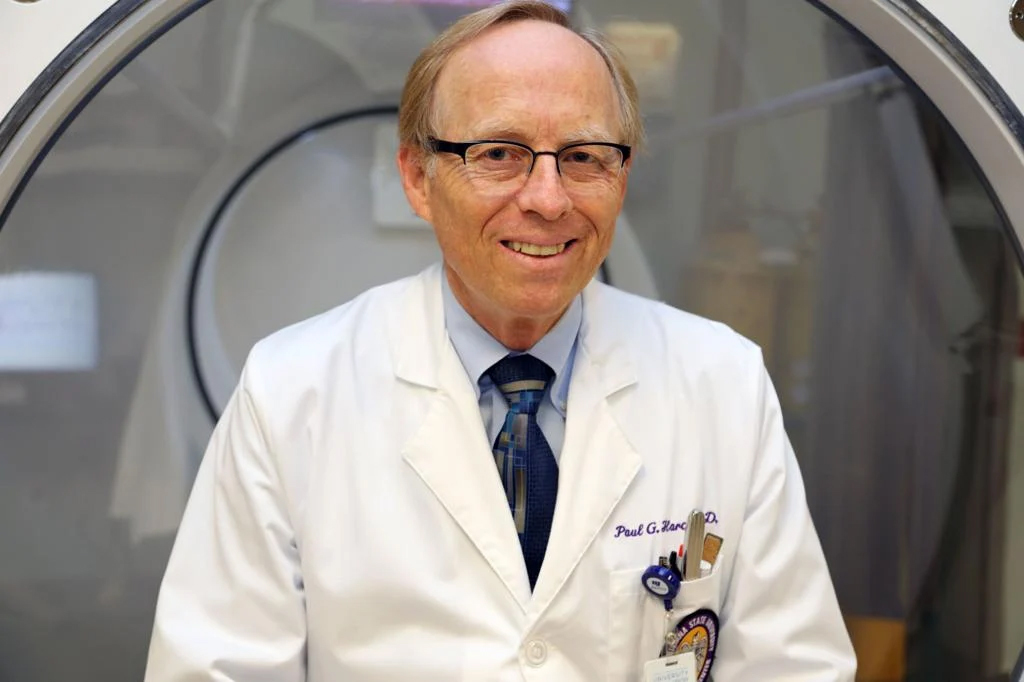
Dr. Paul G. Harch, MD
Dr. Harch initiated and continues to be a private practice that has resulted in the largest case experience in neurological hyperbaric medicine in the world. In this practice, he adapted the concepts of conventional hyperbaric oxygen therapy to wounds in the central nervous system, which spawned the subsequent academic and research practice. Harch HBOT is the best place to receive oxygen therapy treatments, and patients have traveled from more than 50 countries to be treated by Dr. Harch himself.
Harch HBOT – Hyperbaric Oxygen Therapy Clinic
5216 Lapalco Blvd.
Marrero, LA
504-309-4948
hbot@hbot.com
https://hbot.com/
Recent HBOT News
Executive summary: The Brain Injury and Mechanism of Action of Hyperbaric Oxygen for Persistent Post-Concussive Symptoms after Mild Traumatic Brain Injury (mTBI) (BIMA) Study.
The Brain Injury and Mechanism of Action of Hyperbaric Oxygen for Persistent Post-Concussive Symptoms after Mild Traumatic Brain Injury (mTBI) (BIMA) study, sponsored by the Department of Defense and held under an investigational new drug application by the Office of the Army Surgeon General, is one of the largest and most complex clinical trials of hyperbaric oxygen (HBO₂) for post-concussive symptoms (PCS) in U.S. military service members.
Hyperbaric oxygen for mild traumatic brain injury: Design and baseline summary.
The Brain Injury and Mechanisms of Action of Hyperbaric Oxygen for Persistent Post-Concussive Symptoms after Mild Traumatic Brain Injury (mTBI) (BIMA) study, sponsored by the Department of Defense, is a randomized double-blind, sham-controlled clinical trial that has a longer duration of follow-up and more comprehensive assessment battery compared to recent HBO₂ studies. BIMA randomized 71 participants from September 2012 to May 2014. Primary results are expected in 2017. Randomized military personnel received hyperbaric oxygen (HBO₂) at 1.5 atmospheres absolute (ATA) or sham chamber sessions at 1.2 ATA, air, for 60 minutes daily for 40 sessions. Outcomes include neuropsychological, neuroimaging, neurological, vestibular, autonomic function, electroencephalography, and visual systems evaluated at baseline, immediately following intervention at 13 weeks and six months with self-report symptom and quality of life questionnaires at 12 months, 24 months and 36 months. Characteristics include: median age 33 years (range 21-53); 99% male; 82% Caucasian; 49% diagnosed post-traumatic stress disorder; 28% with most recent injury three months to one year prior to enrollment; 32% blast injuries; and 73% multiple injuries. This manuscript describes the study design, outcome assessment battery, and baseline characteristics. Independent of a therapeutic role of HBO₂, results of BIMA will aid understanding of mTBI.
Neuropsychological assessments in a hyperbaric trial of post-concussive symptoms.
Results of studies addressing the effect of mild traumatic brain injury (mTBI) and post-traumatic stress disorder (PTSD) on symptoms and neuropsychological assessments are mixed regarding cognitive deficits in these populations. Neuropsychological assessments were compared between U.S. military service members with mTBI only (n=36) vs. those with mTBI÷ PTSD (n=35) from a randomized interventional study of mTBI participants with persistent post-concussive symptoms (PCS). The mTBI group endorsed worse symptoms than published norms on PCS, PTSD and pain scales (⟩50% abnormal on Neurobehavioral Symptom Inventory (NSI), PTSD Checklist-Civilian, McGill Pain Questionnaire-Short Form) and some quality of life domains. Worse symptom reporting was found in the mTBI÷ PTSD group compared to mTBI (e.g., mean NSI total score in mTBI 27.5 (SD=12.7), mTBI÷ PTSD 39.9 (SD=13.6), p⟨0.001). The mTBI÷PTSD group performed worse than mTBI on the Weschler Adult Intelligence Scale digit span (mean difference -1.5, 95% CI[-2.9,-0.1], p=0.04) and symbol search (mean difference -1.5, 95% CI[-2.7,-0.2], p=0.03) and Grooved Pegboard (dominant hand mean difference -7.0, 95% CI[-11.5,-2.4], p=0.003; non-dominant mean difference -9.8, 95% CI[-14.9,-4.7], p⟨0.001). Differences were detected in ANAM simple reaction time (p=0.04) and mathematical processing (p=0.03) but not verbal fluency or visuospatial memory assessments. Results indicate increased symptom severity and some cognitive deficits in mTBI÷ PTSD compared to mTBI alone.