
HBOT Conversations:
Dr. Paul Harch & 8,101 Genes
He is the author of The Oxygen Revolution and is considered an International expert and pioneer in the field of Hyperbaric Oxygen Therapy (HBOT). His informative, and comprehensive guide on HBOT has helped countless souls better understand what HBOT is and how it directly affects the body at the genetic level.
This episode on 8,101 genes is the eighth in a nine episode series that will be released weekly with Dr. Harch.
Watch the Podcast
In episode 8 of 9, host Edward di Girolamo speaks with world renowned HBOT expert, Dr. Paul G. Harch, about aging and the 8,101 genes HBOT affects.
di Girolamo starts this conversation with Dr. Harch bringing up the 8,101 genes that are activated by Hyperbaric Oxygen Therapy. The discussion leads to talk of Big Pharma, telomeres, reparative gene process, patents, and successful business models for HBOT clinics.
Dr. Harch explains that Hyperbaric Oxygen Therapy affects 8,101 of our genes, and it’s doing so on a different level for the ones that are overactive and abnormal in the disease process. He speaks of a 2004 lecture he gave to A4M about the effects of HBOT on longevity; and asks, “Where is senescence and aging based?”, answering with, “It’s in our DNA”. Dr. Harch dives in to how HBOT turns on our genes to grow new tissue and stimulates cellular repair and regeneration. di Girolamo agrees and brings up a different past lecture from Dr. Harch where Harch referred to Hyperbaric Oxygen Therapy as the ‘Fountain of Youth‘.
This series ends with Dr. Harch discussing a Buffalo VA study, and how the study subjects (comprised of older veterans) literally came alive and started propositioning nurses after Hyperbaric Oxygen Therapy treatments. He explained this is why no follow-up study was ever done because they weren’t expecting such and didn’t know what to do. Makes sense…. studies have shown success in HBOT treating erectile dysfunction.
If you are searching for the Fountain of Youth and ready to activate 8,101 genes in your body —- find a Hyperbaric Oxygen Therapy clinic near you.
Subscribe Now, It’s Free!
Guest
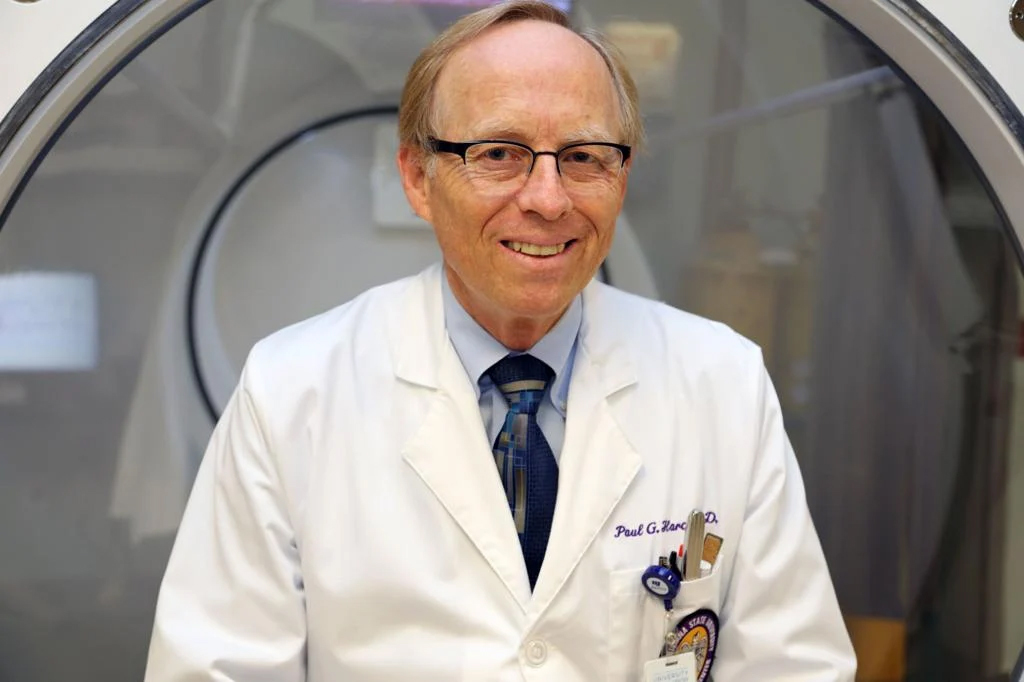
Dr. Paul G. Harch, MD
Dr. Harch initiated and continues to be a private practice that has resulted in the largest case experience in neurological hyperbaric medicine in the world. In this practice, he adapted the concepts of conventional hyperbaric oxygen therapy to wounds in the central nervous system, which spawned the subsequent academic and research practice. Harch HBOT is the best place to receive oxygen therapy treatments, and patients have traveled from more than 50 countries to be treated by Dr. Harch himself.
Harch HBOT – Hyperbaric Oxygen Therapy Clinic
5216 Lapalco Blvd.
Marrero, LA
504-309-4948
hbot@hbot.com
https://hbot.com/
Recent HBOT News
Interventions in the management of infection in the foot in diabetes: a systematic review.
Abstract: The expert panel on diabetic foot infection (DFI) of the International Working Group on the Diabetic Foot conducted a systematic review seeking all published reports relating to any type of treatment for infection of the foot in persons with diabetes...
Brain perfusion imaging with voxel-based analysis in secondary progressive multiple sclerosis patients with a moderate to severe stage of disease: a boon for the workforce.
The present study was carried out to evaluate cerebral perfusion in multiple sclerosis (MS) patients with a moderate to severe stage of disease. Some patients underwent hyperbaric oxygen therapy (HBOT) and brain perfusion between before and after that was compared. We retrospectively reviewed 25 secondary progressive (SP)-MS patients from the hospital database. Neurological disability evaluated by Expanded Disability Status Scale Score (EDSS). Brain perfusion was performed by (99 m) Tc-labeled bicisate (ECD) brain SPECT and the data were compared using statistical parametric mapping (SPM). In total, 16 patients underwent HBOT. Before HBOT and at the end of 20 sessions of oxygen treatment, 99mTc-ECD brain perfusion single photon emission computed tomography (SPECT) was performed again then the results were evaluated and compared. Brain perfusion was performed by (99 m) Tc-labeled bicisate (ECD) brain SPECT and the data were compared using statistical parametric mapping (SPM). A total of 25 SP-MS patients, 14 females (56 %) and 11 males (44 %) with a mean age of 38.92 ± 11.28 years included in the study. The mean disease duration was 8.70 ± 5.30 years. Of the 25 patients, 2 (8 %) had a normal SPECT and 23 (92 %) had abnormal brain perfusion SPECT studies. The study showed a significant association between severity of perfusion impairment with disease duration and also with EDSS (P <0.05). There was a significant improvement in pre- and post-treatment perfusion scans (P <0.05)
[Efficacy of hyperbaric oxygen therapy in the treatment of ischemic toe ulcer in a patient presenting systemic sclerosis].
The medical treatment of ischemic ulcers in patients with systemic sclerosis remains difficult. Despite the major help provided by vasodilator treatments, the risk of spontaneous or surgical amputation remains high. A 48-year-old female patient from Guadeloupe was treated in our department for diffuse systemic sclerosis present for 15 years complicated by lung, joint and digestive involvement, and associated with severe Raynaud’s phenomenon. The clinical course was marked by the occurrence of multiple ischemic ulcers, which were resistant to conventional medical treatment and resulted in two surgical amputations (to the 2nd and 3rd interphalangeal joints of the toes of the left foot). Treatment with an endothelin-receptor antagonist and a calcium inhibitor was then introduced for secondary prevention. Two years later, the patient consulted for a further ischemic ulcer of the left 4th toe. She refused the proposed treatment with iloprost. Because of the unfavorable outcome and the absence of therapeutic alternative to amputation, hyperbaric oxygen therapy was initiated. Thirty 90-minutes sessions of pure oxygen at 2.5 ATA were conducted over a 10-week period. Complete healing was obtained after 8 months. We report herein a clinical case illustrating the efficacy of hyperbaric oxygen therapy for the treatment of ischemic ulcers of the toes in systemic sclerosis.