
HBOT Conversations:
Dr. Paul Harch & 8,101 Genes
He is the author of The Oxygen Revolution and is considered an International expert and pioneer in the field of Hyperbaric Oxygen Therapy (HBOT). His informative, and comprehensive guide on HBOT has helped countless souls better understand what HBOT is and how it directly affects the body at the genetic level.
This episode on 8,101 genes is the eighth in a nine episode series that will be released weekly with Dr. Harch.
Watch the Podcast
In episode 8 of 9, host Edward di Girolamo speaks with world renowned HBOT expert, Dr. Paul G. Harch, about aging and the 8,101 genes HBOT affects.
di Girolamo starts this conversation with Dr. Harch bringing up the 8,101 genes that are activated by Hyperbaric Oxygen Therapy. The discussion leads to talk of Big Pharma, telomeres, reparative gene process, patents, and successful business models for HBOT clinics.
Dr. Harch explains that Hyperbaric Oxygen Therapy affects 8,101 of our genes, and it’s doing so on a different level for the ones that are overactive and abnormal in the disease process. He speaks of a 2004 lecture he gave to A4M about the effects of HBOT on longevity; and asks, “Where is senescence and aging based?”, answering with, “It’s in our DNA”. Dr. Harch dives in to how HBOT turns on our genes to grow new tissue and stimulates cellular repair and regeneration. di Girolamo agrees and brings up a different past lecture from Dr. Harch where Harch referred to Hyperbaric Oxygen Therapy as the ‘Fountain of Youth‘.
This series ends with Dr. Harch discussing a Buffalo VA study, and how the study subjects (comprised of older veterans) literally came alive and started propositioning nurses after Hyperbaric Oxygen Therapy treatments. He explained this is why no follow-up study was ever done because they weren’t expecting such and didn’t know what to do. Makes sense…. studies have shown success in HBOT treating erectile dysfunction.
If you are searching for the Fountain of Youth and ready to activate 8,101 genes in your body —- find a Hyperbaric Oxygen Therapy clinic near you.
Subscribe Now, It’s Free!
Guest
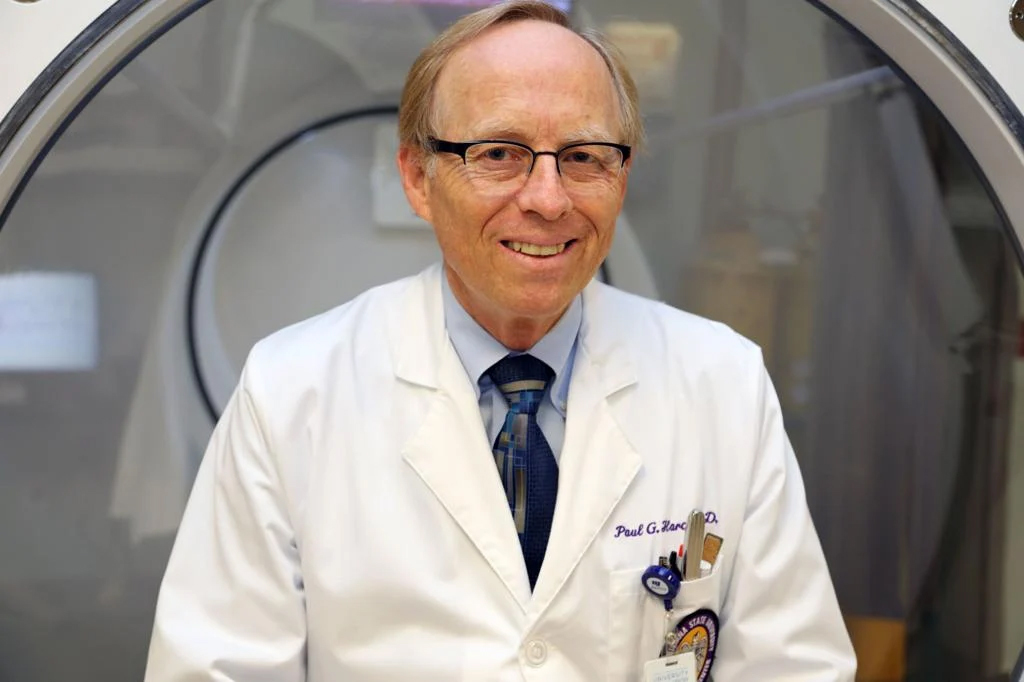
Dr. Paul G. Harch, MD
Dr. Harch initiated and continues to be a private practice that has resulted in the largest case experience in neurological hyperbaric medicine in the world. In this practice, he adapted the concepts of conventional hyperbaric oxygen therapy to wounds in the central nervous system, which spawned the subsequent academic and research practice. Harch HBOT is the best place to receive oxygen therapy treatments, and patients have traveled from more than 50 countries to be treated by Dr. Harch himself.
Harch HBOT – Hyperbaric Oxygen Therapy Clinic
5216 Lapalco Blvd.
Marrero, LA
504-309-4948
hbot@hbot.com
https://hbot.com/
Recent HBOT News
Hyperbaric oxygen therapy for the treatment of traumatic brain injury: a meta-analysis.
Compelling evidence suggests the advantage of hyperbaric oxygen therapy (HBOT) in traumatic brain injury. The present meta-analysis evaluated the outcomes of HBOT in patients with traumatic brain injury (TBI). Prospective studies comparing hyperbaric oxygen therapy vs. control in patients with mild (GCS 13-15) to severe (GCS 3-8) TBI were hand-searched from medical databases using the terms “hyperbaric oxygen therapy, traumatic brain injury, and post-concussion syndrome”. Glasgow coma scale (GCS) was the primary outcome, while Glasgow outcome score (GOS), overall mortality, and changes in post-traumatic stress disorder (PTSD) score, constituted the secondary outcomes. The results of eight studies (average age of patients, 23-41 years) reveal a higher post-treatment GCS score in the HBOT group (pooled difference in means = 3.13, 95 % CI 2.34-3.92, P < 0.001), in addition to greater improvement in GOS and lower mortality, as compared to the control group. However, no significant change in the PTSD score was observed. Patients undergoing hyperbaric therapy achieved significant improvement in the GCS and GOS with a lower overall mortality, suggesting its utility as a standard intensive care regimen in traumatic brain injury.
Effects of hyperbaric oxygen therapy on RAGE and MCP-1 expression in rats with spinal cord injury.
Abstract: The inflammatory response is an important source of secondary damage to neuronal tissue in the spinal cord following spinal cord injury (SCI). Hyperbaric oxygen (HBO) therapy reduces inflammation and promotes the restoration of locomotor function following...
Can we use an ex vivo continuous hemofiltration model to describe the adsorption and elimination of meropenem and piperacillin?
Abstract: To determine the adsorption and elimination characteristics of meropenem and piperacillin during simulated continuous renal replacement therapy (CRRT), and to compare the observed data from this ex vivo study with previous data from clinical studies. This...