
HBOT Conversations:
Dr. Paul Harch & Autism
Dr. Paul G. Harch, M.D. has used hyperbaric oxygen therapy to treat more than 100 different conditions, including stroke, dementia, autism, and traumatic brain injury. His goal is to help his patients get their lives back using hyperbaric oxygen therapy.
He is the author of The Oxygen Revolution and is considered an International expert and pioneer in the field of Hyperbaric Oxygen Therapy (HBOT). His informative, and comprehensive guide on HBOT has helped countless souls better understand what HBOT is and how it directly affects the body at the genetic level.
This episode on Autism is the seventh in a nine episode series that will be released weekly with Dr. Harch.
Watch the Podcast
In episode 7 of 9, host Edward di Girolamo speaks with world renowned HBOT expert, Dr. Paul G. Harch about Autism.
The percentage of children with Autism is increasing at an alarming rate. In order to successfully treat Autism and navigate around the roadblocks, Dr. Harch explains that it’s important to understand that Autism is not a psychiatric diagnosis. Autism is a wounding condition of the brain, without all of the potential contributors being identified to the wounding process.
Dr. Harch was the first to treat a series of children with Autism using Hyperbaric Oxygen Therapy; a therapy which in and of itself is neuroplastic (it is a neuroplast — affecting neuroplasticity). He states that there’s a plethora of information on the fact that Autism is a physical brain abnormality, and that’s what’s causing this Autism phenomenon. Functional imaging scans that have been done on these Autistic children shows 90% of them have a problem involving primarily the temporal lobes and frontal lobes; mostly temporal lobes. Dr. Harch has treated a good series of these children with Hyperbaric Oxygen Therapy and about 80% of them will respond to the treatment. There are various causes, which may explain why 100% don’t respond to HBOT, since there are different insults to the brains and/or it’s environmental. But, Dr. Harch stresses that there’s no such thing as a genetic epidemic, so this Autism epidemic we’re seeing must either be caused by environmental factors or infectious agents.
Dr. Harch affirms that the underlying nature of Autism is that there’s a dominant immune dysfunction in these children that often manifests in the GI tract, but also in the brain. Dr. Harch recommends our viewers read this beautiful article by Dr. Dan Rossignol, a Family Practice Physician with two autistic sons. In the article Dr. Rossignol reviews all of the pathophysiology — the disease processes — that have been identified in Autistic children, and he reviews all of the science of Hyperbaric Oxygen Therapy and the effect it has on all of those disease processes. In the end, HBOT is shown to be a good match for the treatment of Autism.
di Girolamo asks Dr. Harch if Autism appears to be an inflammatory issue, with Dr. Harch agreeing that it does seem to appear that way. Dr. Harch went on to explain that of the 8,1001 genes that have been shown to be affected in human cells by a single Hyperbaric Oxygen exposure, the largest clusters involved are the anti-inflammatory genes — upregulation is turned on and there’s suppression of the pro-inflammatory genes. Plus, there are many genes that are activated within the immune system which also supports the use of HBOT for the treatment of Autism as a dominant immune dysfunction.
The studies have been controversial and complicated on Hyperbaric Oxygen Therapy for Autism. But contrary to the results of these studies, Dr. Harch is here to say that the proof is in the imaging. He has imaging revealing that after only one treatment — sometimes it’s a series of treatments — changes are seen in these children’s brains, and there’s improvement in profusion (such as in the temporal lobes).
Dr. Harch professes that what he’s been trying to do all these years, these decades, is to answer a simple question, “Does Hyperbaric Oxygen Therapy work for your condition or not?” He explains it’s critical to start with HBOT solely and not throw a bunch of other therapies into the mix because then you have too many variables, and you won’t know exactly what’s helping and what’s not. He explains Hyperbaric Oxygen Therapy is a foundation biological therapy, and declares there is no identified therapy out there that can do what Hyperbaric Oxygen can do; including activating 40% of our genome. There’s nothing.
Dr. Harch references Chapter 12 of his book, The Oxygen Revolution, and says “I’m sorry but if your doctor is giving you negative information, flatly ignore him! Go get this therapy for your child!” Treating with HBOT is no different than if you dosed the child with a drug, or a drug combination. This is a two component drug we’re dosing with that’s safe and effective — pressure and oxygen. We encourage you to try it, because it could change your life if you or your child are a part of this 80% success rate.
Subscribe Now, It’s Free!
Guest
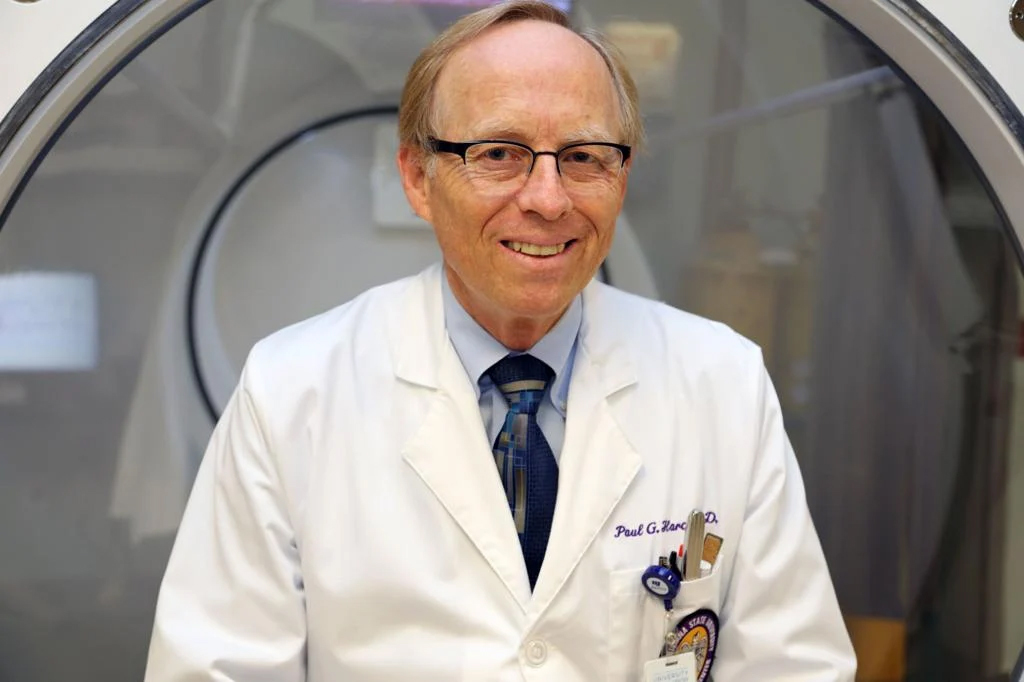
Dr. Paul G. Harch, MD
Dr. Harch initiated and continues to be a private practice that has resulted in the largest case experience in neurological hyperbaric medicine in the world. In this practice, he adapted the concepts of conventional hyperbaric oxygen therapy to wounds in the central nervous system, which spawned the subsequent academic and research practice. Harch HBOT is the best place to receive oxygen therapy treatments, and patients have traveled from more than 50 countries to be treated by Dr. Harch himself.
Harch HBOT – Hyperbaric Oxygen Therapy Clinic
5216 Lapalco Blvd.
Marrero, LA
504-309-4948
hbot@hbot.com
https://hbot.com/
Recent HBOT News
Linear analysis of heart rate variability in post-concussive syndrome.
Heart rate variability (HRV) represents measurable output of coordinated structural and functional systems within the body and brain. Both mild traumatic brain injury (mTBI) and HRV are modulated by changes in autonomic nervous system function. We present baseline HRV results from an ongoing mTBI clinical trial. HRV was assessed via 24-hour ambulatory electrocardiography; recordings were segmented by physiological state (sleep, wakefulness, exercise, standing still). Time, frequency, and spatial domain measures were summarized and compared with symptoms, sleep quality, and neurological examination. Median low frequency/high frequency (LF/HF) ratio exceeded 1.0 across segments, indicating prevalence of sympathetic modulation. Abnormal Sharpened Romberg Test was associated with 29% LF/HF decrease (95% CI [2.1, 47.7], p=0.04); pathological nystagmus associated with decreased standard deviation of electrocardiogram R-R interval (SDNN) index (25% decrease, 95% CI [0.8, 43.4], p=0.04). Increased sympathetic modulation was associated with increased anger scores (19% LF/HF increase with 5-point State Trait Anger Expression Inventory-2 trait anger increase (95% CI [1.2, 39.1], p=0.04)). A 13% HF increase (95% CI [2.1, 25.7], p=0.02) was observed with increased Pittsburgh Sleep Quality Index scores. These results support autonomic nervous system dysfunction in service members after mTBI.
TBI study questioned: Dr. Weaver response.
Abstract: Weaver, Lindblad, Wilson, Churchill, Deru, , , , (). TBI study questioned: Dr. Weaver response. Undersea & hyperbaric medicine : journal of the Undersea and Hyperbaric Medical Society, Inc, ;44(1):82-85. https://www.ncbi.nlm.nih.gov/pubmed/28768093
Sleep assessments for a mild traumatic brain injury trial in a military population.
Baseline sleep characteristics were explored for 71 U.S. military service members with mild traumatic brain injury (mTBI) enrolled in a post-concussive syndrome clinical trial. The Pittsburgh Sleep Quality Index (PSQI), sleep diary, several disorder-specific questionnaires, actigraphy and polysomnographic nap were collected. Almost all (97%) reported ongoing sleep problems. The mean global PSQI score was 13.5 (SD=3.8) and 87% met insomnia criteria. Sleep maintenance efficiency was 79.1% for PSQI, 82.7% for sleep diary and 90.5% for actigraphy; total sleep time was 288, 302 and 400 minutes, respectively. There was no correlation between actigraphy and subjective questionnaires. Overall, 70% met hypersomnia conditions, 70% were at high risk for obstructive sleep apnea (OSA), 32% were symptomatic for restless legs syndrome, and 6% reported cataplexy. Nearly half (44%) reported coexisting insomnia, hypersomnia and high OSA risk. Participants with post-traumatic stress disorder (PTSD) had higher PSQI scores and increased OSA risk. Older participants and those with higher aggression, anxiety or depression also had increased OSA risk. The results confirm poor sleep quality in mTBI with insomnia, hypersomnia, and OSA risk higher than previously reported, and imply sleep disorders in mTBI may be underdiagnosed or exacerbated by comorbid PTSD.