
HBOT Conversations:
Dr. Paul Harch & Inflammation
Dr. Paul G. Harch, M.D. has used hyperbaric oxygen therapy to treat more than 100 different conditions, including stroke, dementia, autism, and traumatic brain injury. His goal is to help his patients get their lives back using hyperbaric oxygen therapy.
He is the author of The Oxygen Revolution and is considered an International expert and pioneer in the field of Hyperbaric Oxygen Therapy (HBOT). His informative, and comprehensive guide on HBOT has helped countless souls better understand what HBOT is and how it directly affects the body at the genetic level.
This episode on Inflammation is the first in a 9 episode series that will be released weekly with Dr. Harch.
Watch the Podcast
HBOT News podcast host, Edward di Girolamo, talks with special guest and HBOT expert, Dr. Paul G. Harch, MD. This is the first of nine episodes with Dr. Harch examining the God-given miracle of Hyperbaric Oxygen Therapy.
In this episode, we dive into how HBOT is a game-changer for inflammation. Harch explains that inflammation is the driving factor for countless chronic illnesses, but thankfully Hyperbaric Oxygen Therapy is a natural proven way to suppress inflammation.
Harch summarizes a fascinating study done in 2008, by Dr. Cassandra Godman. Her team took skin biopsies and extracted the normal tissue, then they examined the cells that lined the tiniest blood vessels in the tissue. Next, they put these cells in a petri dish and put them in a hyperbaric chamber and gave him a single hyperbaric treatment. Afterwards, they did a mass gene array analysis for 48 hours. What happened next was ground-breaking in better understanding the role that HBOT has on inflammation.
At the end of 24 hours 8,101 of our 19,000 protein coding genes in our 23 chromosomes were either significantly turned on or turned off & suppressed. That single HBOT treatment turned on the anti-inflammatory genes and the growth and repair hormone genes, and the largest cluster suppressed were the pro-inflammatory genes.
Our inflammatory reaction is inescapable when an injury occurs. But, when the patient receives hyperbaric oxygen therapy treatment after an injury (the sooner the better), it can have an overwhelming positive influence on the inflammatory reaction at any place along the spectrum. Harch continues to explain that the anti-inflammatory effects of hyperbaric oxygen are wide-ranging.
Harch spoke of the Navy’s experience with Hyperbaric Oxygen Therapy, as the Navy really kind of dominated this field for many years. The Navy reported that if you can get someone in a chamber within one hour of coming out of the water – when they’re symptomatic for decompression sickness – then the first hyperbaric treatment is curative in 90% of cases. Everyone thought that HBOT was treating bubbles in the brain at that point, but the reality is they were treating inflammation. We now know that it’s the inflammatory reaction in the brain after the bubbles passed that Hyperbaric Oxygen Therapy is treating; not the bubbles.
HBOT isn’t new, it dates back well over a hundred years. It’s still misunderstood, because many believe that HBOT therapy is a treatment for diseases. But, the reality is that HBOT is a treatment for disease processes, and it’s these processes that cause the diseases. We treat the inflammation that causes the disease processes, and in turn we treat the disease. That’s the power of Hyperbaric Oxygen Therapy.
Stay tuned for all nine episodes that will be release each Friday for the next eight weeks.
Guest
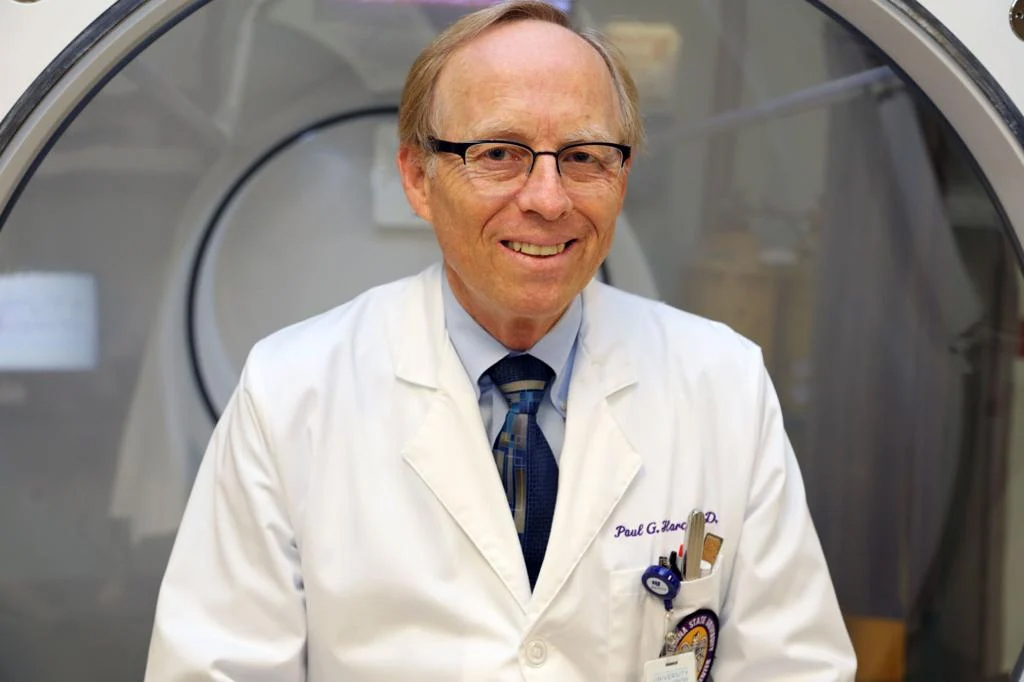
Dr. Paul G. Harch, MD
Dr. Paul G. Harch, M.D. is a clinician in emergency medicine and hyperbaric medicine who is the former director of the University Medical Center Hyperbaric Medicine Department and LSU Hyperbaric Medicine Fellowship. Currently, he is a Clinical Professor of Medicine in the Section of Emergency Medicine at LSU School of Medicine in New Orleans. He graduated from the Johns Hopkins University School of Medicine after graduating from the University of California at Irvine with magna cum laude/Phi Beta Kappa honors.
Dr. Harch initiated and continues to be a private practice that has resulted in the largest case experience in neurological hyperbaric medicine in the world. In this practice, he adapted the concepts of conventional hyperbaric oxygen therapy to wounds in the central nervous system, which spawned the subsequent academic and research practice. Harch HBOT is the best place to receive oxygen therapy treatments, and patients have traveled from more than 50 countries to be treated by Dr. Harch himself.
Harch HBOT – Hyperbaric Oxygen Therapy Clinic
5216 Lapalco Blvd.
Marrero, LA
504-309-4948
hbot@hbot.com
https://hbot.com/
Subscribe Now, It’s Free !
Recent HBOT News
Linear analysis of heart rate variability in post-concussive syndrome.
Heart rate variability (HRV) represents measurable output of coordinated structural and functional systems within the body and brain. Both mild traumatic brain injury (mTBI) and HRV are modulated by changes in autonomic nervous system function. We present baseline HRV results from an ongoing mTBI clinical trial. HRV was assessed via 24-hour ambulatory electrocardiography; recordings were segmented by physiological state (sleep, wakefulness, exercise, standing still). Time, frequency, and spatial domain measures were summarized and compared with symptoms, sleep quality, and neurological examination. Median low frequency/high frequency (LF/HF) ratio exceeded 1.0 across segments, indicating prevalence of sympathetic modulation. Abnormal Sharpened Romberg Test was associated with 29% LF/HF decrease (95% CI [2.1, 47.7], p=0.04); pathological nystagmus associated with decreased standard deviation of electrocardiogram R-R interval (SDNN) index (25% decrease, 95% CI [0.8, 43.4], p=0.04). Increased sympathetic modulation was associated with increased anger scores (19% LF/HF increase with 5-point State Trait Anger Expression Inventory-2 trait anger increase (95% CI [1.2, 39.1], p=0.04)). A 13% HF increase (95% CI [2.1, 25.7], p=0.02) was observed with increased Pittsburgh Sleep Quality Index scores. These results support autonomic nervous system dysfunction in service members after mTBI.
TBI study questioned: Dr. Weaver response.
Abstract: Weaver, Lindblad, Wilson, Churchill, Deru, , , , (). TBI study questioned: Dr. Weaver response. Undersea & hyperbaric medicine : journal of the Undersea and Hyperbaric Medical Society, Inc, ;44(1):82-85. https://www.ncbi.nlm.nih.gov/pubmed/28768093
Sleep assessments for a mild traumatic brain injury trial in a military population.
Baseline sleep characteristics were explored for 71 U.S. military service members with mild traumatic brain injury (mTBI) enrolled in a post-concussive syndrome clinical trial. The Pittsburgh Sleep Quality Index (PSQI), sleep diary, several disorder-specific questionnaires, actigraphy and polysomnographic nap were collected. Almost all (97%) reported ongoing sleep problems. The mean global PSQI score was 13.5 (SD=3.8) and 87% met insomnia criteria. Sleep maintenance efficiency was 79.1% for PSQI, 82.7% for sleep diary and 90.5% for actigraphy; total sleep time was 288, 302 and 400 minutes, respectively. There was no correlation between actigraphy and subjective questionnaires. Overall, 70% met hypersomnia conditions, 70% were at high risk for obstructive sleep apnea (OSA), 32% were symptomatic for restless legs syndrome, and 6% reported cataplexy. Nearly half (44%) reported coexisting insomnia, hypersomnia and high OSA risk. Participants with post-traumatic stress disorder (PTSD) had higher PSQI scores and increased OSA risk. Older participants and those with higher aggression, anxiety or depression also had increased OSA risk. The results confirm poor sleep quality in mTBI with insomnia, hypersomnia, and OSA risk higher than previously reported, and imply sleep disorders in mTBI may be underdiagnosed or exacerbated by comorbid PTSD.