
HBOT Conversations:
Laurie Anderson (Part 2)
Healing COVID with HBOT
Dr. Laurie is a Doctor of Pharmacy, and a graduate of the University of North Carolina – Chapel Hill (UNC-CH) School of Pharmacy and the Pharmacy Practice Residency Program at the University of California – San Francisco (UCSF). Dr. Laurie spent many years in clinical practice, first as a neurosurgery clinical pharmacist at UCSF Medical Center and then as a general medicine and critical care clinical pharmacist at Duke Medical Center. For the past 14 years Dr. Laurie has been working in industry, and is currently a safety scientist in early phase drug development, designing safety strategies for First Time in Human clinical trials.
Through her own journey navigating chronic illness, Dr. Laurie has explored and embraced many forms of alternative and non-traditional medicine to support her body for healing. She has gravitated towards practitioners and modalities that treat the whole patient, with the mantra that tending to mind, body and spirit is the true key to lasting health. Over the years, Dr. Laurie has discovered that this often leads to a ‘less is more’ approach. She discovered HBOT when she was struggling to heal from COVID, and now tells anyone who will listen about the power of oxygen and pressure.
Watch the Podcast
We continue Dr. Laurie Anderson’s HBOT News Network interview, diving in deeper to Hyperbaric Oxygen Therapy to heal COVID, and we bring up her struggles with Lyme Disease. Her interview is being released as a three part series, with Part 1 being released last week.
This podcast starts with our host, Ed di Girolamo, explaining to the audience that he and Dr. Laurie had a brief conversation before the interview, and they discussed autoimmune diseases, or the mechanisms of autoimmune diseases, that would include inflammation or hypoxia. He askes Dr. Laurie if this was discussed in her schooling when she got her doctorate in pharmacology. She explained that it was certainly talked about, but she really started to understand the trajectory of an underlying inflammatory process when she got sick. To help her heal, she applied her own medical knowledge to her healing process, and explains —
“But that wasn’t a cornerstone of what we learned, and it really became a cornerstone of my own healing, that getting control of inflammation was the way that my immune system was going to ramp back up and that my body was going to heal, unequivocally. It was all about addressing that inflammation.”
di Girolamo explains that years ago he attended a medical conference in Albuquerque that was specific to hyperbaric oxygen therapy, and he was on the edge of his seat for all three days. It was then that he started to truly understand how to read the science of HBOT. He brings up Lyme disease, which Dr. Laurie has personally struggled with, and recalls that there was a group of people there who have done HBOT and we’re so passionate in pushing it to help with Lyme disease because hyperbarics helped them, and they believe in it. di Girolamo states that through speaking to the medical profession about HBOT and Lyme, he has learned that Lyme disease is a virus and by doing a certain protocol of HBOT you’re essentially feeding the virus so much oxygen that it basically can not survive anymore and you “drown it”.
As the conversation progresses about Lyme disease, Dr. Laurie lists some symptoms and how HBOT helped her with tremendously with sleeping. After her first treatment she slept for 12 hours, which was unheard of for her. And she recalls that it was a very deep and refreshing sleep. She struggled for years and years with sleep from Lyme disease. Back then, HBOT was on the table as an alternative method of healing but she was only introduced to the mono-chambers and due to her extreme claustrophobia, it was not a healing avenue she wanted to explore at that time. She is thankful for the large multi-place chambers at Extivita that allowed Dr. Laurie to take a leap of faith and finally try HBOT.
Dr. Laurie’s career involves her reviewing the safety of clinical trials daily, so she explains that in order for a trial or study to be safe and effective, dosage is critical. di Girolamo explained that it’s the same for HBOT…. the right dosage of oxygen + pressure is critical to having healing success. He mentioned the podcasts with Dr. Stevens & Dr. Harch, as they both spoke in depth about dosage for hyperbaric oxygen therapy, especially for the indications that are considered to be “off label” for treatment with HBOT. Every person is unique and what works for one might not work the same for the next, so dosage can be tricky. But, in the end di Girolamo explains —
“I think at least in my conclusion, my humble opinion, is that any hyperbaric oxygen is better than no hyperbaric oxygen.”
Dr. Laurie referred to HBOT as a gift, because all that oxygen does so much for your brain. Which is exactly where it’s been proven to help veterans heal from PTSD, depression, anxiety, and even TBIs. She stresses that the mind-body connection is so strong, but it’s not talked about like it should be. In her opinion, she thinks that all that oxygen is strengthening the mind-body connection to the point where the brain is receiving that surge of oxygen and basically then signal the body that it’s ok…. let’s heal.
Stay tuned next week for Part 3 of Dr. Laurie’s podcast.
Guests
Dr. Laurie Anderson, Pharm.D.
Through her own journey navigating chronic illness, Dr. Laurie has explored and embraced many forms of alternative and non-traditional medicine to support her body for healing. She has gravitated towards practitioners and modalities that treat the whole patient, with the mantra that tending to mind, body and spirit is the true key to lasting health. Over the years, Dr. Laurie has discovered that this often leads to a ‘less is more’ approach.
When not working, Dr. Laurie is an avid gardener, ballroom dancer and traveler with her husband. Remaining curious and finding joy in every day are her super powers.
Subscribe Now, It’s Free!
Recent HBOT News
Effect of hyperbaric oxygen therapy on chronic neurocognitive deficits of post-traumatic brain injury patients: retrospective analysis.
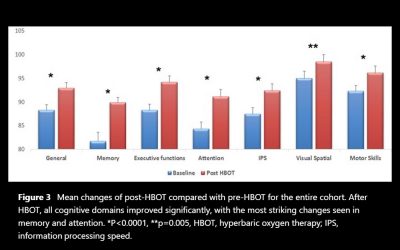
The aim of the study is to evaluate the effect of hyperbaric oxygen therapy (HBOT) in participants suffering from chronic neurological deficits due to traumatic brain injury (TBI) of all severities in the largest cohort evaluated so far with objective cognitive function tests and metabolic brain imaging. A retrospective analysis was conducted of 154 patients suffering from chronic neurocognitive damage due to TBI, who had undergone computerised cognitive evaluations pre-HBOT and post-HBOT treatment. The average age was 42.7-14.6 years, and 58.4% were men. All patients had documented TBI 0.3-33 years (mean 4.6-5.8, median 2.75 years) prior to HBOT. HBOT was associated with significant improvement in all of the cognitive domains, with a mean change in global cognitive scores of 4.6-8.5 (p<0.00001).
Malnutrition screening in outpatients receiving hyperbaric oxygen therapy: an opportunity for improvement?
Outpatients who receive hyperbaric oxygen treatment (HBOT) may represent a group at significant risk of malnutrition owing to the underlying conditions that are often treated with HBOT (e.g., non-healing diabetic wounds and radiation-induced skin injury). In this issue, See and colleagues provide new, preliminary evidence of the prevalence of malnutrition in a small group of HBOT outpatients treated in an Australian hospital, reporting that approximately one-third of patients receiving HBOT were at risk of malnutrition. To our knowledge, routine malnutrition screening is not available in HBOT centres providing outpatient treatment, which may be a key gap in the nutrition care of these patients. Malnutrition screening was developed to identify those at risk of malnutrition across the healthcare continuum.
Addition of Hyperbaric Oxygen Therapy vs Medical Therapy Alone for Idiopathic Sudden Sensorineural Hearing Loss: A Systematic Review and Meta-analysis.
Abstract: Importance Sudden sensorineural hearing loss (SSNHL) causes substantial disease burden for both individuals and socioeconomic aspects. The benefit of hyperbaric oxygen therapy (HBOT) in addition to standard medical therapy (MT) for idiopathic SSNHL has been...