
News & Research
Hyperbaric Oxygen Therapy has been used for the better part of two centuries. Search our arhives below for past HBOT news and research or scroll down for the latest.
The Latest HBOT News & Research
Simvastatin Decreases Hyperoxic Oxygen-Induced Acute Lung Injury by Upregulating eNOS.
Abstract: Statins, which are 3-hydroxy-3-methylglutaryl coenzyme A (HMG-CoA) reductase competitive inhibitors, not only lower blood cholesterol, but also exert pleiotropic and beneficial effects in various diseases. However, the effects of statins...
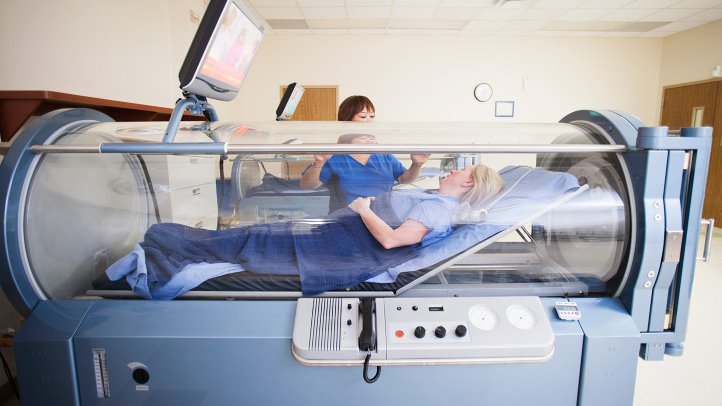
Can Hyperbaric Oxygen Therapy Treat Ulcerative Colitis?
One woman with UC shares how hyperbaric oxygen therapy helped her recover from a severe flare.There is no cure for ulcerative colitis. It took me a long time to realize that the chronic condition is a lifelong journey with a number of therapies...
Maryland High School Quarterback Credits Hyperbaric Chamber for Improvement After Concussion
Almost 2 million kids suffer concussions every year playing sports like hockey, soccer and football, but one local athlete says he found a treatment that is making him better a lot faster. Spencer Silverstein, quarterback of the football team at...
Clinical Trial – 1% Chloroprocaine(PF) vs. Bupivacaine Spinals
The use of 1% Chloroprocaine (PF) spinal anesthesia will reduce the recovery times and
discharge time of patients undergoing hemorrhoidectomies as compared to 0.75% bupivacaine
spinal. The primary objective is to compare the recovery times (return of motor and sensory
function) and discharge time (voiding time) between 2-Chloroprocaine and 0.75% bupivacaine
spinal anesthesia for hemorrhoidectomies. This is a randomized, prospective study assigning
patients to either 2-Chloroprocaine (PF) or 0.75% bupivacaine spinal anesthesia group.
Clinical Trial – RCT of Epinephrine (None, 100mcg, and 200mcg) in a Hyperbaric Bupivacaine, Fentanyl and Morphine Spinal in C-sections.
This is a prospective, randomized, double blind study of 75 patients (n=25 for each group) in
which epinephrine (100mcg or 200mcg) or normal saline vehicle is added to intrathecal
hyperbaric bupivacaine (0.75% bupivacaine hydrochloride in 8.25% dextrose), fentanyl, and
morphine to prolong the duration of the spinal anesthetic in scheduled cesarean deliveries.
The primary outcome of duration will be the time to T10 level sensory regression as well as
motor level regression that will be graded via the modified Bromage scale.
Repeat cesarean sections, in particular, are associated with increased operative time and
thus often performed with a spinal-epidural (CSE) technique. The epidural component is,
however, untested and may not provide adequate anesthesia, thus the higher risk of conversion
to a general anesthesia. Epinephrine is routinely used to prolong spinal anesthesia. If
effective for the duration of a repeat cesarean section it would obviate the additional time
and risks of performing the epidural and still avoid sufficient duration to avoid conversion
to a general anesthetic.
Current treatment of central retinal artery occlusion: a national survey.
Central retinal artery occlusion (CRAO) is an ophthalmological emergency, the retinal analog of a stroke. To date there is no consensus or national guidelines on how this disorder should be managed. As academic neurologists and ophthalmologists treat CRAO frequently, we set out to understand how these clinicians approach patients with CRAO with a national survey. We identified university-associated teaching hospitals offering vascular neurology, neuro-ophthalmology and/or retina fellowships in the US and asked the directors of the programs to respond to questions in an open response format to profile the acute management of CRAO at their institution.
Clinical Trial – Hyperbaric Oxygen Therapy Effect on Post Concussion Syndrome in Children
Due its high incidence, mTBI and its consequences of PPCS are a major public health issue.
There is no consensus regarding the treatment of PPCS in pediatrics. Relying on its results
in adults, HBOT offers a promising new direction of treatment, which targets the basic
pathological processes responsible for post-concussion symptoms.
The effect of hyperbaric oxygen therapy in pediatric TBI has never been evaluated.
The aim of the current study is to evaluate in a prospective cross-over, randomized study,
the effect of HBOT on children with PPCS due to mild TBI.
Clinical Trial – Observational Follow-up to ST-001 Calciphylaxis Pain Treatment With Intravenous Sodium Thiosulfate
This is an 8-week observational follow-up study of patients who participated in the ST-001
CALISTA study (A Phase 3, Intravenous Sodium Thiosulfate for Acute Calciphylaxis Treatment: A
Multicenter, Randomized, Double-blind, Placebo-controlled Clinical Trial).
Hyperbaric oxygen ameliorated the lesion scope and nerve function in acute spinal cord injury patients: A retrospective study.
This is a retrospective study to assess the therapeutic effect of hyperbaric oxygen (HBO) in early treatment of acute spinal cord injury (SCI) using magnetic resonance imaging (MRI) and electrophysiology in diagnosing. Forty acute SCI patients from Sun Yat-Sen Memorial Hospital who were assigned into HBO treatment were included during August 2013 to October 2014.The patients with adverse reactions or contraindications for HBO were assigned as controls. Both of two groups (HBO and Control) received medicine treatment with Urbason, GM-1 and mecobalamine after surgery. ASIA and the Frankel scores were used to evaluate the therapeutic effect of HBO at the 15th and 30th day after HBO treatment by using MRI and electrophysiology features. Significant therapeutic effect of HBO treatment on acute SCI patients was observed compared with the control group (P<0.05). Comparison for ASIA and Frankel scores showed that motor and neurological functions were significantly improved in HBO group at day 15 and day 30 post treatment. MRI images showed that the grade III injury in HBO group was significant lower than the control group. In comparison with the control, the peak of somatosensory evoked potential (SEP) and motor evoked potential (MEP) amplitude increased, the latency was shortened, and the conduction velocity of sensory nerve (SCV) and motor nerve (MCV) was significantly increased in the HBO group (P<0.05). HBO treatment has a great efficacy in acute SCI patients. HBO therapy at early stage of acute SCI is beneficiary to the recovery.