
News & Research
Hyperbaric Oxygen Therapy has been used for the better part of two centuries. Search our arhives below for past HBOT news and research or scroll down for the latest.
The Latest HBOT News & Research

Resolving TBI’s and Suicide Hailed as Most Important Scientific Breakthrough for 2019 Oxygen Under Pressure (HBOT) – Read Why Medical Studies Have Proven This Works
Durham, NC (January 15, 2020) - Congressman Andy Biggs (AZ-05) and Senator Kevin Cramer (R-ND) recently introduced the TBI and PTSD Treatment Act [House Bill 4370; Senate Bill 2504], in late 2019 to direct the Veterans Administration (VA) to...

The effect of hyperbaric oxygenation therapy on myocardial function
Abstract: Hyperbaric oxygenation therapy is successfully implemented for the treatment of several disorders. Data on the effect of hyperbaric oxygenation on echocardiographic parameters in asymptomatic patients is limited. The current study sought...
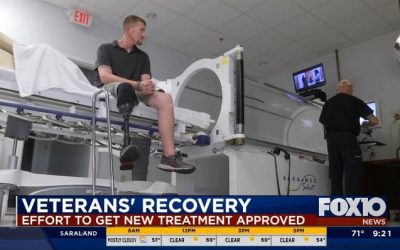
Local doctor continues to push VA to approve Hyperbaric Oxygen Therapy for veterans
The AC133 antigen is a novel antigen selectively expressed on a subset of CD34+ cells in human fetal liver, bone marrow, and blood as demonstrated by flow cytometric analyses. In this study, we have further assessed the expression of AC133 on CD34+ cells in hemopoietic samples and found that there was a highly significant difference between normal bone marrow and cord blood versus aphereses (p <0.0001) but not between bone marrow and cord blood. Most of the clonogenic cells (67%) were contained in the CD34+AC133+ fraction. Compared with cultures of the CD34+AC133- cells, generation of progenitor cells in long-term culture on bone marrow stroma was consistently 10- to 100-fold higher in cultures initiated with CD34+AC133+ cells and was maintained for the 8-10 weeks of culture.
Clinical Trial – Subarachnoid Bupivacaine in Obese Patients Undergoing Cesarean Delivery
This study evaluates the effect of subarachnoid hyperbaric bupivacaine on mean arterial blood
pressure (MAP) of pregnant patients with obesity undergoing cesarean section half of the
patients will receive subarachnoid hyperbaric bupivacaine at a dose of 5 mg while the other
half will receive a dose of 10 mg
Clinical Trial – Use of Intrathecal Analgesia in Appendectomy
Acute appendicitis which is the most common cause of acute abdominal pain, is an acute
inflammation of appendix vermiformis. Appendectomy operations can be performed as
laparoscopic and open surgery. Addition of opioids to intrathecal local anesthetics to
improve the quality of preoperative analgesia is an increasingly used method in recent years.
The aim of this study is to compare bupivacaine-fentanyl and bupivacaine-alfentanil which are
used intrathecally to create motor and sensory block. 50 volunteer patients who were
diagnosed as appendicitis by laboratory tests and clinical diagnostic methods in general
surgery clinic and classified as American Society of Anesthesiologists Classification I-II
(ASA Class I-II) aged between 20-60 years scheduled for laparoscopic appendectomy operation,
were included in this study. The patients were randomly assigned into two groups, Group I and
Group II. Patients received spinal anesthesia with either 10 mg heavy bupivacaine (2 cc)+25
mcg fentanyl (0.5 cc) intrathecally (Group I, n=25) or 10 mg heavy bupivacaine (2 cc)+250 mcg
alfentanil (0.5 cc) intrathecally (Group II, n=25).
Clinical Trial – Intrathecal Additives to Prevent Post Spinal Shivering in Transurethral Prostatectomy
Spinal anesthesia is the technique of choice in transurethral prostatectomy.However,one of
the common complications of spinal anesthesia is shivering which is even exaggerated in
patients undergoing transurethral prostatectomy.this high incidence is most probably caused
by sympathetic block and use of large amount of irrigation fluid during surgery.There are two
methods to reduce shivering.Previous studies showed that intrathecal fentanyl is an
appropriate method to reduce shivering.Intrathecal dexamethasone could reduce shivering by
regulating immune responses.

HBOT for Infertility = Creation of a Baby Friendly Environment
This article originally appeared on WoundReference. Introduction We have previously discussed the rationale for using hyperbaric oxygen therapy (HBOT) in an “off-label” indication. We suggested that there must be a scientific rationale, physiology...
Clinical Trial – Inner and Middle Ear Effects of Hyperbaric Oxygen Thrapy
Audiological evaluation performed to patients on hyperbaric oxygen therapy to see its effects
on middle ear pressure

Inside the treatment that is helping a boy who nearly drowned
ABC13's Shelley Childers explains the treatment facility and the method used to help those like baby Dylan who nearly drowned. NEW ORLEANS, Louisiana (KTRK) -- Inside a small, indistinct building on the side of a busy street just south of New...