
News & Research
Hyperbaric Oxygen Therapy has been used for the better part of two centuries. Search our arhives below for past HBOT news and research or scroll down for the latest.
The Latest HBOT News & Research
Hyperbaric oxygenation for tumour sensitisation to radiotherapy.
Abstract: Cancer is a common disease and radiotherapy is one well-established treatment for some solid tumours. Hyperbaric oxygenation therapy (HBOT) may improve the ability of radiotherapy to kill hypoxic cancer cells, so the administration of...
A Pilot Study of Short-Duration Hyperbaric Oxygen Therapy to Improve HbA1c, Leukocyte, and Serum Creatinine in Patients with Diabetic Foot Ulcer Wagner 3-4.
To evaluate the short-duration hyperbaric oxygen therapy (HBOT) can improve HbA1c levels, leukocyte count, and serum creatinine levels in patients with diabetic foot ulcer (DFU) Wagner 3-4. Blood samples from all DFU patients at Sanglah General Hospital, Denpasar, were taken for HbA1c, leukocyte, and serum creatinine test before debridement procedure, and the patients were then grouped into either standard therapy or standard therapy with HBOT for 10 sessions (combination therapy). At the end of therapy, all blood tests were resumed. Each group consisted of 15 patients. Results of laboratory analysis before and after treatment were significant regarding decrease of HbA1c levels in standard therapy (10.98 ± 2.37 % to 9.70 ± 2.46 %; p = 0.006), HbA1c levels in combination therapy (9.42 ± 1.96 % to 7.07 ± 1.16 %; p < 0.001), and leukocyte count in combination therapy (13.97 ± 6.24 x 10 cells/L to 8.84 ± 2.88 x 10 cells/L; p = 0.009).
Hyperbaric oxygen treatment for the management of radiation-induced xerostomia.
Abstract: Hyperbaric oxygen therapy (HBOT) is widely used for the treatment of the late effects of radiation therapy. We report a prospective observational cohort study of 51 patients designed to examine the effectiveness of hyperbaric oxygen...
Long-term results of a pilot study evaluating hyperbaric oxygen therapy to improve umbilical cord blood engraftment.
Abstract: Umbilical cord blood (UCB) transplantation is a promising option for hematopoietic stem cell transplantation in patients with hematologic malignancies who lack an HLA-matched sibling or well-matched unrelated donor; however, it has a...
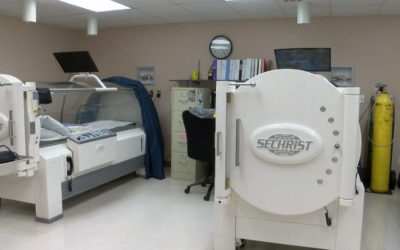
Doctors using hyperbaric oxygen therapy to treat diabetes, cancer patients
KPLC, Lake Charles, LA - LA reporting on the use of Hyperbaric Oxygen Therapy or HBOT as a supplement to tradtional treatment methods to treat secondary injuries and increase quality of live for Diabetes and Cancer patients. Read the full article:...
Magnitude of benefit for adjuvant radiotherapy following minimally invasive surgery in intermediate to high risk HPV-positive oropharyngeal squamous cell carcinoma.
Abstract: To determine the outcomes and toxicities of minimally-invasive surgery with adjuvant intensity-modulated radiotherapy +/- chemotherapy (AT) compared to definitive surgical therapy (ST) in a contemporary cohort of HPV-positive...
Healing of spongiosus-cutaneous fistula with Hyperbaric Oxygen Therapy (HBOT): a case report.
Abstract: We present a case of a spongiosus-cutaneous fistula in a 39-year-old man with recurrent episodes of cutaneous abscess in dorsal middle third penis (5 - 3 cm) treated with Hyperbaric Oxygen Therapy (HBOT). After emptying nodular abscess,...
Clinical Trial – Caudal Block,Saddle Block, Anorectal Surgery
Anorectal surgery includes pilonidal sinus, hemorrhoidectomy, anal fissure, and anal fistula
operations. Various surgical and anesthetic techniques have been used to increase the level
of analgesia in perioperative period and decrease the length of stay in the hospital. In this
study, investigators investigate the effects of routinely applied anesthesia techniques
during anorectal surgery, caudal block and saddle block, on patients’ perioperative
hemodynamic values, sensory and motor block levels, and postoperative pain scores.
Clinical Trial – Hyperbaric Oxygen Therapy for Ulcerative Colitis Flares
Ulcerative colitis (UC) is a chronic inflammatory bowel disease associated with recurrent
mucosal inflammation. Clinically, the disease is characterized by bloody diarrhea, abdominal
pain, and constitutional symptoms such as fever and weight loss. Treatment strategies vary
based on disease activity and target various aspects of the inflammatory cascade. Options
include: anti-inflammatory drugs (mesalamine), immunosuppressive or modulatory medications
(corticosteroids, thiopurines, cyclosporine) and biologic agents (Anti-TNF). Disease severity
can be wide ranging, and nearly 25% of UC patients are hospitalized for acute severe disease.
Of these patients, 30% will undergo colectomy after the acute episode, a quarter of which
will experience post-operative complications. Although there has been great progress in
treatment of UC over the past decade, even with the anti-TNF agent infliximab, the one-year
remission rate for patients not responding to conservative management is barely 20%.
Furthermore, corticosteroids have significant long-term consequences and immune suppressive
drugs such as 6-mercaptopurine, azathioprine and infliximab have been associated with serious
adverse events including life-threatening infections and lymphomas. With growing evidence
that the pathogenesis of UC is multi-factorial and involves a complex interaction of genetic
and environmental factors, newer treatment modalities are being evaluated to target the
mucosal immune response and mucosal inflammatory regulatory system.
Hyperbaric oxygen offers a promising new treatment option since it targets both tissue
hypoxia and inflammation. Recent small scales studies evaluating the impact of hyperbaric
oxygen treatment in acute ulcerative colitis flares demonstrated improved outcomes. The
mechanisms underlying the improvement are not known. In this study, we will treat ulcerative
colitis flares with hyperbaric oxygen and measure changes in both markers of tissue hypoxia
and inflammation. We hypothesize that hyperbaric oxygen will (a) improve outcomes, and (b)
show reductions in markers of both tissue hypoxia and inflammation.