
HBOT Conversations:
Dr. Hemal Mehta & Fasting (Part 2)
Dr. Hemal Mehta, MD is a Medical Director and an Independent Medical Examiner who focuses on pain management through a Regenerative medicine approach. Dr. Mehta is Board Certified in Physical Medicine and Pain Management. He received his Doctor of Medicine Degree from Ross University School of Medicine and completed his residency at East Carolina. He is the Medical Director of Vibrant Health of North Carolina, Tennessee Integrative Pain Institute, and TN Integrative Healthcare: Musculoskeletal and Regenerative Center; additionally, Dr. Mehta is the attending physician at Nashville Regenerative Orthopedics. Dr. Mehta is the 2013 recipient of the Inaugural Patient Appreciation Award at Nashville Academy of Medicine, and the 2004 Research Resident of the Year for East Carolina University. Dr. Mehta has extensive experience with stem cell proliferation, and angiogenesis. He has incorporated Ozone Injection Therapy, PRP (Platelet-Rich Plasma) Injections, Hyperbaric Oxygen Therapy and Regenerative Matrix and Regenerative Medicine Procedures – to name a few – into his integrative wellness & longevity medical practices.
Watch the Podcast
di Girolamo & Dr. Mehta examine the use of Vitamin C IV therapy for cancer, and how the combination of Vitamin C IV therapy, fasting and oxygen therapy – especially in the form of Hyperbaric Oxygen Therapy – has been known to put patients in remission and completely eliminate some very serious cancers. Dr. Mehta describes Hyperbaric Oxygen as a “game changer” when adding it into a cancer treatment protocol. He explains that as doctors they are trained to look at chemotherapy first to treat cancer, but there are many holistic ways to help a cancer patient shrink the tumors, stop the spread and live a longer life. He agrees that HBOT would be a great option to help cancer patients on their healing journey.
Diet is another holistic way to treat cancer. A water fast that puts the body in a ketogenic state, or a ketogenic organic diet are all ranked high as ideal ways to use alternative, natural methods for cancer and pain relief.
Dr. Mehta tells a personal story of his past that involved his father’s diagnosis of papillary thyroid cancer, and how it was the holistic and natural methods Dr. Mehta recommended that gave him extended life. Vitamin C Therapy, consuming organic wheatgrass daily, and daily deep breathing techniques to increase oxygen levels all contributed to him living 3 years longer than his prognosis. After massive shrinkage of the tumors during those 3 years; his father was convinced by an Ocologist to undergo chemotherapy in hopes that it would completely eradicate the cancer from his body. The chemotherapy caused cardio toxicity and unfortunately ultimately lead to Dr. Mehta’s father passing away.
di Girolamo suggests that viewers watch Research Rundown Episode 16: The Ketogenic Diet and Hyperbaric Oxygen Therapy Prolong Survival in Mice with Systemic Metastatic Cancer. This is a popular Research Rundown where our host, Ed di Girolamo, analyzes a study led by researcher, Dominic D’Agostino. The benefit of combining ketogenic diet with Hyperbaric Oxygen Therapy (HBOT) for metastatic cancer treatment is some very exciting research in the world of HBOT, cancer research, and fasting! This particular research and Dominic’s involvement to help prove that cancer can be eliminated (and maybe even cured) by combining a heavy ketogenic diet and Hyperbaric Oxygen Therapy is further discussed in this HBOT News Conversations episode with Dr. Mehta.
*Pease consult your doctor to see if fasting is right for you.
Guest

Dr. Hemal Mehta
Subscribe Now, It’s Free!
Recent HBOT News

Increasing Veteran’s Access to Hyperbaric Oxygen Treatments
The new MISSION Act, passed by Congress last year, could pave the way for Hyperbaric Oxygen Therapy (HBOT) to be covered by the VA. In general, the act is making better healthcare more easily accessible to veterans. There are a couple of specific clauses, such as the...
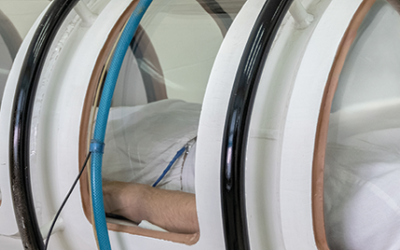
Treatment of Traumatic Brain Injury With Hyperbaric Oxygen Therapy
Hyperbaric oxygen therapy (HBOT) is defined as the use of oxygen at higher than atmospheric pressure for the treatment of underlying disease processes and the diseases they produce. Modern HBOT in which 100% O2 is breathed in a pressurized chamber dates back to the 1930s, when it was first used for treatment of decompression illness in divers. There are currently 13 FDA-approved uses for HBOT, including decompression illness, gas gangrene, air embolism, osteomyelitis, radiation necrosis, and the most recent addition—diabetic ulcers. HBOT can dramatically and permanently improve symptoms of chronic TBI months or even many years after the original head injury. This assertion is generally met with skepticism within the medical establishment because we have been taught for generations that any post-concussion symptoms persisting more than 6 months or so after a head injury are due to permanent brain damage that cannot be repaired.
Clinical Trial – Comparison of Clorotekal and Bupivacaine for Short Obstetric Surgery
The following obstetric procedures are commonly performed with spinal anesthesia on labor and
delivery: bilateral tubal ligation, external cephalic version, cerclage insertion, cerclage
removal, minimally invasive fetal surgery, and evacuation of retained products of conception.
Bupivacaine is currently the standard spinal medication for these procedures because of its
long history of safe use, its low incidence of transient neurologic symptoms, and its ability
to provide a dependable, dense block with a high degree of maternal satisfaction. While
bupivacaine has the aforementioned advantages, it unfortunately has a long duration of
action, up to 240-380 minutes, which far exceeds the time necessary to complete most
obstetric procedures. Clorotekal®, the first Food and Drug Administration approved
chloroprocaine solution created for spinal injection, is a potential alternative. When
compared with bupivacaine spinals, chloroprocaine spinals have been shown to facilitate
clinically significant shorter times to resolution of motor and sensory block, first
ambulation, micturition, and discharge readiness. The objective of this study is to determine
if a strategy of spinal anesthesia with chloroprocaine will reduce the duration of motor
block, compared with equivalent block with hyperbaric bupivacaine..