
HBOT Conversations:
Dr. Jay Stevens
Sports-Related Injuries & Performance Enhancement
Dr. James “Jay” Stevens is the Medical Director of Extivita-RTP. He earned a Bachelor of Arts in Zoology from UNC-Chapel Hill and a Doctor of Medicine from East Carolina University School of Medicine. He completed a Family Practice Residency at the Fairfax Family Practice Program at the Medical College of Virginia and the first Sports Medicine Fellowship at the University of North Carolina, Chapel Hill in 1991. He is Board Certified in both Family Practice and Anti-aging Medicine. He also holds a Certificate of Added Qualification in Sports Medicine. In 2003 he founded Carolina Family Practice & Sports Medicine with locations in Cary, Raleigh, and Holly Springs, NC. He has served as the Team Physician for the National Hockey League’s 2006 Stanley Cup Champion Carolina Hurricanes since their arrival in 1997. He also serves as Company Physician for the Carolina Ballet.
Watch the Podcast
HBOT News Network welcomes back Dr. James “Jay” Stevens, M.D. to talk about sports related injuries & performance enhancement with Hyperbaric Oxygen Therapy. Dr. Stevens was recently featured on HBOT News Conversations, to discuss the combination of water fasting and Hyperbaric Oxygen Therapy for Extivita-RTP‘s Longevity Challenge.
Dr. Stevens holds a fellowship trained in sports medicine from the University of North Carolina. For the past 25 years Dr. Stevens has had the good fortune to be the team physician for the NHL (National Hockey League) team, Carolina Hurricanes; he even has a Stanley cup ring that was gifted to him from the team. In the value of sports activity and exercise, Dr. Stevens has worked with athletes young and old — world class athletes, to an octogenarian who just wants to run a 3k for charity reasons. He doesn’t just talk the talk either, he walks the walk. Dr. Stevens himself is a triathlon athlete and half Ironman.
Dr. Stevens has been involved in Hyperbaric Oxygen Therapy for 14 years. He says it captivated him long ago, and explains that once someone truly understands the science of Hyperbaric Oxygen and cellular injury, you begin to appreciate how the two align quite nicely. He claims that virtually every injury is amenable to Hyperbaric Oxygen. He uses a sports sprain as an example, stating that compression plays a major part in the healing of a sprain. But, what if we could wrap the body with a certain amount of pressure and deliver 300 times more oxygen to the injury at the cellular level, combining that therapy with the normal healing of the tissue breathing room air at sea level. That’s Dr. Stevens focus on healing sports injuries; incorporating hyperbaric oxygen therapy into the healing protocol to accelerate tissue healing. A bad sprain might take you a few weeks or maybe even a few months or an entire season to heal naturally; but if you add in HBOT, the average person just sliced their healing time in half. Wouldn’t any sports athlete want to heal sooner and safer, and get back to the sport they love that much faster? Dr. Stevens said that is all possible when you incorporate Hyperbaric Oxygen Therapy into the healing process.
HBOT works exceptionally well healing ligaments and tendons; it responds much more readily to the combination of oxygen and pressure. But why is that? Dr. Stevens explains that if you look at a torn muscle, for instance, it’s heavily supplied by blood. Yet, the blood supply in a muscle is much different than a tendon or a ligament, and blood supply is where the healing is going to take place. Yet, when it comes to HBOT it’s fair to say it’s independent of blood supply; because when we combine oxygen and pressure the oxygen is diffused into plasma (the extracellular matrix) at a tremendous gradient compared to normal atmospheric pressure and normal oxygen. And that is why ligaments and tendons are going to heal faster, because you’re getting more oxygen to an area of the body that normally doesn’t get very much.
di Girolamo tells the story of a friend who completed two HBOT sessions a day for 5 days straight for an atrocious sprained ankle. The sprain was so bad that she was put in a hard boot, yet at the end of those 5 days the inflammation had dissipated completely. She went back to the doctor and graduated to a soft cast, and was even able to walk in the soft cast. Considering the severity of her sprain, her doctor was absolutely amazed at how fast she was healing; and she contributed it all to Hyperbaric Oxygen treatments.
Dr. Stevens explains that by this patient doing two treatments a day, she was experiencing the “hermetic effect”. Essentially, this means that within hours of leaving an HBOT chamber a patient’s oxygen levels return to normal, however those cells were just exposed to very high concentrations of oxygen, so now there is this tandem back and forth of hyperoxia to relative hypoxia which induces phenomenal cellular changes of repair and response. Dr. Stevens explains that it’s all evolutionary based, and that’s what’s happening when someone does two HBOT “dives” in a day. They are initiating this bounce between hyperoxia to hypoxia to hyperoxia and back to hypoxia, and so on. It’s fascinating how this process stimulates such extreme cellular repair.
But, what about using Hyperbaric Oxygen Therapy long-term; whether that be for sports injuries or even just health and wellness? Dr. Stevens enlightens us that there are some really good studies out there on this. Dr. Stevens says chronic use of Hyperbaric Oxygen Therapy is simply optimizing the cellular milieu (or the cellular state) for energy production — he sees no concern for using Hyperbaric Oxygen long-term, and has yet to come across any logic that would say using HBOT long term is detrimental.
Dr. Stevens reminds us that Hyperbaric Oxygen Therapy is extremely safe. So if you’re looking into a home unit (maybe like what the NFL or NBA players have, called a ‘soft chamber’) and you’re asking “Could I do a hyperbaric treatment every day after I get home from the game?”, Dr. Stevens says the answer is essentially “yes”. It would help your recovery at multiple levels of energy production, the bruises will go away quicker, you will sleep better and your body will simply recover from the stress of competitive play at a much, much faster rate for performance enhancement. But, oxygen toxicity is a real thing too, with too much of anything having the opposite effect. Dr. Stevens suggests at some point it’s good to take a break… maybe do the “dives” 5x a week and take the weekend off. By doing such, you are sure to still reap all the hermetic effect benefits of hyperoxia to hypoxia and back again to initiate cellular repair.
Dr. Stevens and di Girolamo stresses that every athlete should know about HBOT and be given the choice on whether or not they want to use this noninvasive therapy to heal better and quicker. This is why HBOT News was born, to help educate the world on all the ways Hyperbaric Oxygen Therapy can help someone heal from the inside out. Too many times the world today is so hung up data and the research, that they don’t just open their eyes and look at the facts. Hyperbaric Oxygen Therapy has been around for well over a hundred years, with the proof being in the healing. We don’t need FDA approval to heal an injury. With that said, if you are injured, especially if you are severely injured, please seek out a Hyperbaric Oxygen Therapy (HBOT) chamber and witness the miracle firsthand of oxygen and pressure combined.
Guest

Dr. Jay Stevens
Dr. James “Jay” Stevens earned a Bachelor of Arts in Zoology from UNC-Chapel Hill and a Doctor of Medicine from East Carolina University School of Medicine. He completed a Family Practice Residency at the Fairfax Family Practice Program at the Medical College of Virginia and the first Sports Medicine Fellowship at the University of North Carolina, Chapel Hill in 1991. He is Board Certified in both Family Practice and Anti-aging Medicine. He also has a Certificate of Added Qualification in Sports Medicine. In 2003 he founded Carolina Family Practice & Sports Medicine with locations in Cary, Raleigh, and Holly Springs, NC. He has served as the Team Physician for the National Hockey League’s 2006 Stanley Cup Champion Carolina Hurricanes since their arrival in 1997. He serves as Company Physician for the Carolina Ballet as well.
In 2009, his commitment to helping his patients create healthy lifestyles for long-term wellness, along with his desire to provide the highest quality health care services, motivated Dr. Stevens to establish Essential Health & Wellness (EHW). EHW offers its patients a comprehensive health care service tailored around their busy schedules with the goal of optimizing their performance and longevity.
In 2018, he continued this commitment to long-term wellness of his patients by becoming the Medical Director at Extivita RTP, a hyperbaric oxygen therapy facility with two, twelve seat treatment chambers in the Research Triangle Park, Durham, NC.
Dr. Stevens is also a Fellow in both the American Academy of Anti-Aging and Regenerative Medicine and the American Academy of Family Practice. He is a member of the American Medical Society of Sports Medicine and Hyperbaric Medicine International.
Dr. Stevens lives in Cary, NC with his wife, Dr. Patience Stevens. They have three sons Eric, James, and Timothy. He is passionate about surfing, triathlon and almost any form of exercise.
Subscribe Now, It’s Free!
Recent HBOT News
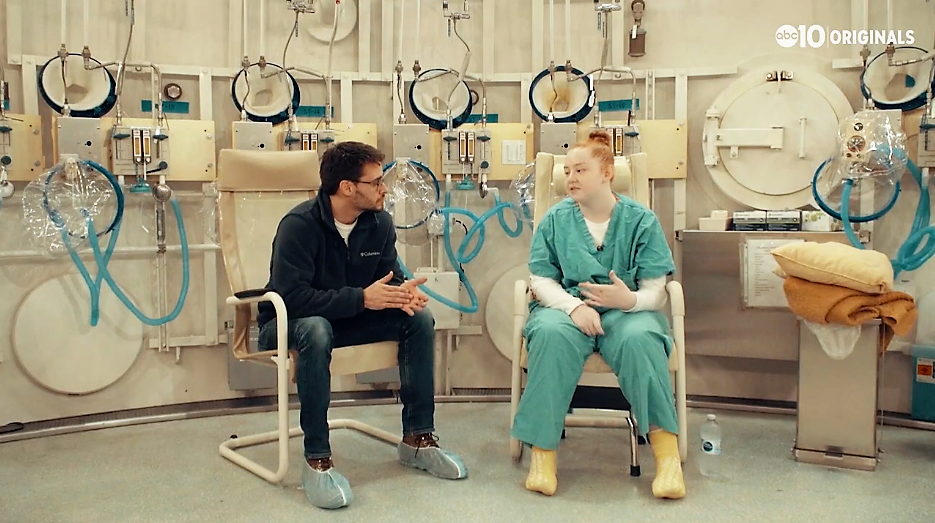
Healing under pressure: Inside a military hyperbaric chamber
At 16, she had a stroke. At 17, her town burned in the Camp Fire. Now, as her community rebuilds, she's healing thanks to hyperbaric therapy. SACRAMENTO, Calif — February 2, 2017, started off as an ordinary day for the Pipkin Family. Patrick and Stacey Pipkin just...
Clinical Trial – High-flow Oxygen for Vaso-occlusive Pain Crisis
Sickle cell disease (SCD) is characterized by recurrent vaso-occlusive pain crisis (VOC),
which may evolve to acute chest syndrome (ACS), the most common cause of death among adult
patients with SCD. Currently, there is no safe and effective treatment to abort VOC or
prevent secondary ACS. Management of VOC mostly involve a symptomatic approach including
hydration, analgesics, transfusion, and incentive spirometry, which was investigated in a
very limited number of patients (<30).
The polymerisation of HbS is one major feature in the pathogenesis of vaso-occlusion. Among
factors determining the rate and extent of HbS polymer formation, the hypoxic stimulus is one
of the most potent and readily alterable. Current guidelines recommend oxygen therapy in
patients with VOC in order to maintain a target oxygen saturation of 95%. Low-flow nasal
oxygen (LFNO) is routinely used to achieve this normoxia approach, particularly in patients
at risk of secondary ACS because they may experience acute desaturation. In contrast, various
case series suggest a potential beneficial role of intensified oxygen therapy targeting
hyperoxia for the management of VOC, particularly with the use of hyperbaric oxygen, but the
latter is difficult to implement in routine clinical practice.
A recent high-flow nasal oxygen (HFNO) technology allows the delivery of humidified gas at
high fraction of inspired oxygen (FiO2) through nasal cannula. The FiO2 can be adjusted up to
100% (allowing hyperoxia that may reverse sickling) and the flow can be increased up to 60
L/min (which generates positive airway pressure and dead space flushing, that may prevent
evolution of VOC towards ACS by alleviating atelectasis and opioid-induced hypercapnia). In
patients with acute respiratory failure, HFNO has been shown to improve patient's comfort,
oxygenation, and survival as compared to standard oxygen or non-invasive ventilation.
The aim of the present study is to test the efficacy and safety of HFNO for the management of
VOC and prevention of secondary ACS. The investigators will use a multi-arm multi-stage
(MAMS) design to achieve these goals. HFNO will be delivered through AIRVO 2 (Fisher and
Paykel Healthcare, New Zealand), a device that incorporates a turbine allowing its use in
hospital wards.
Clinical Trial – Hyperbaric Oxygen Therapy and Allogeneic Peripheral Blood Stem Cell (PBSC) Transplant
Subjects with Acute Myeloblastic Leukemia (AML) and myelodysplastic syndrome (MDS) who are
considered eligible for allogeneic stem cell transplant by the transplant team at WCI (Wilmot
Cancer Institute)will be enrolled in the study. Patients will receive Melphalan on day -2 and
HBO (Hyperbaric Oxygen) therapy on day 0 of the transplant. After neutrophil recovery is
documented, the patients will be seen in clinic at least weekly through day +100.