
HBOT Conversations:
Dr. Paul Harch & 8,101 Genes
He is the author of The Oxygen Revolution and is considered an International expert and pioneer in the field of Hyperbaric Oxygen Therapy (HBOT). His informative, and comprehensive guide on HBOT has helped countless souls better understand what HBOT is and how it directly affects the body at the genetic level.
This episode on 8,101 genes is the eighth in a nine episode series that will be released weekly with Dr. Harch.
Watch the Podcast
In episode 8 of 9, host Edward di Girolamo speaks with world renowned HBOT expert, Dr. Paul G. Harch, about aging and the 8,101 genes HBOT affects.
di Girolamo starts this conversation with Dr. Harch bringing up the 8,101 genes that are activated by Hyperbaric Oxygen Therapy. The discussion leads to talk of Big Pharma, telomeres, reparative gene process, patents, and successful business models for HBOT clinics.
Dr. Harch explains that Hyperbaric Oxygen Therapy affects 8,101 of our genes, and it’s doing so on a different level for the ones that are overactive and abnormal in the disease process. He speaks of a 2004 lecture he gave to A4M about the effects of HBOT on longevity; and asks, “Where is senescence and aging based?”, answering with, “It’s in our DNA”. Dr. Harch dives in to how HBOT turns on our genes to grow new tissue and stimulates cellular repair and regeneration. di Girolamo agrees and brings up a different past lecture from Dr. Harch where Harch referred to Hyperbaric Oxygen Therapy as the ‘Fountain of Youth‘.
This series ends with Dr. Harch discussing a Buffalo VA study, and how the study subjects (comprised of older veterans) literally came alive and started propositioning nurses after Hyperbaric Oxygen Therapy treatments. He explained this is why no follow-up study was ever done because they weren’t expecting such and didn’t know what to do. Makes sense…. studies have shown success in HBOT treating erectile dysfunction.
If you are searching for the Fountain of Youth and ready to activate 8,101 genes in your body —- find a Hyperbaric Oxygen Therapy clinic near you.
Subscribe Now, It’s Free!
Guest
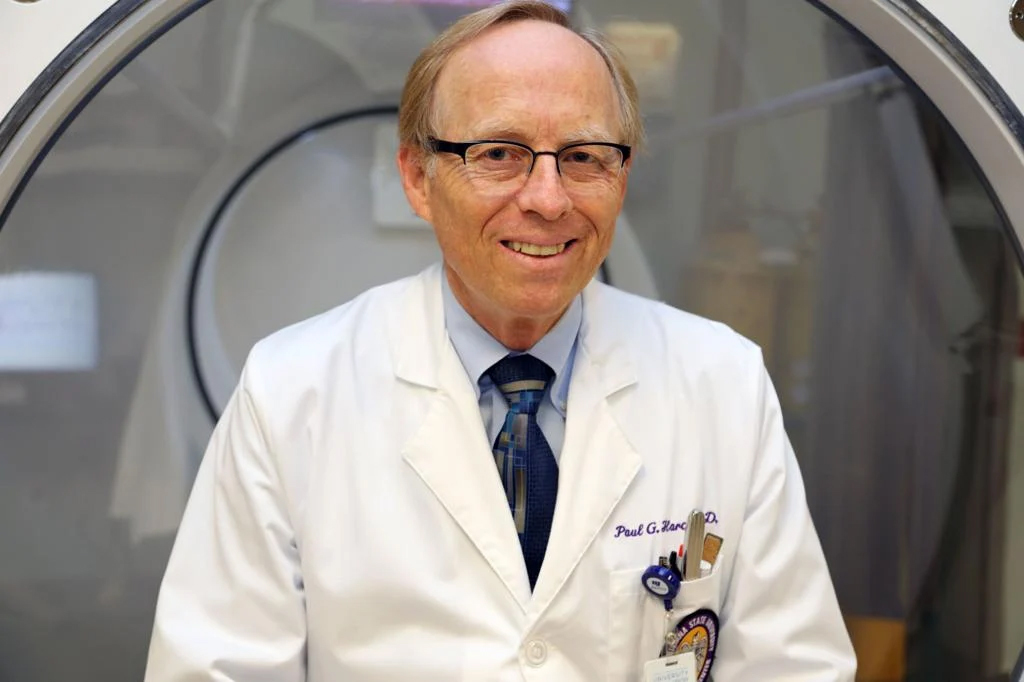
Dr. Paul G. Harch, MD
Dr. Harch initiated and continues to be a private practice that has resulted in the largest case experience in neurological hyperbaric medicine in the world. In this practice, he adapted the concepts of conventional hyperbaric oxygen therapy to wounds in the central nervous system, which spawned the subsequent academic and research practice. Harch HBOT is the best place to receive oxygen therapy treatments, and patients have traveled from more than 50 countries to be treated by Dr. Harch himself.
Harch HBOT – Hyperbaric Oxygen Therapy Clinic
5216 Lapalco Blvd.
Marrero, LA
504-309-4948
hbot@hbot.com
https://hbot.com/
Recent HBOT News
Clinical Trial – Hyperbaric Oxygenation in Athletes: Standard Versus Low Pressure
Currently, Hyperbaric Oxigen (HBO) is a widely used treatment for several conditions. There
are 14 indications for HBO, officially recognized by the Undersea and Hyperbaric Medical
Society (UHMS), but research is discovering other interesting applications.
HBO plays an important role in enhancing antioxidant defense mechanisms by increasing radical
oxygen species (ROS) and nitric oxide species (NOS). This controlled oxidative stress has
been shown to stop the vicious circle of inflammation – damage – hypoxia already seen in
several diseases. Increased neoangiogenesis has been demonstrated at pressures of 2
atmospheres absolute (ATA), while effects helping ischemic tissues need pressures between 2.5
and 2.8 ATA to develop.
During sports activities, metabolism generates waste products – mostly CO2, lactic acid, but
also ROS. HBO could be useful in modulating antioxidant mechanisms and helping cells in the
recovery after training and sportive competitions.
The authors hypothesize that:
1. HBO can reduce oxidative stress in healthy professional athletes
2. HBO can ameliorate the lactic acid clearance after a maximal exercise
3. HBO at low pressures (L-HBO at 1.45 ATA) is at least comparable to conventional HBO (at
2.5 ATA) in reducing oxidative stress and ameliorating lactic acid clearance after a
maximal exercise.
The Authors will include healthy athletes. These will be randomly assigned to a control
group, a L-HBO group, or a HBO group. The Authors will assess oxidative stress changes and
lactic acid clearance (testing it after a maximal exercise) before and after 20 L-HBO/HBO
treatments, and after 2 months after the end of treatments.
Clinical Trial – Hyperbaric Oxygen Therapy Compared to Pharmaceutical in Fibromyalgia With Emotional Trauma
The investigators have previously studied the efficacy of hyperbaric oxygen therapy (HBOT) as
a treatment for Fibromyalgia syndrome (FMS) in a prospective, active control, crossover
clinical trial. The results demonstrated significant amelioration of all FMS symptoms, with
significant improvement in life quality; furthermore, the investigators were able to
demonstrate significant neuroplasticity on SPECT imaging, with a decrease of the
hyperactivity in posterior regions and elevation of the reduced activity in frontal areas.
In this study, the investigators intend to both repeat and expand the investigator’s previous
findings, treating FMS patients with history of emotional trauma with HBOT, while performing
an extensive of evaluation both before and after treatment.
In the current study, the investigators plan to compare HBOT to current standard of care of
FMS (pharmacological and non – pharmacological).

Hyperbaric Oxygen Therapy gets Lincoln CPA back in business for tax season
17 years ago Tom Shotkoski was diagnosed with colorectal cancer. But, when his surgical site became infected, Shotsoski was left with a life of debilitating pain that restricted him from even being able to sit. His doctors recommended Hyperbaric Oxygen Therapy to...