
HBOT Conversations:
Dr. Paul Harch & 8,101 Genes
He is the author of The Oxygen Revolution and is considered an International expert and pioneer in the field of Hyperbaric Oxygen Therapy (HBOT). His informative, and comprehensive guide on HBOT has helped countless souls better understand what HBOT is and how it directly affects the body at the genetic level.
This episode on 8,101 genes is the eighth in a nine episode series that will be released weekly with Dr. Harch.
Watch the Podcast
In episode 8 of 9, host Edward di Girolamo speaks with world renowned HBOT expert, Dr. Paul G. Harch, about aging and the 8,101 genes HBOT affects.
di Girolamo starts this conversation with Dr. Harch bringing up the 8,101 genes that are activated by Hyperbaric Oxygen Therapy. The discussion leads to talk of Big Pharma, telomeres, reparative gene process, patents, and successful business models for HBOT clinics.
Dr. Harch explains that Hyperbaric Oxygen Therapy affects 8,101 of our genes, and it’s doing so on a different level for the ones that are overactive and abnormal in the disease process. He speaks of a 2004 lecture he gave to A4M about the effects of HBOT on longevity; and asks, “Where is senescence and aging based?”, answering with, “It’s in our DNA”. Dr. Harch dives in to how HBOT turns on our genes to grow new tissue and stimulates cellular repair and regeneration. di Girolamo agrees and brings up a different past lecture from Dr. Harch where Harch referred to Hyperbaric Oxygen Therapy as the ‘Fountain of Youth‘.
This series ends with Dr. Harch discussing a Buffalo VA study, and how the study subjects (comprised of older veterans) literally came alive and started propositioning nurses after Hyperbaric Oxygen Therapy treatments. He explained this is why no follow-up study was ever done because they weren’t expecting such and didn’t know what to do. Makes sense…. studies have shown success in HBOT treating erectile dysfunction.
If you are searching for the Fountain of Youth and ready to activate 8,101 genes in your body —- find a Hyperbaric Oxygen Therapy clinic near you.
Subscribe Now, It’s Free!
Guest
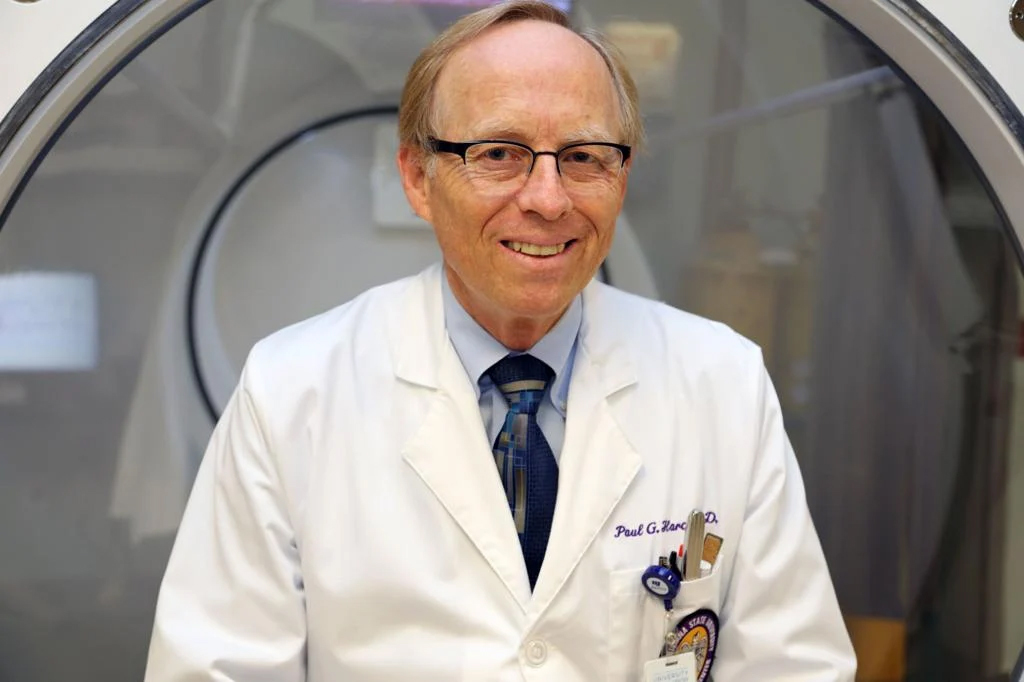
Dr. Paul G. Harch, MD
Dr. Harch initiated and continues to be a private practice that has resulted in the largest case experience in neurological hyperbaric medicine in the world. In this practice, he adapted the concepts of conventional hyperbaric oxygen therapy to wounds in the central nervous system, which spawned the subsequent academic and research practice. Harch HBOT is the best place to receive oxygen therapy treatments, and patients have traveled from more than 50 countries to be treated by Dr. Harch himself.
Harch HBOT – Hyperbaric Oxygen Therapy Clinic
5216 Lapalco Blvd.
Marrero, LA
504-309-4948
hbot@hbot.com
https://hbot.com/
Recent HBOT News
Cerebral hypoperfusion in autism spectrum disorder
Cerebral hypoperfusion, or insufficient blood flow in the brain, occurs in many areas of the brain in patients diagnosed with autism spectrum disorder (ASD). Hypoperfusion was demonstrated in the brains of individuals with ASD when compared to normal healthy control brains either using positron emission tomography (PET) or single‑photon emission computed tomography (SPECT). The affected areas include, but are not limited to the: prefrontal, frontal, temporal, occipital, and parietal cortices; thalami; basal ganglia; cingulate cortex; caudate nucleus; the limbic system including the hippocampal area; putamen; substantia nigra; cerebellum; and associative cortices. Moreover, correlations between symptom scores and hypoperfusion in the brains of individuals diagnosed with an ASD were found indicating that the greater the autism symptom pathology, the more significant the cerebral hypoperfusion or vascular pathology in the brain. Evidence suggests that brain inflammation and vascular inflammation may explain a part of the hypoperfusion. There is also evidence of a lack of normal compensatory increase in blood flow when the subjects are challenged with a task. Some studies propose treatments that can address the hypoperfusion found among individuals diagnosed with an ASD, bringing symptom relief to some extent. This review will explore the evidence that indicates cerebral hypoperfusion in ASD, as well as the possible etiological aspects, complications, and treatments.
Clinical Trial – Spinal Anesthesia in Caesarean Section
Spinal anesthesia is a safe technique, widely used and tested in the gynecological field, so
as to be considered the first choice technique in cesarean section, which allows to quickly
obtain a valid sensor and motor block. Bupivacaine is one of the most widely used drug for
obtaining spinal anesthesia in pregnant women undergoing caesarean section. Bupivacaine is a
local anesthetic available as a racemic mixture of its two enantiomers, the R (+)-
dextrobupivacaine and the S (-) – levobupivacaine, whose clinical use is widely validated.
Racemic bupivacaine is available as a simple or hyperbaric solution, the latter being the
most commonly used for spinal anesthesia. Levobupivacaine, which is the pure levorotatory
enantiomer of racemic bupivacaine, is a slightly hypobaric solution compared to liquor and
has shown less heart and nerve toxicity, probably due to its ability to bind proteins more
rapidly, and a greater selectivity towards the sensory component compared to Bupivacaine,
presents action and effects better predictable. Its baricity would also offer the advantage
of providing a less sensitive block to the position.
Hypotension is one of the most common complications of spinal anesthesia and is particularly
relevant in caesarean section because, in addition to the adverse effects on the parturient,
it can have repercussions on the fetus through a reduction of placental perfusion.
Some studies have showed a similar incidence of hypotension in patients treated with
bupivacaine compared to those treated with levobupivacaine, while others assert an
equivalence between the two drugs. In most studies, however, a significantly lower incidence
of hypotension and a greater hemodynamic stability were reported in pregnant patients
undergoing spinal anesthesia by caesarean section with levobupivacaine.
Being both hyperbaric bupivacaine and levobupivacaine routinely used at the "G. Rodolico"
Universitary Hospital of Catania for the spinal anesthesia of pregnant women undergoing
caesarean section and being their use decided exclusively at discretion of the treating
anesthesiologist, in the light of the discrepant data in the literature about the incidence
of hypotension with the two drugs, the main objective of this observational study is to
evaluate the hemodynamic effects mediated by levobupivacaine on pregnant women subjected to
elective cesarean section and to compare them with those mediated by hyperbaric bupivacaine
in an historical court of pregnant women subjected to caesarean section in the period between
April 2017 and April 2018. The hemodynamic parameters will be monitored in real time with a
non-invasive hemodynamic monitoring system (EV1000® platform + Clearsight® system – Edwards
LifeSciences), routinely used in the "G. Rodolico" Universitary Hospital of Catania, allowing
to obtain greater accuracy and veracity of the results compared to previous studies conducted
on such anesthetics.
Role of Hyperbaric Oxygen Therapy in Trauma Care
Article from Bio Spectrum Media discusses how technological advancements have made the use of HBOT more efficient in Trauma Care: Head Trauma is one of the major causes of death and disabilities across the world. This can be caused due a contusion (bruise),...