
HBOT Conversations:
Dr. Paul Harch & 8,101 Genes
He is the author of The Oxygen Revolution and is considered an International expert and pioneer in the field of Hyperbaric Oxygen Therapy (HBOT). His informative, and comprehensive guide on HBOT has helped countless souls better understand what HBOT is and how it directly affects the body at the genetic level.
This episode on 8,101 genes is the eighth in a nine episode series that will be released weekly with Dr. Harch.
Watch the Podcast
In episode 8 of 9, host Edward di Girolamo speaks with world renowned HBOT expert, Dr. Paul G. Harch, about aging and the 8,101 genes HBOT affects.
di Girolamo starts this conversation with Dr. Harch bringing up the 8,101 genes that are activated by Hyperbaric Oxygen Therapy. The discussion leads to talk of Big Pharma, telomeres, reparative gene process, patents, and successful business models for HBOT clinics.
Dr. Harch explains that Hyperbaric Oxygen Therapy affects 8,101 of our genes, and it’s doing so on a different level for the ones that are overactive and abnormal in the disease process. He speaks of a 2004 lecture he gave to A4M about the effects of HBOT on longevity; and asks, “Where is senescence and aging based?”, answering with, “It’s in our DNA”. Dr. Harch dives in to how HBOT turns on our genes to grow new tissue and stimulates cellular repair and regeneration. di Girolamo agrees and brings up a different past lecture from Dr. Harch where Harch referred to Hyperbaric Oxygen Therapy as the ‘Fountain of Youth‘.
This series ends with Dr. Harch discussing a Buffalo VA study, and how the study subjects (comprised of older veterans) literally came alive and started propositioning nurses after Hyperbaric Oxygen Therapy treatments. He explained this is why no follow-up study was ever done because they weren’t expecting such and didn’t know what to do. Makes sense…. studies have shown success in HBOT treating erectile dysfunction.
If you are searching for the Fountain of Youth and ready to activate 8,101 genes in your body —- find a Hyperbaric Oxygen Therapy clinic near you.
Subscribe Now, It’s Free!
Guest
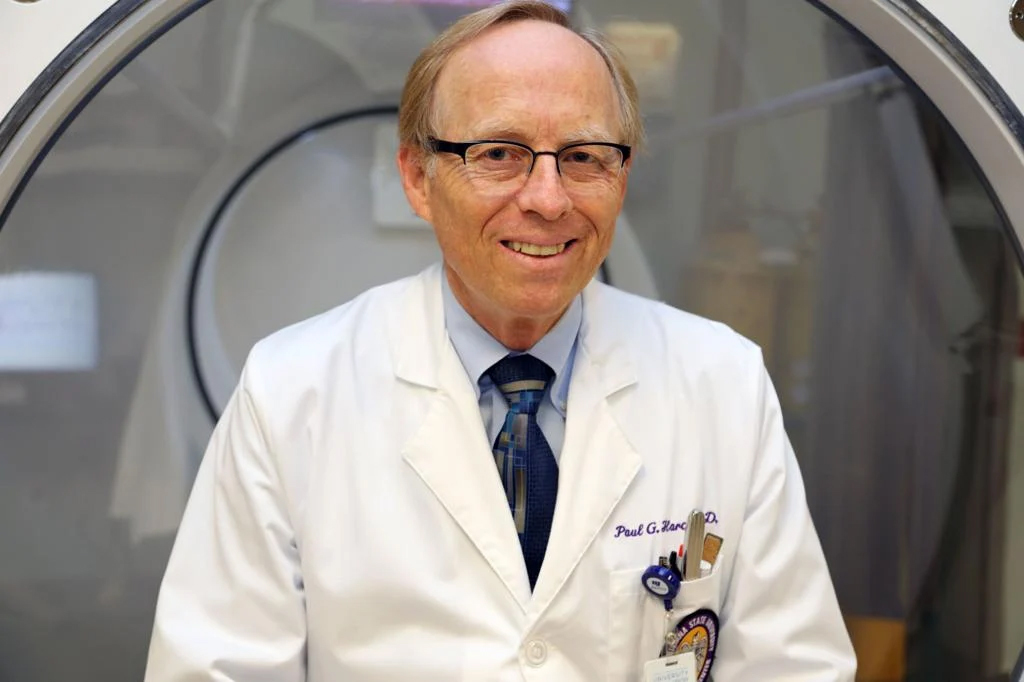
Dr. Paul G. Harch, MD
Dr. Harch initiated and continues to be a private practice that has resulted in the largest case experience in neurological hyperbaric medicine in the world. In this practice, he adapted the concepts of conventional hyperbaric oxygen therapy to wounds in the central nervous system, which spawned the subsequent academic and research practice. Harch HBOT is the best place to receive oxygen therapy treatments, and patients have traveled from more than 50 countries to be treated by Dr. Harch himself.
Harch HBOT – Hyperbaric Oxygen Therapy Clinic
5216 Lapalco Blvd.
Marrero, LA
504-309-4948
hbot@hbot.com
https://hbot.com/
Recent HBOT News
Clinical Trial – Intrathecal Neostigmine for Prevention of PDPH
Neuraxial blocks continue to be the cornerstone of anesthesia and postoperative analgesia for
normal vaginal delivery and elective caesarean section due to its approved safety and
efficiency for decades. Post-dural puncture headache (PDPH) is still one of the most common
complications of neuraxial anesthetic techniques. The headache could be severe and limit the
activities of the new mother to care for her baby, prolong hospital stay.
PDPH is defined as a headache that develops within five days of dural puncture and can’t be
attributed to any other types of headache and mostly is postural in character.
Neostigmine methylsulfate is a synthetic carbamic acid ester which reversibly inhibits the
enzyme Acetylcholine esterase (AChE) that makes more Acetylcholine molecules available at
cholinergic receptors. Neostigmine is used in anesthesia mainly as a reversal for
non-depolarizing neuromuscular agents.
Intrathecal (IT) neostigmine was tried as an adjuvant to local anesthetics in IT block for
elective cesarean sections to decrease local anesthetic consumption and to prolong
postoperative analgesia. Side effects of IT neostigmine are dose-dependent with doses more
than 25 µg especially nausea and vomiting and could be decreased by increasing the baricities
of the local anesthetic solutions and by early head up position after IT injection. However,
its effect on PDPH was not investigated before in literature.
Parturients will be randomly assigned into one of two groups: the intervention group will
receive 20 µg with IT Bupivacaine and the control group will receive an equivalent volume of
dextrose 5% with the IT Bupivacaine.
The objective of the current study is to evaluate the efficacy and safety of IT neostigmine
as an adjuvant to bupivacaine in reducing the incidence and severity of post-dural puncture
headache in parturients scheduled for an elective cesarean section.
Evidence brief: hyperbaric oxygen therapy (HBOT) for traumatic brain injury and/or post-traumatic stress disorder.
This report is a product of the VA Evidence-based Synthesis Program. The purpose is to provide “timely and accurate syntheses of targeted healthcare topics. to improve the health and healthcare of Veterans”. The authors have made a comprehensive search and analysis of the literature and make recommendations to assist clinicians in dealing with veterans suffering from either traumatic brain injury (TBI) or post-traumatic stress disorder (PTSD). The report is timely and of great potential impact given the vigorous and lengthy debate among hyperbaric physicians and lay people determined to find an answer for the large numbers of veterans deeply affected with some combination of PTSD and post-concussion dysfunction.
Clinical Trial – Hyperbaric Oxygen Therapy in Children With Inflammatory Bowel Diseases
The study assesses the effectiveness of hyperbaric oxygen therapy in the treatment of
inflammatory bowel disease in children.