
HBOT Conversations:
Dr. Paul Harch & 8,101 Genes
He is the author of The Oxygen Revolution and is considered an International expert and pioneer in the field of Hyperbaric Oxygen Therapy (HBOT). His informative, and comprehensive guide on HBOT has helped countless souls better understand what HBOT is and how it directly affects the body at the genetic level.
This episode on 8,101 genes is the eighth in a nine episode series that will be released weekly with Dr. Harch.
Watch the Podcast
In episode 8 of 9, host Edward di Girolamo speaks with world renowned HBOT expert, Dr. Paul G. Harch, about aging and the 8,101 genes HBOT affects.
di Girolamo starts this conversation with Dr. Harch bringing up the 8,101 genes that are activated by Hyperbaric Oxygen Therapy. The discussion leads to talk of Big Pharma, telomeres, reparative gene process, patents, and successful business models for HBOT clinics.
Dr. Harch explains that Hyperbaric Oxygen Therapy affects 8,101 of our genes, and it’s doing so on a different level for the ones that are overactive and abnormal in the disease process. He speaks of a 2004 lecture he gave to A4M about the effects of HBOT on longevity; and asks, “Where is senescence and aging based?”, answering with, “It’s in our DNA”. Dr. Harch dives in to how HBOT turns on our genes to grow new tissue and stimulates cellular repair and regeneration. di Girolamo agrees and brings up a different past lecture from Dr. Harch where Harch referred to Hyperbaric Oxygen Therapy as the ‘Fountain of Youth‘.
This series ends with Dr. Harch discussing a Buffalo VA study, and how the study subjects (comprised of older veterans) literally came alive and started propositioning nurses after Hyperbaric Oxygen Therapy treatments. He explained this is why no follow-up study was ever done because they weren’t expecting such and didn’t know what to do. Makes sense…. studies have shown success in HBOT treating erectile dysfunction.
If you are searching for the Fountain of Youth and ready to activate 8,101 genes in your body —- find a Hyperbaric Oxygen Therapy clinic near you.
Subscribe Now, It’s Free!
Guest
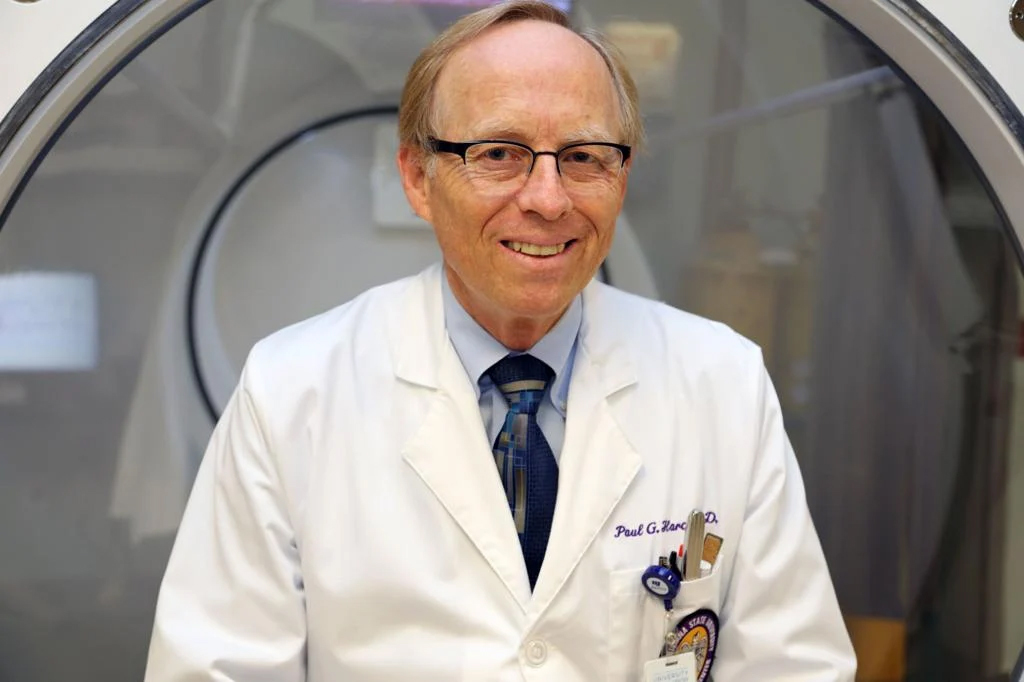
Dr. Paul G. Harch, MD
Dr. Harch initiated and continues to be a private practice that has resulted in the largest case experience in neurological hyperbaric medicine in the world. In this practice, he adapted the concepts of conventional hyperbaric oxygen therapy to wounds in the central nervous system, which spawned the subsequent academic and research practice. Harch HBOT is the best place to receive oxygen therapy treatments, and patients have traveled from more than 50 countries to be treated by Dr. Harch himself.
Harch HBOT – Hyperbaric Oxygen Therapy Clinic
5216 Lapalco Blvd.
Marrero, LA
504-309-4948
hbot@hbot.com
https://hbot.com/
Recent HBOT News
Healing of spongiosus-cutaneous fistula with Hyperbaric Oxygen Therapy (HBOT): a case report.
Abstract: We present a case of a spongiosus-cutaneous fistula in a 39-year-old man with recurrent episodes of cutaneous abscess in dorsal middle third penis (5 - 3 cm) treated with Hyperbaric Oxygen Therapy (HBOT). After emptying nodular abscess, the patient was...
Clinical Trial – Caudal Block,Saddle Block, Anorectal Surgery
Anorectal surgery includes pilonidal sinus, hemorrhoidectomy, anal fissure, and anal fistula
operations. Various surgical and anesthetic techniques have been used to increase the level
of analgesia in perioperative period and decrease the length of stay in the hospital. In this
study, investigators investigate the effects of routinely applied anesthesia techniques
during anorectal surgery, caudal block and saddle block, on patients’ perioperative
hemodynamic values, sensory and motor block levels, and postoperative pain scores.
Clinical Trial – Hyperbaric Oxygen Therapy for Ulcerative Colitis Flares
Ulcerative colitis (UC) is a chronic inflammatory bowel disease associated with recurrent
mucosal inflammation. Clinically, the disease is characterized by bloody diarrhea, abdominal
pain, and constitutional symptoms such as fever and weight loss. Treatment strategies vary
based on disease activity and target various aspects of the inflammatory cascade. Options
include: anti-inflammatory drugs (mesalamine), immunosuppressive or modulatory medications
(corticosteroids, thiopurines, cyclosporine) and biologic agents (Anti-TNF). Disease severity
can be wide ranging, and nearly 25% of UC patients are hospitalized for acute severe disease.
Of these patients, 30% will undergo colectomy after the acute episode, a quarter of which
will experience post-operative complications. Although there has been great progress in
treatment of UC over the past decade, even with the anti-TNF agent infliximab, the one-year
remission rate for patients not responding to conservative management is barely 20%.
Furthermore, corticosteroids have significant long-term consequences and immune suppressive
drugs such as 6-mercaptopurine, azathioprine and infliximab have been associated with serious
adverse events including life-threatening infections and lymphomas. With growing evidence
that the pathogenesis of UC is multi-factorial and involves a complex interaction of genetic
and environmental factors, newer treatment modalities are being evaluated to target the
mucosal immune response and mucosal inflammatory regulatory system.
Hyperbaric oxygen offers a promising new treatment option since it targets both tissue
hypoxia and inflammation. Recent small scales studies evaluating the impact of hyperbaric
oxygen treatment in acute ulcerative colitis flares demonstrated improved outcomes. The
mechanisms underlying the improvement are not known. In this study, we will treat ulcerative
colitis flares with hyperbaric oxygen and measure changes in both markers of tissue hypoxia
and inflammation. We hypothesize that hyperbaric oxygen will (a) improve outcomes, and (b)
show reductions in markers of both tissue hypoxia and inflammation.