
HBOT Conversations:
Dr. Paul Harch & 8,101 Genes
He is the author of The Oxygen Revolution and is considered an International expert and pioneer in the field of Hyperbaric Oxygen Therapy (HBOT). His informative, and comprehensive guide on HBOT has helped countless souls better understand what HBOT is and how it directly affects the body at the genetic level.
This episode on 8,101 genes is the eighth in a nine episode series that will be released weekly with Dr. Harch.
Watch the Podcast
In episode 8 of 9, host Edward di Girolamo speaks with world renowned HBOT expert, Dr. Paul G. Harch, about aging and the 8,101 genes HBOT affects.
di Girolamo starts this conversation with Dr. Harch bringing up the 8,101 genes that are activated by Hyperbaric Oxygen Therapy. The discussion leads to talk of Big Pharma, telomeres, reparative gene process, patents, and successful business models for HBOT clinics.
Dr. Harch explains that Hyperbaric Oxygen Therapy affects 8,101 of our genes, and it’s doing so on a different level for the ones that are overactive and abnormal in the disease process. He speaks of a 2004 lecture he gave to A4M about the effects of HBOT on longevity; and asks, “Where is senescence and aging based?”, answering with, “It’s in our DNA”. Dr. Harch dives in to how HBOT turns on our genes to grow new tissue and stimulates cellular repair and regeneration. di Girolamo agrees and brings up a different past lecture from Dr. Harch where Harch referred to Hyperbaric Oxygen Therapy as the ‘Fountain of Youth‘.
This series ends with Dr. Harch discussing a Buffalo VA study, and how the study subjects (comprised of older veterans) literally came alive and started propositioning nurses after Hyperbaric Oxygen Therapy treatments. He explained this is why no follow-up study was ever done because they weren’t expecting such and didn’t know what to do. Makes sense…. studies have shown success in HBOT treating erectile dysfunction.
If you are searching for the Fountain of Youth and ready to activate 8,101 genes in your body —- find a Hyperbaric Oxygen Therapy clinic near you.
Subscribe Now, It’s Free!
Guest
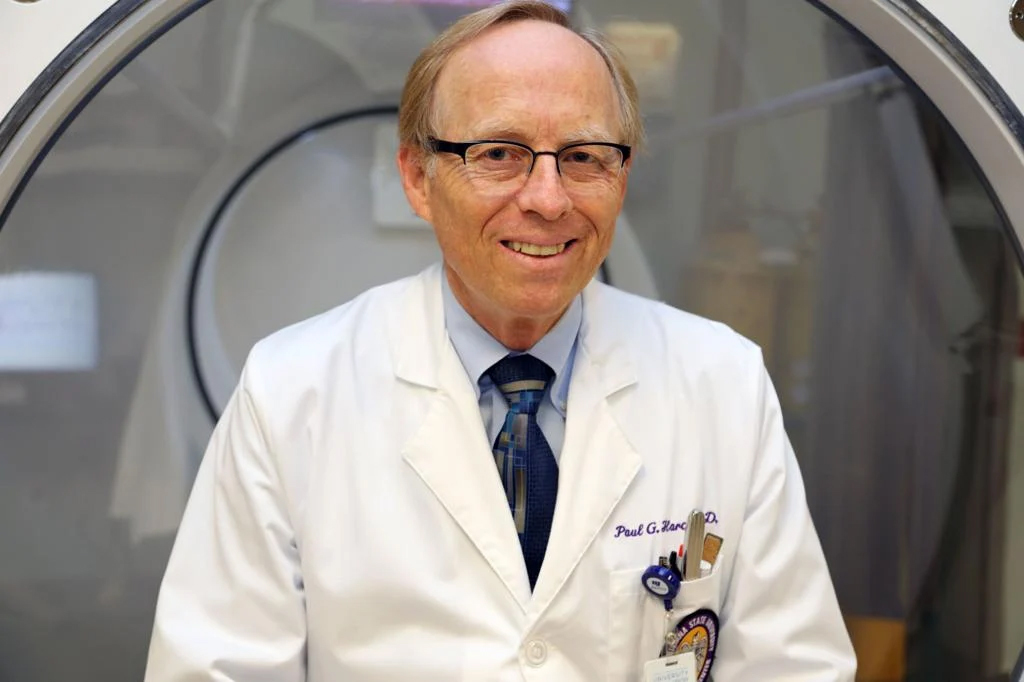
Dr. Paul G. Harch, MD
Dr. Harch initiated and continues to be a private practice that has resulted in the largest case experience in neurological hyperbaric medicine in the world. In this practice, he adapted the concepts of conventional hyperbaric oxygen therapy to wounds in the central nervous system, which spawned the subsequent academic and research practice. Harch HBOT is the best place to receive oxygen therapy treatments, and patients have traveled from more than 50 countries to be treated by Dr. Harch himself.
Harch HBOT – Hyperbaric Oxygen Therapy Clinic
5216 Lapalco Blvd.
Marrero, LA
504-309-4948
hbot@hbot.com
https://hbot.com/
Recent HBOT News
Clinical Trial – SOFT Block Versus Spinal Anesthesia in Patientsusing Ilizarov External Fixator
Peripheral nerve block is an ideal choice for lower limb surgery because of the peripheral
site of the surgical procedure and the ability to block pain pathways at multiple levels. On
the contrary to other anesthetic techniques, as spinal or general anesthesia, properly
performed peripheral nerve blocks bypass adverse events as hemodynamic instability and
respiratory complications, properly treat post-operative pain leading to early hospital
discharge. Additional advantages of peripheral nerve blocks are that they can be used in
patients receiving anti-coagulants or lumbosacral disease in addition to avoidance of airway
instrumentation.
Recently, there has been a significant interest in regional anesthesia and peripheral nerve
blockade. This is facilitated by a significant advance of the research in this field and
availability of better equipment facilitating regional anesthesia.The aim of this study was
to assess the efficacy and safety of SOFT block (sciatic-obturator-femoral nerve block
technique) in comparison with spinal anesthesia in patients undergoing surgery for fixation
of open tibial fractures using Ilizarov external fixator.
Clinical Trial – Effect of Intrathecal Morphine on Chronic Pain After Elective Caesarean Section
The incidence of chronic post-surgical pain (CPSP) after caesarean section (CS) is reported
to be as high as 18%, reflecting it to be a significant clinical problem. Studies related to
prevention of progression of acute post-CS pain to its chronicity are sparse. Current
guidelines on post-CS analgesia recommend the use of intrathecal (IT) opioids to spinal
anaesthesia for improved post-CS pain relief. Despite its frequent use, studies related to
the IT morphine use and its association with post-CS chronic pain are lacking.
A recent prospective observation study revealed a significant reduction in persistent pain
after CS when IT morphine was used as an adjuvant to spinal anaesthesia. However, there is no
any randomized controlled trial (RCT) that has explored this association to date. We
hypothesized that spinal morphine would reduce the incidence of persistent pain after CS.
Long non-coding RNA LINC00152 promotes cell growth and invasion of papillary thyroid carcinoma by regulating the miR-497/BDNF axis.
Abstract: Long intergenic non-coding RNA 152 (LINC00152) was reported to be tightly linked to tumorigenesis and progression in multiple cancers. However, its biological role and modulatory mechanism in papillary thyroid carcinoma (PTC) has not been elucidated. In this...