
HBOT Conversations:
Dr. Paul Harch & 8,101 Genes
He is the author of The Oxygen Revolution and is considered an International expert and pioneer in the field of Hyperbaric Oxygen Therapy (HBOT). His informative, and comprehensive guide on HBOT has helped countless souls better understand what HBOT is and how it directly affects the body at the genetic level.
This episode on 8,101 genes is the eighth in a nine episode series that will be released weekly with Dr. Harch.
Watch the Podcast
In episode 8 of 9, host Edward di Girolamo speaks with world renowned HBOT expert, Dr. Paul G. Harch, about aging and the 8,101 genes HBOT affects.
di Girolamo starts this conversation with Dr. Harch bringing up the 8,101 genes that are activated by Hyperbaric Oxygen Therapy. The discussion leads to talk of Big Pharma, telomeres, reparative gene process, patents, and successful business models for HBOT clinics.
Dr. Harch explains that Hyperbaric Oxygen Therapy affects 8,101 of our genes, and it’s doing so on a different level for the ones that are overactive and abnormal in the disease process. He speaks of a 2004 lecture he gave to A4M about the effects of HBOT on longevity; and asks, “Where is senescence and aging based?”, answering with, “It’s in our DNA”. Dr. Harch dives in to how HBOT turns on our genes to grow new tissue and stimulates cellular repair and regeneration. di Girolamo agrees and brings up a different past lecture from Dr. Harch where Harch referred to Hyperbaric Oxygen Therapy as the ‘Fountain of Youth‘.
This series ends with Dr. Harch discussing a Buffalo VA study, and how the study subjects (comprised of older veterans) literally came alive and started propositioning nurses after Hyperbaric Oxygen Therapy treatments. He explained this is why no follow-up study was ever done because they weren’t expecting such and didn’t know what to do. Makes sense…. studies have shown success in HBOT treating erectile dysfunction.
If you are searching for the Fountain of Youth and ready to activate 8,101 genes in your body —- find a Hyperbaric Oxygen Therapy clinic near you.
Subscribe Now, It’s Free!
Guest
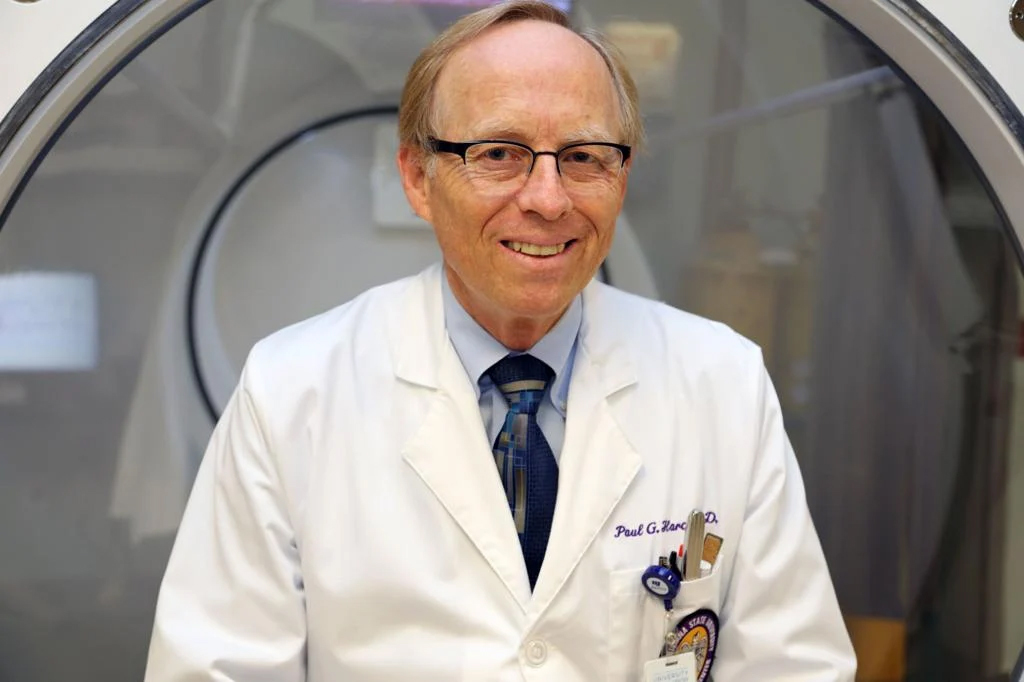
Dr. Paul G. Harch, MD
Dr. Harch initiated and continues to be a private practice that has resulted in the largest case experience in neurological hyperbaric medicine in the world. In this practice, he adapted the concepts of conventional hyperbaric oxygen therapy to wounds in the central nervous system, which spawned the subsequent academic and research practice. Harch HBOT is the best place to receive oxygen therapy treatments, and patients have traveled from more than 50 countries to be treated by Dr. Harch himself.
Harch HBOT – Hyperbaric Oxygen Therapy Clinic
5216 Lapalco Blvd.
Marrero, LA
504-309-4948
hbot@hbot.com
https://hbot.com/
Recent HBOT News
Clinical Trial – Incidence of Postoperative Delirium in Cancer Patients After Laparoscopic Surgery in Trendelenburg Position
Postoperative delirium is an acute mental syndrome that is caused by diffuse cerebral
dysfunction resulting from the action of predisposing and precipitating factors acting
together. It is associated with an increase in mortality and postoperative morbidity and
prolongs the period of hospitalization of the patient Videolaparoscopic surgery has been
increasingly used as a therapeutic and diagnostic method. In order to have a good
visualization of the anatomical structures on which it will act, it is necessary to introduce
gas into the cavity, a mandatory component known as pneumoperitoneum. This technique gives
special characteristics for the conduction of anesthesia, since the positive intra-abdominal
pressure results in changes in the patient’s physiology. Some types of laparoscopic surgery
require the position of Trendelenburg for better visualization of the operative field. Among
the changes related to this position are the increase in cardiac output and intracranial
pressure.
In order to optimize the anesthetic procedure, anesthetic blocks have been increasingly used,
especially the spinal. The association of general anesthesia with spinal anesthesia, followed
by its contraindications is advantageous, because lower doses of anesthetic agents are
necessary for the maintenance of general anesthesia. This association results in an earlier
awakening, a reduction of nausea / vomiting, postoperative pain, length of hospital stay,
cost effectiveness and greater patient satisfaction. As a disadvantage, by associating
general anesthesia with spinal anesthesia, patients become susceptible to the adverse events
of spinal anesthesia. Among these, the most common are headache, hypotension, nausea and
vomiting, pruritus, urinary retention and tremor. Performing spinal anesthesia with opioids
alone, without the use of local anesthetic is also possible, with morphine being the most
used. The benefit of this variation of technique is analgesia for a period of 12 to 24 hours,
without the cardiovascular consequences resulting from the action of the local anesthetic.
JUSTIFICATION: There are no studies in the literature evaluating The objective of this study
is to analyze if the anesthetic techniques employed, general anesthesia or general anesthesia
associated with subarachnoid block, for videolaparoscopic oncologic surgeries, in
Trendelenburg position, differ in relation to the incidence of delirium in the postoperative
period.
Incense burning smoke sensitizes lung cancer cells to EGFR TKI by inducing AREG expression.
Abstract: Incense burning is common in Asian countries due to the religious beliefs. Environmental exposure to incense burning smoke is a potential risk factor for tumor development and progression of non-small cell lung cancer (NSCLC). Eastern Asia ethnic origin is...
A diver with immersion pulmonary oedema and prolonged respiratory symptoms.
Abstract: Immersion pulmonary oedema (IPE) is particularly associated with an excessive reaction to exercise and/or cold stress. IPE usually resolves without recompression therapy within a day or two. Herein we report a diver diagnosed with IPE, in whom symptoms...