
HBOT Conversations:
Dr. Paul Harch & 8,101 Genes
He is the author of The Oxygen Revolution and is considered an International expert and pioneer in the field of Hyperbaric Oxygen Therapy (HBOT). His informative, and comprehensive guide on HBOT has helped countless souls better understand what HBOT is and how it directly affects the body at the genetic level.
This episode on 8,101 genes is the eighth in a nine episode series that will be released weekly with Dr. Harch.
Watch the Podcast
In episode 8 of 9, host Edward di Girolamo speaks with world renowned HBOT expert, Dr. Paul G. Harch, about aging and the 8,101 genes HBOT affects.
di Girolamo starts this conversation with Dr. Harch bringing up the 8,101 genes that are activated by Hyperbaric Oxygen Therapy. The discussion leads to talk of Big Pharma, telomeres, reparative gene process, patents, and successful business models for HBOT clinics.
Dr. Harch explains that Hyperbaric Oxygen Therapy affects 8,101 of our genes, and it’s doing so on a different level for the ones that are overactive and abnormal in the disease process. He speaks of a 2004 lecture he gave to A4M about the effects of HBOT on longevity; and asks, “Where is senescence and aging based?”, answering with, “It’s in our DNA”. Dr. Harch dives in to how HBOT turns on our genes to grow new tissue and stimulates cellular repair and regeneration. di Girolamo agrees and brings up a different past lecture from Dr. Harch where Harch referred to Hyperbaric Oxygen Therapy as the ‘Fountain of Youth‘.
This series ends with Dr. Harch discussing a Buffalo VA study, and how the study subjects (comprised of older veterans) literally came alive and started propositioning nurses after Hyperbaric Oxygen Therapy treatments. He explained this is why no follow-up study was ever done because they weren’t expecting such and didn’t know what to do. Makes sense…. studies have shown success in HBOT treating erectile dysfunction.
If you are searching for the Fountain of Youth and ready to activate 8,101 genes in your body —- find a Hyperbaric Oxygen Therapy clinic near you.
Subscribe Now, It’s Free!
Guest
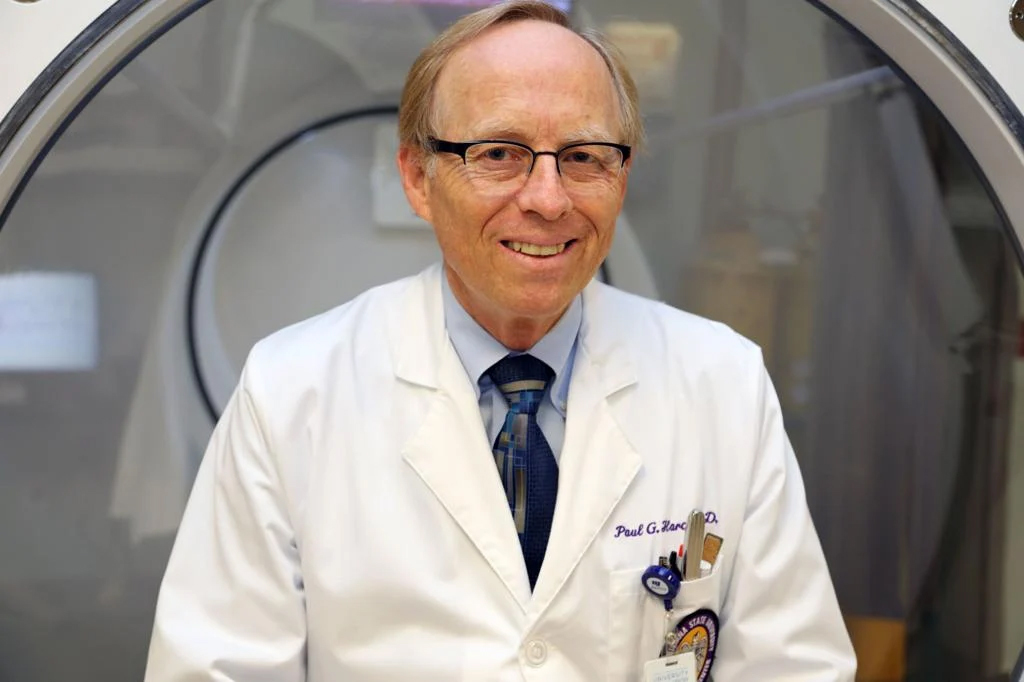
Dr. Paul G. Harch, MD
Dr. Harch initiated and continues to be a private practice that has resulted in the largest case experience in neurological hyperbaric medicine in the world. In this practice, he adapted the concepts of conventional hyperbaric oxygen therapy to wounds in the central nervous system, which spawned the subsequent academic and research practice. Harch HBOT is the best place to receive oxygen therapy treatments, and patients have traveled from more than 50 countries to be treated by Dr. Harch himself.
Harch HBOT – Hyperbaric Oxygen Therapy Clinic
5216 Lapalco Blvd.
Marrero, LA
504-309-4948
hbot@hbot.com
https://hbot.com/
Recent HBOT News
International Survey Regarding the Use of Rehabilitation Modalities in Horses.
Abstract: To define which biologic, electrophysical and other modalities are used in horses for injury or performance issues, a questionnaire regarding 38 modalities was distributed to eight veterinary groups. A total of 305 complete or partial responses were obtained...
Clinical Trial – Effects of Repetitive Hyperbaric Oxygen Therapy in Patients With Acute Ischaemic Stroke
Background and Rationale:
Cerebrovascular disease is always ranked at the top causes of death and most of hospitalized
acute stroke patients have ischemic stroke [1].
Although the mortality rate of acute ischemic stroke is less than that of hemorrhagic stroke
[1], it still results in patient disabilities and complications that often lead to
significant costs to individuals, families, and society.
Traditional treatment for acute ischemic stroke includes thrombolytic therapy by injecting
tissue plasminogen activator (t-PA) within three hours after onset of symptoms [2],
antiplatelets and/or anticoagulant agents administered within the first 48 hours. Clinically,
the narrow time window of thrombolytic therapy and coexisting contraindications limit the use
of t-PA [2]. Thus, searching for an effective supplemental treatment for acute ischemic
stroke is imperative.
Hyperbaric oxygen therapy (HBOT) is valuable in treating acute carbon monoxide poisoning
[3,4], air or gas embolism [5], facilitating wound healing [6] and has been used as an
adjuvant treatment for many neurological disorders that need further study as concussion [7]
, stroke [8,9], cerebral palsy [ 10],traumatic brain injury [ 11], cerebral air embolism
[12], Autism [13] and multiple sclerosis [14].
Indications of hyperbaric oxygen therapy recommended by undersea and hyperbaric medical
society (UHMS) [15] are 1.air or gas embolism [5], 2.carbon monoxide poisoning [3,4],
3.clostridial myositis and myonecrosis [16], 4.crush injury, compartment syndrome and other
acute traumatic ischemias [17], 5.decompression sickness [18], 6.arterial insufficiencies
[19], 7.severe anemia [20], 8.intracranial abscess [21], 9.necrotizing soft tissue infections
[22],10. refractory osteomyelitis [23], 11.delayed radiation injury [24], 12.compromised
grafts and flaps [25], 13.acute thermal burn injury [26] and 14.idiopathic sudden
sensorineural hearing loss [27].
Known mechanisms of HBOT-induced neuroprotection include enhancing neuronal viability via
increased tissue oxygen delivery to the area of diminished blood flow, reducing brain edema,
and improving metabolism after ischemia [28,29]. Furthermore, a recent study performed on a
rat suggested that upregulation of the expression of glial derived neurotrophic factor (GDNF)
and nerve growth factor (NGF) might underlie the effect of HBOT [30].
The effectiveness of use of Hyperbaric oxygen therapy in human ischemic stroke is still
controversial that need further evaluation.
Clinical Trial – Effect of Adjuvant Hyperbaric Oxygen Therapy on Bells Palsy Outcome
This is a randomized, single blinded, non-placebo controlled that will compare one group of
Bells Palsy patients receiving the current standard of care including oral corticosteroids
and oral antivirals against an experimental group receiving the current standard of care in
addition to hyperbaric oxygen therapy. Outcome assessment will be based on both objective
analyses of facial movements as well as subjective quality of life scales.