
HBOT Conversations:
Dr. Paul Harch & 8,101 Genes
He is the author of The Oxygen Revolution and is considered an International expert and pioneer in the field of Hyperbaric Oxygen Therapy (HBOT). His informative, and comprehensive guide on HBOT has helped countless souls better understand what HBOT is and how it directly affects the body at the genetic level.
This episode on 8,101 genes is the eighth in a nine episode series that will be released weekly with Dr. Harch.
Watch the Podcast
In episode 8 of 9, host Edward di Girolamo speaks with world renowned HBOT expert, Dr. Paul G. Harch, about aging and the 8,101 genes HBOT affects.
di Girolamo starts this conversation with Dr. Harch bringing up the 8,101 genes that are activated by Hyperbaric Oxygen Therapy. The discussion leads to talk of Big Pharma, telomeres, reparative gene process, patents, and successful business models for HBOT clinics.
Dr. Harch explains that Hyperbaric Oxygen Therapy affects 8,101 of our genes, and it’s doing so on a different level for the ones that are overactive and abnormal in the disease process. He speaks of a 2004 lecture he gave to A4M about the effects of HBOT on longevity; and asks, “Where is senescence and aging based?”, answering with, “It’s in our DNA”. Dr. Harch dives in to how HBOT turns on our genes to grow new tissue and stimulates cellular repair and regeneration. di Girolamo agrees and brings up a different past lecture from Dr. Harch where Harch referred to Hyperbaric Oxygen Therapy as the ‘Fountain of Youth‘.
This series ends with Dr. Harch discussing a Buffalo VA study, and how the study subjects (comprised of older veterans) literally came alive and started propositioning nurses after Hyperbaric Oxygen Therapy treatments. He explained this is why no follow-up study was ever done because they weren’t expecting such and didn’t know what to do. Makes sense…. studies have shown success in HBOT treating erectile dysfunction.
If you are searching for the Fountain of Youth and ready to activate 8,101 genes in your body —- find a Hyperbaric Oxygen Therapy clinic near you.
Subscribe Now, It’s Free!
Guest
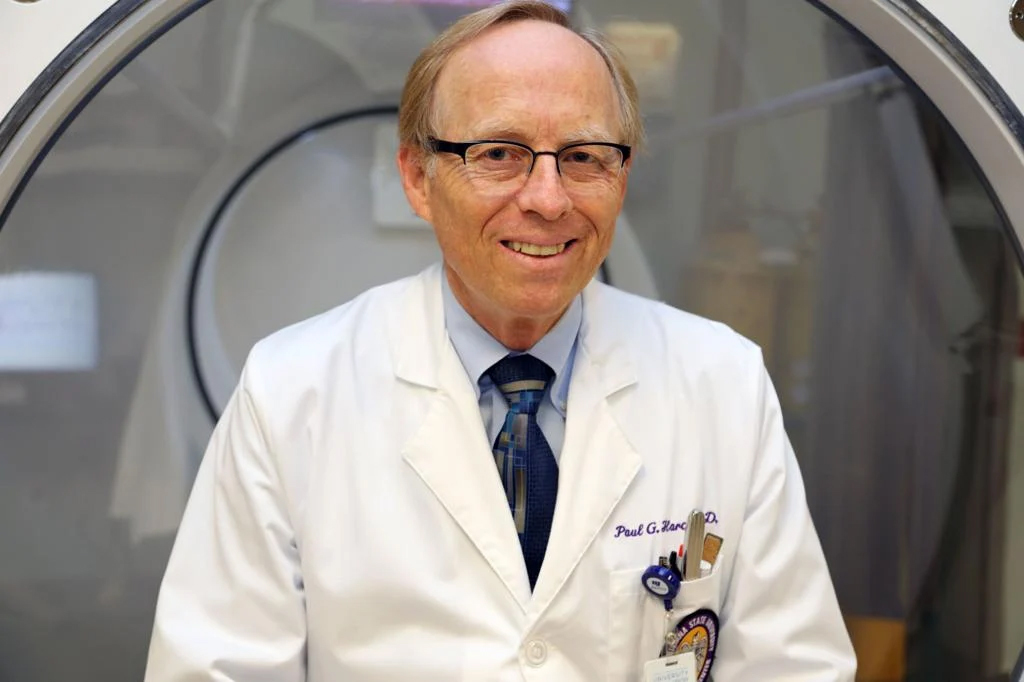
Dr. Paul G. Harch, MD
Dr. Harch initiated and continues to be a private practice that has resulted in the largest case experience in neurological hyperbaric medicine in the world. In this practice, he adapted the concepts of conventional hyperbaric oxygen therapy to wounds in the central nervous system, which spawned the subsequent academic and research practice. Harch HBOT is the best place to receive oxygen therapy treatments, and patients have traveled from more than 50 countries to be treated by Dr. Harch himself.
Harch HBOT – Hyperbaric Oxygen Therapy Clinic
5216 Lapalco Blvd.
Marrero, LA
504-309-4948
hbot@hbot.com
https://hbot.com/
Recent HBOT News
Clinical Trial – Comparative Study of the Analgesic Effect of Spinal Anesthesia or Infiltration Anesthesia for Hemorrhoidectomy
Background and Objectives: Postoperative analgesia and early recovery are relevant for
hospital discharge after hemorrhoidectomy. This study investigated the postoperative
analgesic effect with local infiltration compared with spinal block.
Methods: This randomized study included 40 patients aged 18 to 60 years old. Local group (LG)
received local infiltration under general anaesthesia; spinal group (SG) received a
subarachnoid block. LG received general anaesthesia with propofol, atracurium and propofol
infusion as well as a local infiltration of 20 ml 0.75% ropivacaine. SG received 2 ml of 0.5%
hyperbaric bupivacaine. Analgesic supplementation was with 50µg of fentanyl for LG and 1%
lidocaine for SG. There were assessed: postoperative pain intensity, sphincter relaxation,
motor blockade of lower limbs, time to discharge, analgesic dose over 1 week and adverse
effects.
Clinical Trial – Spinal Anesthesia Associated With General Anesthesia in Coronary Artery Bypass
CONTEXT: In patients eligible for coronary artery bypass surgery, anesthesia should provide a
number of conditions that exceed the limits of cardiovascular stability, myocardial
protection and other organs. Moreover, the combination of general anesthesia and spinal
anesthesia lessens the homeostatic, metabolic, hormonal and immunosuppressive changes. The
goal of this research was to evaluate the consumption of fentanyl citrate in intra-operative
in Coronary Artery Bypass Grafting (CABG) surgery with cardiopulmonary bypass under spinal
anesthesia associated with general anesthesia.
METHODS: Clinical, prospective, randomized and double covered study, approved by the Research
Ethics Committee. Fifty-six patients candidates for CABG with CPB, after signing the Terms of
consent, were randomized and divided into two groups: GI – General and GII – General +
subarachnoid. General anesthesia was induced according to the weight of each patient and
maintenance with isoflurane and fentanyl. Spinal anesthesia was induced with 20 mg of 0.5%
hyperbaric bupivacaine and 200 mcg of morphine, the patient is placed in cephalo-position
slope of 45 degrees for 10 minutes in Group II. In the statistical study was performed using
the Mann-Whitney test; the level of statistical significance was set at 5%.
Deep tissue biopsy vs. superficial swab culture, including microbial loading determination, in the microbiological assessment of Skin and Soft Tissue Infections (SSTIs).
Abstract: Thirty-two patients affected by SSTIs including DFIs were enrolled between 2013 and 2014. Superficial swab was obtained before and after cleansing with sterile saline, and after ultrasonic debridement; deep tissue biopsy was obtained from ulcer base. Samples...