
HBOT Conversations:
Dr. Paul Harch & 8,101 Genes
He is the author of The Oxygen Revolution and is considered an International expert and pioneer in the field of Hyperbaric Oxygen Therapy (HBOT). His informative, and comprehensive guide on HBOT has helped countless souls better understand what HBOT is and how it directly affects the body at the genetic level.
This episode on 8,101 genes is the eighth in a nine episode series that will be released weekly with Dr. Harch.
Watch the Podcast
In episode 8 of 9, host Edward di Girolamo speaks with world renowned HBOT expert, Dr. Paul G. Harch, about aging and the 8,101 genes HBOT affects.
di Girolamo starts this conversation with Dr. Harch bringing up the 8,101 genes that are activated by Hyperbaric Oxygen Therapy. The discussion leads to talk of Big Pharma, telomeres, reparative gene process, patents, and successful business models for HBOT clinics.
Dr. Harch explains that Hyperbaric Oxygen Therapy affects 8,101 of our genes, and it’s doing so on a different level for the ones that are overactive and abnormal in the disease process. He speaks of a 2004 lecture he gave to A4M about the effects of HBOT on longevity; and asks, “Where is senescence and aging based?”, answering with, “It’s in our DNA”. Dr. Harch dives in to how HBOT turns on our genes to grow new tissue and stimulates cellular repair and regeneration. di Girolamo agrees and brings up a different past lecture from Dr. Harch where Harch referred to Hyperbaric Oxygen Therapy as the ‘Fountain of Youth‘.
This series ends with Dr. Harch discussing a Buffalo VA study, and how the study subjects (comprised of older veterans) literally came alive and started propositioning nurses after Hyperbaric Oxygen Therapy treatments. He explained this is why no follow-up study was ever done because they weren’t expecting such and didn’t know what to do. Makes sense…. studies have shown success in HBOT treating erectile dysfunction.
If you are searching for the Fountain of Youth and ready to activate 8,101 genes in your body —- find a Hyperbaric Oxygen Therapy clinic near you.
Subscribe Now, It’s Free!
Guest
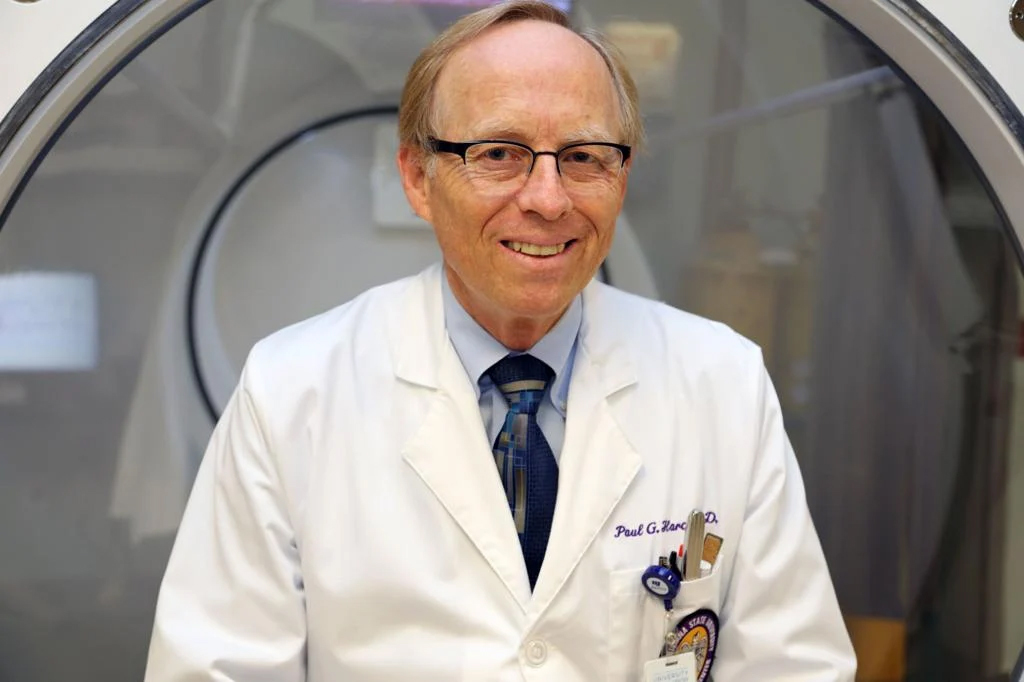
Dr. Paul G. Harch, MD
Dr. Harch initiated and continues to be a private practice that has resulted in the largest case experience in neurological hyperbaric medicine in the world. In this practice, he adapted the concepts of conventional hyperbaric oxygen therapy to wounds in the central nervous system, which spawned the subsequent academic and research practice. Harch HBOT is the best place to receive oxygen therapy treatments, and patients have traveled from more than 50 countries to be treated by Dr. Harch himself.
Harch HBOT – Hyperbaric Oxygen Therapy Clinic
5216 Lapalco Blvd.
Marrero, LA
504-309-4948
hbot@hbot.com
https://hbot.com/
Recent HBOT News
The wound/burn guidelines – 3: Guidelines for the diagnosis and treatment for diabetic ulcer/gangrene.
Abstract: We aimed to prepare guidelines for the management of diabetic ulcer/gangrene with emphasis on the diagnosis and treatment of skin symptoms. They serve as a tool to improve the quality of the diagnosis and treatment in each patient and, further, to improve...
Clinical Trial – HBOT Global Functioning After Stroke
Stroke is one of the leading causes of disability and death in North America and Europe. Up
to 30% of stroke survivors never recuperate completely and suffer from loss of function and
poor quality of life. To improve recovery after stroke, innovative interventions should be a
priority.
Hyperbaric oxygen therapy (HBOT) is an intermittent inhalation of 100% oxygen in a hyperbaric
chamber at a pressure higher than 1 absolute atmosphere (ATA). There is a growing body of
evidence that HBOT can enhance ability of brain to changes its structure (neuroplasticity) in
order to recover. Exercise program during HBOT can augment the effect. Although, recent
randomized controlled trials in patients with chronic brain injury showed promising results,
there are no studies demonstrating combine effect HBOT and exercise rehabilitation program on
stroke recovery.
The proposed study investigates feasibility, safety and efficacy of using a combination of
HBOT and exercise program to improve arm function recovery in chronic stroke patients. In
this pilot randomized control trial, investigators will compare the combination of HBOT and
the focused rehabilitation exercise program versus exercise program alone on recovery of arm
function in patients with chronic stroke.
Clinical Trial – Hyperbaric Oxygen Therapy and Acute Kidney Injury
Kidney injury is a serious complication of cardiac surgery that occurs in up to 30% of
patients and increases the risk of adverse outcomes. Kidney injury initiates when oxygen
supply to the kidney drops below levels that are needed for normal cellular function, causing
tissue oxygen deficiency (hypoxia), activation of the inflammatory cascade, and oxidative
stress. Together, these events further impair tissue oxygenation, culminating in impaired
kidney function due to cellular injury and death.
There are no effective therapies for kidney injury after cardiac surgery, but there is
evidence that recovery is possible if the processes of injury – i.e., impaired oxygen
delivery, increased inflammatory response, and oxidative stress – are ameliorated soon after
the onset of injury. Hyperbaric oxygen therapy (HBOT) – which entails the intermittent
inhalation of 100% oxygen in a hyperbaric chamber at a pressure higher than one absolute
atmosphere (> 760 mmHg) – has been shown to positively affect all of these processes (i.e.,
to improve tissue oxygenation, reduce inflammation, and reduce oxidative stress). Thus, we
hypothesized that HBOT will reduce the severity of kidney injury after cardiac surgery if it
is initiated soon after onset of injury. This hypothesis has not been tested in humans, but
is supported by animal studies.
In this first-in-human, unblinded, controlled pilot trial, 20 adult patients who develop
severe kidney injury soon after cardiac surgery will be randomized (after obtaining informed
consent from the patient or surrogate) to standard-of-care or early HBOT. Severe kidney
injury will be defined as a ≥30% drop in kidney function within 6 hours of surgery (as
determined by change in creatinine from before surgery to Intensive Care Unit (ICU)
admission). This degree of injury occurs in ~ 2% of patients and is associated with a 12-fold
increase in the risk of complete kidney failure (requiring dialysis) or death. Patients will
be excluded if they have any relative or absolute contraindications to HBOT (e.g., severe
ventricular dysfunction, ventricular assist device, severe respiratory dysfunction,
pneumothorax, bronchospasm).