
HBOT Conversations:
Dr. Paul Harch & 8,101 Genes
He is the author of The Oxygen Revolution and is considered an International expert and pioneer in the field of Hyperbaric Oxygen Therapy (HBOT). His informative, and comprehensive guide on HBOT has helped countless souls better understand what HBOT is and how it directly affects the body at the genetic level.
This episode on 8,101 genes is the eighth in a nine episode series that will be released weekly with Dr. Harch.
Watch the Podcast
In episode 8 of 9, host Edward di Girolamo speaks with world renowned HBOT expert, Dr. Paul G. Harch, about aging and the 8,101 genes HBOT affects.
di Girolamo starts this conversation with Dr. Harch bringing up the 8,101 genes that are activated by Hyperbaric Oxygen Therapy. The discussion leads to talk of Big Pharma, telomeres, reparative gene process, patents, and successful business models for HBOT clinics.
Dr. Harch explains that Hyperbaric Oxygen Therapy affects 8,101 of our genes, and it’s doing so on a different level for the ones that are overactive and abnormal in the disease process. He speaks of a 2004 lecture he gave to A4M about the effects of HBOT on longevity; and asks, “Where is senescence and aging based?”, answering with, “It’s in our DNA”. Dr. Harch dives in to how HBOT turns on our genes to grow new tissue and stimulates cellular repair and regeneration. di Girolamo agrees and brings up a different past lecture from Dr. Harch where Harch referred to Hyperbaric Oxygen Therapy as the ‘Fountain of Youth‘.
This series ends with Dr. Harch discussing a Buffalo VA study, and how the study subjects (comprised of older veterans) literally came alive and started propositioning nurses after Hyperbaric Oxygen Therapy treatments. He explained this is why no follow-up study was ever done because they weren’t expecting such and didn’t know what to do. Makes sense…. studies have shown success in HBOT treating erectile dysfunction.
If you are searching for the Fountain of Youth and ready to activate 8,101 genes in your body —- find a Hyperbaric Oxygen Therapy clinic near you.
Subscribe Now, It’s Free!
Guest
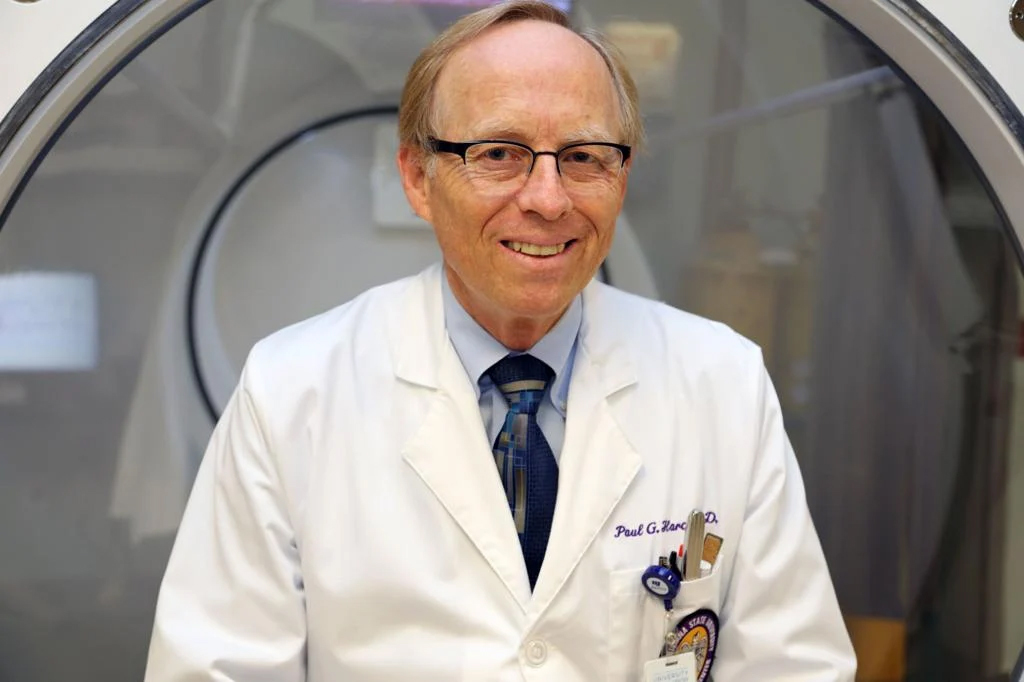
Dr. Paul G. Harch, MD
Dr. Harch initiated and continues to be a private practice that has resulted in the largest case experience in neurological hyperbaric medicine in the world. In this practice, he adapted the concepts of conventional hyperbaric oxygen therapy to wounds in the central nervous system, which spawned the subsequent academic and research practice. Harch HBOT is the best place to receive oxygen therapy treatments, and patients have traveled from more than 50 countries to be treated by Dr. Harch himself.
Harch HBOT – Hyperbaric Oxygen Therapy Clinic
5216 Lapalco Blvd.
Marrero, LA
504-309-4948
hbot@hbot.com
https://hbot.com/
Recent HBOT News
Clinical Trial – Hyperbaric Oxygen Therapy as Adjunctive Therapy to Scaling and Root-planing in the Management of Periodontitis in Patients With Type 2 Diabetes
Diabetes and Periodontitis are both prevalent diseases affecting millions of Americans.
Periodontitis is prevalent among Diabetics. Furthermore, Periodontitis and associated
inflammation can increase insulin resistance in Diabetics and worsens the condition.
Hyperbaric Oxygen Therapy (HBOT) has the potential to improve periodontal treatment outcome
in poorly controlled diabetics. The study will compare periodontal treatment (SRP) outcome
between 2 main diabetic type 2 patient groups receiving medical care treatment: either
Conventional Wound Therapies (CWC) with or without adjunctive Hyperbaric Oxygen Therapy at
LLU Health.
24 poorly controlled diabetic mellitus (DM) type 2 subjects (HbA1c =>7%) with Periodontitis
will be assigned into the study arms HBO therapy and Non HBO therapy, based on their medical
needs.
For all subjects demographic data (age, gender, ethnicity, smoking history, alcohol use
history, BMI, current medication list) and oral health habits will be obtained. Blood samples
for HbA1c determinations, clinical periodontal measurements (plaque index, probing
measurements including pocket depth, attachment levels, gingival index and
bleeding-on-probing) and subgingival microbial samples will be obtained at baseline and end
of the study. Subgingival microbial samples will be collected from three randomly selected
sites and analyzed for detection of about 300 of the most prevalent oral bacterial species.
Differences in periodontal clinical outcomes and bacterial profiles will be identified
utilizing ANCOVA (Analysis of Covariance).
Reinforcement of the bactericidal effect of ciprofloxacin on Pseudomonas aeruginosa biofilm by hyperbaric oxygen treatment.
Chronic Pseudomonas aeruginosa lung infection is the most severe complication in cystic fibrosis patients. It is characterised by antibiotic-tolerant biofilms in the endobronchial mucus with zones of oxygen (O2) depletion mainly due to polymorphonuclear leucocyte activity. Whilst the exact mechanisms affecting antibiotic effectiveness on biofilms remain unclear, accumulating evidence suggests that the efficacy of several bactericidal antibiotics such as ciprofloxacin is enhanced by stimulation of the aerobic respiration of pathogens, and that lack of O2 increases their tolerance. Reoxygenation of O2-depleted biofilms may thus improve susceptibility to ciprofloxacin possibly by restoring aerobic respiration.
The Efficacy of Hyperbaric Oxygen Therapy on Middle Cerebral Artery Occlusion in Animal Studies: A Meta-Analysis.
Abstract: Inconsistent results have been reported for hyperbaric oxygen therapy (HBO) for acute stroke. We conducted a systematic review and meta-analysis to evaluate the benefit of HBO in animal studies of middle cerebral artery occlusion (MCAO). A systematic search...