
HBOT Conversations:
Dr. Paul Harch & Autism
Dr. Paul G. Harch, M.D. has used hyperbaric oxygen therapy to treat more than 100 different conditions, including stroke, dementia, autism, and traumatic brain injury. His goal is to help his patients get their lives back using hyperbaric oxygen therapy.
He is the author of The Oxygen Revolution and is considered an International expert and pioneer in the field of Hyperbaric Oxygen Therapy (HBOT). His informative, and comprehensive guide on HBOT has helped countless souls better understand what HBOT is and how it directly affects the body at the genetic level.
This episode on Autism is the seventh in a nine episode series that will be released weekly with Dr. Harch.
Watch the Podcast
In episode 7 of 9, host Edward di Girolamo speaks with world renowned HBOT expert, Dr. Paul G. Harch about Autism.
The percentage of children with Autism is increasing at an alarming rate. In order to successfully treat Autism and navigate around the roadblocks, Dr. Harch explains that it’s important to understand that Autism is not a psychiatric diagnosis. Autism is a wounding condition of the brain, without all of the potential contributors being identified to the wounding process.
Dr. Harch was the first to treat a series of children with Autism using Hyperbaric Oxygen Therapy; a therapy which in and of itself is neuroplastic (it is a neuroplast — affecting neuroplasticity). He states that there’s a plethora of information on the fact that Autism is a physical brain abnormality, and that’s what’s causing this Autism phenomenon. Functional imaging scans that have been done on these Autistic children shows 90% of them have a problem involving primarily the temporal lobes and frontal lobes; mostly temporal lobes. Dr. Harch has treated a good series of these children with Hyperbaric Oxygen Therapy and about 80% of them will respond to the treatment. There are various causes, which may explain why 100% don’t respond to HBOT, since there are different insults to the brains and/or it’s environmental. But, Dr. Harch stresses that there’s no such thing as a genetic epidemic, so this Autism epidemic we’re seeing must either be caused by environmental factors or infectious agents.
Dr. Harch affirms that the underlying nature of Autism is that there’s a dominant immune dysfunction in these children that often manifests in the GI tract, but also in the brain. Dr. Harch recommends our viewers read this beautiful article by Dr. Dan Rossignol, a Family Practice Physician with two autistic sons. In the article Dr. Rossignol reviews all of the pathophysiology — the disease processes — that have been identified in Autistic children, and he reviews all of the science of Hyperbaric Oxygen Therapy and the effect it has on all of those disease processes. In the end, HBOT is shown to be a good match for the treatment of Autism.
di Girolamo asks Dr. Harch if Autism appears to be an inflammatory issue, with Dr. Harch agreeing that it does seem to appear that way. Dr. Harch went on to explain that of the 8,1001 genes that have been shown to be affected in human cells by a single Hyperbaric Oxygen exposure, the largest clusters involved are the anti-inflammatory genes — upregulation is turned on and there’s suppression of the pro-inflammatory genes. Plus, there are many genes that are activated within the immune system which also supports the use of HBOT for the treatment of Autism as a dominant immune dysfunction.
The studies have been controversial and complicated on Hyperbaric Oxygen Therapy for Autism. But contrary to the results of these studies, Dr. Harch is here to say that the proof is in the imaging. He has imaging revealing that after only one treatment — sometimes it’s a series of treatments — changes are seen in these children’s brains, and there’s improvement in profusion (such as in the temporal lobes).
Dr. Harch professes that what he’s been trying to do all these years, these decades, is to answer a simple question, “Does Hyperbaric Oxygen Therapy work for your condition or not?” He explains it’s critical to start with HBOT solely and not throw a bunch of other therapies into the mix because then you have too many variables, and you won’t know exactly what’s helping and what’s not. He explains Hyperbaric Oxygen Therapy is a foundation biological therapy, and declares there is no identified therapy out there that can do what Hyperbaric Oxygen can do; including activating 40% of our genome. There’s nothing.
Dr. Harch references Chapter 12 of his book, The Oxygen Revolution, and says “I’m sorry but if your doctor is giving you negative information, flatly ignore him! Go get this therapy for your child!” Treating with HBOT is no different than if you dosed the child with a drug, or a drug combination. This is a two component drug we’re dosing with that’s safe and effective — pressure and oxygen. We encourage you to try it, because it could change your life if you or your child are a part of this 80% success rate.
Subscribe Now, It’s Free!
Guest
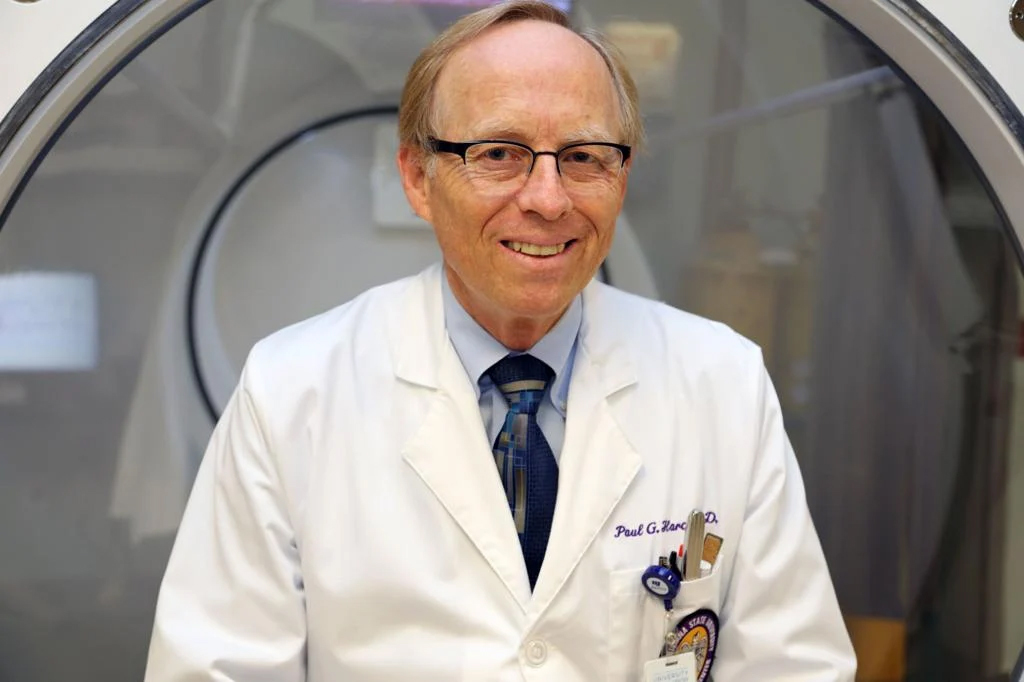
Dr. Paul G. Harch, MD
Dr. Harch initiated and continues to be a private practice that has resulted in the largest case experience in neurological hyperbaric medicine in the world. In this practice, he adapted the concepts of conventional hyperbaric oxygen therapy to wounds in the central nervous system, which spawned the subsequent academic and research practice. Harch HBOT is the best place to receive oxygen therapy treatments, and patients have traveled from more than 50 countries to be treated by Dr. Harch himself.
Harch HBOT – Hyperbaric Oxygen Therapy Clinic
5216 Lapalco Blvd.
Marrero, LA
504-309-4948
hbot@hbot.com
https://hbot.com/
Recent HBOT News
Clinical Trial – Quality of Recovery After General or Spinal Anesthesia for Inguinal Hernia Repair
Different anesthetic techniques have been proposed for carrying out Inguinal hernia repair,
including local anesthesia, regional and general. There are no recent data on the application
of a validated questionnaire to assess which anesthetic technique, local infiltration under
general anesthesia or spinal anesthesia, would provide better quality of recovery in the
opinion of the patients undergoing inguinal hernia repair. The aim of the study is to perform
a randomized clinical trial comparing the quality of recovery (QoR-40) after local
infiltration under general anesthesia via laryngeal mask (LMA) or spinal anesthesia for
unilateral inguinal hernia repair. METHODS – Seventy patients aged 18 to 65 years old, who
were scheduled to undergo unilateral inguinal hernia repair at Santa Lucinda Hospital will be
enrolled in the study. The anesthesia will be performed according to the following sequence:
L Group – intravenous (I.V.) propofol and alfentanyl, followed by LMA positioning. The
anesthesia will be maintained by propofol. For local anesthesia, approximately 50 ml of 0.5%
ropivacaine will be infiltrated along the line of incision in the subcutaneous plane,
followed by peripheral nerve block technique (e.g., ilioinguinal-hypogastric nerve block) and
local wound infiltration at the fascial level. S Group – spinal puncture followed by
intrathecal 15 mg of 0.5% hyperbaric bupivacaine injection and sedation with propofol by
continuous infusion. Pain will be assessed every 15 minutes at Post-anesthesia Care Unit
(PACU) using a 0-10 numeric pain rating scale and I.V. morphine will be administered to
maintain the pain score below 4. The QoR-40 will be administered by a blind investigator 24
hours after surgery.
Clinical Trial – Fascia Iliaca Compartment Block for Proximal-end Femur Fractures
Fracture femur is a common injury which is associated with excruciating pain. Positioning for
neuraxial blocks is always challenging because even slight overriding of the fracture ends is
intensely painful .It can causing major patient distress which accompanied by well-known
physiological sequelae such as sympathetic activation causing tachycardia, hypotension, and
increased cardiac work that may compromise high-risk cardiac patients.
Fascia iliaca compartment block is highly effective in blocking lateral cutaneous nerve of
the thigh and femoral nerve. Fascia iliaca compartment block is not only easy to perform but
it is also associated with minimal risk as the local anesthetic is injected at a safe
distance from the femoral artery and femoral nerve. It is always safe to perform the fascia
iliaca compartment block prior to spinal anesthesia as the patient can respond during
administration of the local anesthetic and can prevent intra-neuronal injections
MicroRNA-148b is a potential prognostic biomarker and predictor of response to radiotherapy in non-small-cell lung cancer.
Abstract: miR-148b has been found to be aberrantly expressed in various tumor types. It has recently been reported to be involved in regulating radioresistance in non-small cell lung cancer (NSCLC) cells. However, its expression level and association with...