
HBOT Conversations:
Dr. Paul Harch & Autism
Dr. Paul G. Harch, M.D. has used hyperbaric oxygen therapy to treat more than 100 different conditions, including stroke, dementia, autism, and traumatic brain injury. His goal is to help his patients get their lives back using hyperbaric oxygen therapy.
He is the author of The Oxygen Revolution and is considered an International expert and pioneer in the field of Hyperbaric Oxygen Therapy (HBOT). His informative, and comprehensive guide on HBOT has helped countless souls better understand what HBOT is and how it directly affects the body at the genetic level.
This episode on Autism is the seventh in a nine episode series that will be released weekly with Dr. Harch.
Watch the Podcast
In episode 7 of 9, host Edward di Girolamo speaks with world renowned HBOT expert, Dr. Paul G. Harch about Autism.
The percentage of children with Autism is increasing at an alarming rate. In order to successfully treat Autism and navigate around the roadblocks, Dr. Harch explains that it’s important to understand that Autism is not a psychiatric diagnosis. Autism is a wounding condition of the brain, without all of the potential contributors being identified to the wounding process.
Dr. Harch was the first to treat a series of children with Autism using Hyperbaric Oxygen Therapy; a therapy which in and of itself is neuroplastic (it is a neuroplast — affecting neuroplasticity). He states that there’s a plethora of information on the fact that Autism is a physical brain abnormality, and that’s what’s causing this Autism phenomenon. Functional imaging scans that have been done on these Autistic children shows 90% of them have a problem involving primarily the temporal lobes and frontal lobes; mostly temporal lobes. Dr. Harch has treated a good series of these children with Hyperbaric Oxygen Therapy and about 80% of them will respond to the treatment. There are various causes, which may explain why 100% don’t respond to HBOT, since there are different insults to the brains and/or it’s environmental. But, Dr. Harch stresses that there’s no such thing as a genetic epidemic, so this Autism epidemic we’re seeing must either be caused by environmental factors or infectious agents.
Dr. Harch affirms that the underlying nature of Autism is that there’s a dominant immune dysfunction in these children that often manifests in the GI tract, but also in the brain. Dr. Harch recommends our viewers read this beautiful article by Dr. Dan Rossignol, a Family Practice Physician with two autistic sons. In the article Dr. Rossignol reviews all of the pathophysiology — the disease processes — that have been identified in Autistic children, and he reviews all of the science of Hyperbaric Oxygen Therapy and the effect it has on all of those disease processes. In the end, HBOT is shown to be a good match for the treatment of Autism.
di Girolamo asks Dr. Harch if Autism appears to be an inflammatory issue, with Dr. Harch agreeing that it does seem to appear that way. Dr. Harch went on to explain that of the 8,1001 genes that have been shown to be affected in human cells by a single Hyperbaric Oxygen exposure, the largest clusters involved are the anti-inflammatory genes — upregulation is turned on and there’s suppression of the pro-inflammatory genes. Plus, there are many genes that are activated within the immune system which also supports the use of HBOT for the treatment of Autism as a dominant immune dysfunction.
The studies have been controversial and complicated on Hyperbaric Oxygen Therapy for Autism. But contrary to the results of these studies, Dr. Harch is here to say that the proof is in the imaging. He has imaging revealing that after only one treatment — sometimes it’s a series of treatments — changes are seen in these children’s brains, and there’s improvement in profusion (such as in the temporal lobes).
Dr. Harch professes that what he’s been trying to do all these years, these decades, is to answer a simple question, “Does Hyperbaric Oxygen Therapy work for your condition or not?” He explains it’s critical to start with HBOT solely and not throw a bunch of other therapies into the mix because then you have too many variables, and you won’t know exactly what’s helping and what’s not. He explains Hyperbaric Oxygen Therapy is a foundation biological therapy, and declares there is no identified therapy out there that can do what Hyperbaric Oxygen can do; including activating 40% of our genome. There’s nothing.
Dr. Harch references Chapter 12 of his book, The Oxygen Revolution, and says “I’m sorry but if your doctor is giving you negative information, flatly ignore him! Go get this therapy for your child!” Treating with HBOT is no different than if you dosed the child with a drug, or a drug combination. This is a two component drug we’re dosing with that’s safe and effective — pressure and oxygen. We encourage you to try it, because it could change your life if you or your child are a part of this 80% success rate.
Subscribe Now, It’s Free!
Guest
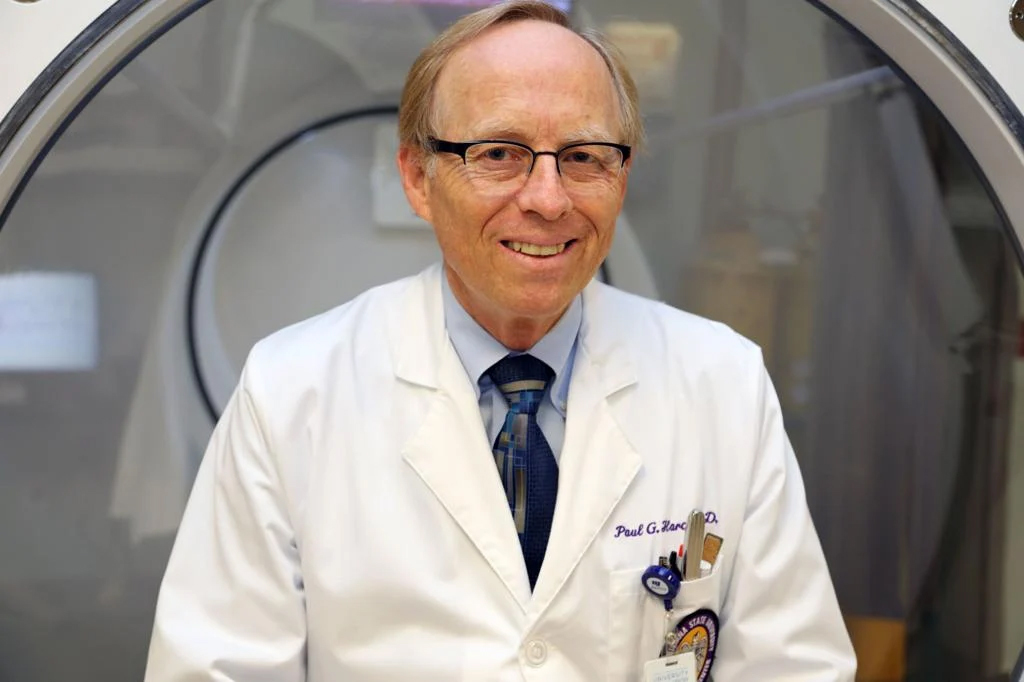
Dr. Paul G. Harch, MD
Dr. Harch initiated and continues to be a private practice that has resulted in the largest case experience in neurological hyperbaric medicine in the world. In this practice, he adapted the concepts of conventional hyperbaric oxygen therapy to wounds in the central nervous system, which spawned the subsequent academic and research practice. Harch HBOT is the best place to receive oxygen therapy treatments, and patients have traveled from more than 50 countries to be treated by Dr. Harch himself.
Harch HBOT – Hyperbaric Oxygen Therapy Clinic
5216 Lapalco Blvd.
Marrero, LA
504-309-4948
hbot@hbot.com
https://hbot.com/
Recent HBOT News
Orbital implant placement using a computer-aided design and manufacturing (CAD/CAM) stereolithographic surgical template protocol.
Abstract: Surgical implant placement in the orbital region for the support of a prosthesis is challenging due to the thin orbital rim and proximity to vital structures. This article reports the use of a computer-aided design and manufacturing (CAD/CAM)...
Clinical Trial – Haemodynamic Effects During Anorectal Surgery: a Comparison of the Jack -Knife and Lithotomy Position
Background and Goal of Study: Minimal dose of spinal hyperbaric bupivacaine is commonly
performed for adult anorectal surgery. This kind of anaesthesia can cause sinus bradycardia
and hypotension wich reason is body position, autonomic nervus system reaction, reflex
reaction even with low levels of sensory block. However, neither the publication of minimal
doses of spinal hyperbaric bupivacaine effects of haemodynamic modifications nor their
accuracy was widely discussed. The aim of the study is to make a comparison of the
haemodynamic modifications due to minimal dose of spinal hyperbaric bupivacaine for adult
anorectal surgery in lithotomy or jack knife position of steering impedance device.
Materials and Methods: Patients will be included which are over then 18 years old, who
underwent anorectal surgery of the benign pathology, requiring spinal anaesthesia, were
admitted in this clinical randomized study, hospitalized in Hospital of Lithuanian University
of Health Sciences Kaunas Clinics and agree to participate to this study (written
settlement). All patients were implicitly divided in to 4 groups by the position will be
operating (lithotomy or jack knife position and by American Society of Anaesthesiologists
(ASA) clas I-II and III-IV). Technique of anaesthesia were strictly standardized by protocol.
All patients were premedicated with oral diazepam 5mg and diclofenac 100mg 60min before
operation. After arrival in the operating theater peripheral vein 18 or 20G catheter was
inserted, infusion therapy were started with crystalloid 5-7ml/kg/hour. Standard monitoring
was used, including noninvasive arterial blood pressure (BP), electrocardiography (ECG),
heart rate, peripheral oxygenation. Circulatory changes were recorded impedance device. 2
single-neck sensors connected vertically on both sides of the neck just below the ears lobe.
Another pair of sensors attached on both sides of the chest processus xiphoid axillary line
level. Thorax allows a variable electrical current, it travels through the lowest resistance
(blood-filled aorta) and resistance is measured. For each heart contraction during changes in
blood volume and velocity. Accordingly, replacing the resistors obtained by impedance
settings.
Haemodynamic variables were recorded in patients in the use of impedance cardiograph:
1. arrives in the operating room;
2. seating on the operating table;
3. following the puncture;
4. 10 min after spinal puncture;
5. was laid in lithotomy or jack knife position;
6. in the beginning and the end of the operation;
7. patient was placed in the bed.
Each measurement was monitoring and recorded the following data( ar findings):
– Cardiac output (CO);
– Systemic vascular resistance (SVR);
– Systolic index (SI)
– Cardiac index (CI);
– Acceleration index (ACI);
– Heart rate (HR);
– Non-invasive systolic (SAP), diastolic (DAP) and mean (MAP) blood pressure;
– Peripheral oxygenation (SpO2); Patients were placed in the sitting position on the slab
(operating table) back to the doctor. Dural puncture was made at L3-L4 or L4-L5 with 27G
Tamanho spinal needle ( BBraun, Germany) by medial punction in aseptic condition, before
the punction was injected lidocaine 1% subcutaneous. 0.5% 4mg of heavy bupivacaine and
0.01% 10µg fentanyl were injected over 2 minutes after free flow of cerebrospinal fluid
was obtained. After sitting for 10 minutes ( sensory block was checked by the dermatomes
with the methods of cold sensitivity) patients were asked to lie in the position wich
operation will be done (lithotomy or jack knife position).
After 20 min. surgery was started. When anaesthesia was imperfect, 25-100µg of fentanyl was
given IV. General anaesthesia will be give in case of failure . These cases will be value
like a failure, patients will be exclude from the study.
Clinically significant hypotension will be define as a mean arterial blood pressure and heart
rate decrease of 20% below baseline values. Systolic arterial blood pressure will reduce to
90mmHG limit, intravenous ephedrine 5-10 mg will be injected. If heart rate will reduce to 45
bpm, bradycardia will be treated with atropine 0,5 mg IV.
Combined free tissue transfer for the management of composite Achilles defects: functional outcomes and patient satisfaction following thigh-based vascularized reconstruction with a neotendon construct.
Abstract: Functional outcomes and quality-of-life measures following salvage reconstruction of composite Achilles/posterior leg defects are limited. We present our experience with combined Achilles defect reconstruction utilizing free tissue transfer with...