
HBOT Conversations:
Dr. Paul Harch & Autism
Dr. Paul G. Harch, M.D. has used hyperbaric oxygen therapy to treat more than 100 different conditions, including stroke, dementia, autism, and traumatic brain injury. His goal is to help his patients get their lives back using hyperbaric oxygen therapy.
He is the author of The Oxygen Revolution and is considered an International expert and pioneer in the field of Hyperbaric Oxygen Therapy (HBOT). His informative, and comprehensive guide on HBOT has helped countless souls better understand what HBOT is and how it directly affects the body at the genetic level.
This episode on Autism is the seventh in a nine episode series that will be released weekly with Dr. Harch.
Watch the Podcast
In episode 7 of 9, host Edward di Girolamo speaks with world renowned HBOT expert, Dr. Paul G. Harch about Autism.
The percentage of children with Autism is increasing at an alarming rate. In order to successfully treat Autism and navigate around the roadblocks, Dr. Harch explains that it’s important to understand that Autism is not a psychiatric diagnosis. Autism is a wounding condition of the brain, without all of the potential contributors being identified to the wounding process.
Dr. Harch was the first to treat a series of children with Autism using Hyperbaric Oxygen Therapy; a therapy which in and of itself is neuroplastic (it is a neuroplast — affecting neuroplasticity). He states that there’s a plethora of information on the fact that Autism is a physical brain abnormality, and that’s what’s causing this Autism phenomenon. Functional imaging scans that have been done on these Autistic children shows 90% of them have a problem involving primarily the temporal lobes and frontal lobes; mostly temporal lobes. Dr. Harch has treated a good series of these children with Hyperbaric Oxygen Therapy and about 80% of them will respond to the treatment. There are various causes, which may explain why 100% don’t respond to HBOT, since there are different insults to the brains and/or it’s environmental. But, Dr. Harch stresses that there’s no such thing as a genetic epidemic, so this Autism epidemic we’re seeing must either be caused by environmental factors or infectious agents.
Dr. Harch affirms that the underlying nature of Autism is that there’s a dominant immune dysfunction in these children that often manifests in the GI tract, but also in the brain. Dr. Harch recommends our viewers read this beautiful article by Dr. Dan Rossignol, a Family Practice Physician with two autistic sons. In the article Dr. Rossignol reviews all of the pathophysiology — the disease processes — that have been identified in Autistic children, and he reviews all of the science of Hyperbaric Oxygen Therapy and the effect it has on all of those disease processes. In the end, HBOT is shown to be a good match for the treatment of Autism.
di Girolamo asks Dr. Harch if Autism appears to be an inflammatory issue, with Dr. Harch agreeing that it does seem to appear that way. Dr. Harch went on to explain that of the 8,1001 genes that have been shown to be affected in human cells by a single Hyperbaric Oxygen exposure, the largest clusters involved are the anti-inflammatory genes — upregulation is turned on and there’s suppression of the pro-inflammatory genes. Plus, there are many genes that are activated within the immune system which also supports the use of HBOT for the treatment of Autism as a dominant immune dysfunction.
The studies have been controversial and complicated on Hyperbaric Oxygen Therapy for Autism. But contrary to the results of these studies, Dr. Harch is here to say that the proof is in the imaging. He has imaging revealing that after only one treatment — sometimes it’s a series of treatments — changes are seen in these children’s brains, and there’s improvement in profusion (such as in the temporal lobes).
Dr. Harch professes that what he’s been trying to do all these years, these decades, is to answer a simple question, “Does Hyperbaric Oxygen Therapy work for your condition or not?” He explains it’s critical to start with HBOT solely and not throw a bunch of other therapies into the mix because then you have too many variables, and you won’t know exactly what’s helping and what’s not. He explains Hyperbaric Oxygen Therapy is a foundation biological therapy, and declares there is no identified therapy out there that can do what Hyperbaric Oxygen can do; including activating 40% of our genome. There’s nothing.
Dr. Harch references Chapter 12 of his book, The Oxygen Revolution, and says “I’m sorry but if your doctor is giving you negative information, flatly ignore him! Go get this therapy for your child!” Treating with HBOT is no different than if you dosed the child with a drug, or a drug combination. This is a two component drug we’re dosing with that’s safe and effective — pressure and oxygen. We encourage you to try it, because it could change your life if you or your child are a part of this 80% success rate.
Subscribe Now, It’s Free!
Guest
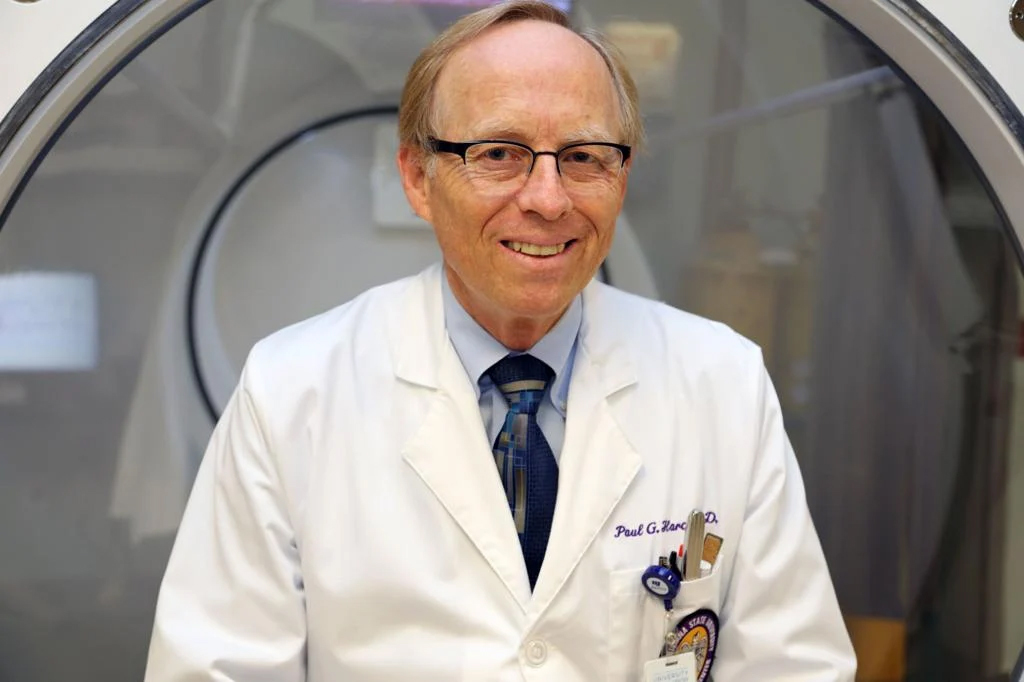
Dr. Paul G. Harch, MD
Dr. Harch initiated and continues to be a private practice that has resulted in the largest case experience in neurological hyperbaric medicine in the world. In this practice, he adapted the concepts of conventional hyperbaric oxygen therapy to wounds in the central nervous system, which spawned the subsequent academic and research practice. Harch HBOT is the best place to receive oxygen therapy treatments, and patients have traveled from more than 50 countries to be treated by Dr. Harch himself.
Harch HBOT – Hyperbaric Oxygen Therapy Clinic
5216 Lapalco Blvd.
Marrero, LA
504-309-4948
hbot@hbot.com
https://hbot.com/
Recent HBOT News
Clinical Trial – Pilot Study Exploring the Use of Hyperbaric Oxygen in Autologous Peripheral Blood Stem Cell Transplantation
By doing this study, researchers hope to learn the following:
– The safety of hyperbaric oxygen administration in the setting of the autologous
transplant
– The effects of hyperbaric oxygen administration on neutrophil count recovery and
engraftment
Evaluation of hyperbaric oxygen therapy for chronic wounds.
Abstract: Treating chronic wounds is challenging. Despite standard wound care, some chronic wounds fail to heal. Therefore, hyperbaric oxygen therapy (HBOT) was developed as an adjunct to standard wound care. To evaluate the efficacy of HBOT for treating chronic...
Clinical Trial – Hyperbaric Oxygen Therapy for Mild Cognitive Impairment
Dementia is a very frequent cognitive disorder among elderly individuals. Its prevalence is
about 15-20% of the population over the age of 65. The most common forms of dementia among
the elderly demented patients are Alzheimer’s disease (AD) (prevalence of 70%) and Vascular
dementia (VD) (prevalence of about 30-40%).There is also a high rate (about 40%) of
coexisting of AD and VD among the dementia patients, defined as mixed dementia.
Mild Cognitive Impairment (MCI) is a pre-dementia phase of cognitive decline. It is also
considered as a prodromal phase of both VD and AD. Its basic clinical features include:
cognitive concern, reflecting a change in cognition, reported by the patient or informant
(i.e., historical or observed evidence of decline over time), with objective evidence of
impairment in one or more cognitive domains (i.e., by formal cognitive testing), as well as
preservation of independence in functional abilities and not being demented (i.e., no
significant impairment social or occupational functioning).
Hyperbaric oxygen therapy (HBOT) has been investigated for treatment of numerous diseases for
more than 300 years. The principal effect of HBOT is increasing the solubility of oxygen in
plasma to a level sufficient to support tissues with minimal oxygen supply carried on by
hemoglobin. Clinical studies published this year present convincing evidence that hyperbaric
oxygen therapy (HBOT) can be the coveted neurotherapeutic method for brain repair. Thus, it
seems that HBOT might be an efficient and clinically feasible method capable of increasing
tissue/cellular oxygenation and effectively evoking neuroplasticity in the chronically
vascular-lesioned areas during the post microvascular lesion phase.
This is a prospective, randomized, control crossed over, study evaluating the effect of HBOT
in patients suffering from Mild Cognitive Impairment and Vascular Subcortical Ischemia.