
HBOT Conversations:
Dr. Paul Harch & Birth Injuries/ Cerebral Palsy
Dr. Paul G. Harch, M.D. has used hyperbaric oxygen therapy to treat more than 100 different conditions, including stroke, dementia, autism, and traumatic brain injury. His goal is to help his patients get their lives back using hyperbaric oxygen therapy.
He is the author of The Oxygen Revolution and is considered an International expert and pioneer in the field of Hyperbaric Oxygen Therapy (HBOT). His informative, and comprehensive guide on HBOT has helped countless souls better understand what HBOT is and how it directly affects the body at the genetic level.
This episode on birth injuries with a strong focus on Cerebral Palsy (CP) is the fifth in a nine episode series that will be released weekly with Dr. Harch.
Watch the Podcast
In episode 5 of 9, host Edward di Girolamo speaks with world renowned HBOT expert, Dr. Paul G. Harch about birth injuries and Cerebral Palsy (Chapter 5 of his book, The Oxygen Revolution).
In Dr. Harch’s book he describes the trip down the birth canal as one of the most high-risk journeys any human will ever make. Dr. Harch educates us on how traumatic birth experiences can trigger Cerebral Palsy diagnoses in young infants, and how premature babies are at great risk for Cerebral Palsy since they are born with the center of the brain undeveloped, still very fragile and prone to spontaneous bleeding.
Every day desperate parents around the world seek alternative healing therapies for their children with cerebral palsy. Dr. Harch dives deep into the use of Hyperbaric Oxygen Therapy (HBOT) for the treatment of Cerebral Palsy and other neurological birth disorders, and explains the reasons why parents should embrace this therapy. Essentially, Dr. Harch describes Cerebral Palsy as a wound to the brain, so it should respond to Hyperbaric Oxygen Therapy the same way as other brain injuries. He confers that it absolutely does.
Dr. Harch reveals success stories of CP children who have had found hope and new life from Hyperbarics. In response to these stories and hearing that it works to heal and ease life-long debilitating CP symptoms, di Girolamo wants to know why more parents aren’t seeking out HBOT to help their cerebral palsy children? Harch relays that there’s too much inconsistent medical literature out there, and in many ways it’s just plain wrong. For example, a parent asks their doctor, “How about HBOT to treat Cerebral Palsy?”— the doctor might be unfamiliar with the therapy, so he/she checks the online medical database for HBOT and CP. Unfortunately this doctor will likely find some skewed data, leading the doctor to respond with “so….. I don’t think it’ll help”. Although, as Dr. Harch explains, the exact opposite is what’s true; HBOT absolutely helps CP patients.
One example given is that a well respected peer-reviewed medical journal, The Lancet, published medical literature on HBOT and CP announcing there was no proven benefit to use Hyperbaric Oxygen Therapy to treat Cerebral Palsy. But, the inconsistency there was that the control group was defined as a placebo, and that was not right. In response, Dr. Pierre Marois and his team, released a retrospective study on HBOT in the treatment of Cerebral Palsy that showed studies and numerous reports demonstrating the positive effects of Hyperbaric Oxygen Therapy (HBOT) in children with Cerebral Palsy.
Dr. Harch suggests our viewers dive into his 2021 presentation at the Team Luke3 Hope for Minds pediatric brain injury conference. Dr. Harch provided a summarization of all of the science showing that Hyperbaric Oxygen Therapy had extremely positive effects on every stage of the stem cell process. Additionally, Dr. Proefrock’s presentation from the same conference, “Current Trends in Naturopathic Treatment of Pediatric Neurological Injury” reveals stem cell data for children in the midst of HBOT treatment; showing that the children who have had Hyperbaric treatments produced 4x the amount of stem cells compared to those who did not.
Dr. Harch explains the roadblock for using Hyperbaric Oxygen for treatment of CP is still extremely difficult to get around, and he references the 2012 article by Novak and Badawai, Last breath: effectiveness of hyperbaric oxygen treatment for Cerebral Palsy as an example. In this article, they concluded that “Hyperbaric Oxygen does not have a clinically important effect on gross motor and self-care function in children with Cerebral Palsy.” Dr. Harch clarifies why they were wrong on the science, and how information like that is what’s preventing the average medical doctor to recommend HBOT for Cerebral Palsy.
di Girolamo and Dr. Harch urges viewers to find out for themselves if HBOT could be a good therapy for them or their loved one(s) living with CP. If you would like to dive into the world of Hyperbaric Oxygen Therapy for the treatment of Cerebral Palsy, HBOT News encourages you to find a licensed Hyperbaric Oxygen Therapy facility with hard mono-chambers or hard multi-place chambers, and act on this responsibly. Just like anything in the world of modern medicine, you can be injured or do more harm than good if HBOT is not administered correctly.
All of the data and success stories Dr. Harch reveals paints a much different picture than what the medical industry is showing us. Go try Hyperbaric Oxygen Therapy sooner than later to treat, heal, and ease the symptoms of Cerebral Palsy. We trust that HBOT can also change your life!
Subscribe Now, It’s Free !
Guest
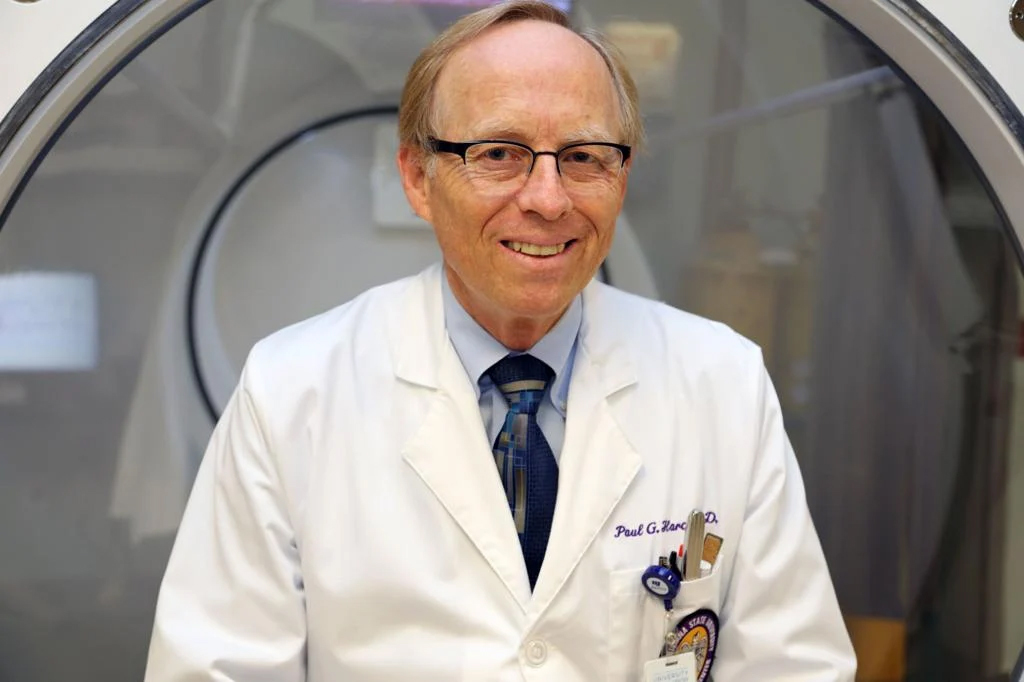
Dr. Paul G. Harch, MD
Dr. Harch initiated and continues to be a private practice that has resulted in the largest case experience in neurological hyperbaric medicine in the world. In this practice, he adapted the concepts of conventional hyperbaric oxygen therapy to wounds in the central nervous system, which spawned the subsequent academic and research practice. Harch HBOT is the best place to receive oxygen therapy treatments, and patients have traveled from more than 50 countries to be treated by Dr. Harch himself.
Harch HBOT – Hyperbaric Oxygen Therapy Clinic
5216 Lapalco Blvd.
Marrero, LA
504-309-4948
hbot@hbot.com
https://hbot.com/
Recent HBOT News
Senate VA Committee Passes Legislation on Hyperbaric Oxygen Therapy
Back in October 2019, at Senator Cramer’s invitation, VA Secretary Robert Wilkie and the Senator toured Healing with Hyperbarics of North Dakota, a Fargo-based HBOT clinic. Cramer states, “The primary point of the federal government is the defense of our nation. Part...
Clinical Trial – the Use of Magnesium Sulfate for Prevention of Postspinal Shivering
Shivering is an unpleasant experience after spinal anesthesia. Shivering is defined as an
involuntary, repetitive activity of skeletal muscles. The mechanisms of shivering in patients
undergoing surgery are mainly intraoperative heat loss, increased sympathetic tone, pain, and
systemic release of pyrogens. Spinal anesthesia significantly impairs the thermoregulation
system by inhibiting tonic vasoconstriction, which plays a significant role in temperature
regulation. Spinal anesthesia also causes redistribution of core heat from the trunk (below
the block level) to the peripheral tissues. These two effects predispose patients to
hypothermia and shivering. The median incidence of shivering related to regional anesthesia
observed in a review of 21 studies is 55%. Shivering increases oxygen consumption, lactic
acidosis, carbon dioxide production, and metabolic rate by up to 400%. Therefore, shivering
may cause problems in patients with low cardiac and pulmonary reserves. The best way to avoid
these intraoperative and postoperative shivering-induced increases in hemodynamic and
metabolic demands is to prevent shivering in the first place. Although magnesium is among
several pharmacological agents used for the treatment of shivering, its effects on prevention
of shivering during central neuraxial blockade have not been evaluated to date. Henceforth,
the aim of this study was to evaluate the effect of magnesiume on shivering during spinal
anesthesia.
Aim:
to compare the efficacy of intravenous versus intrathecal magnesium sulphate for prevention
of post spinal shivering in adult patients undergoing elective lower limb orthopedic
surgeries.
Clinical Trial – Comparing the Effects of Levobupivacaine and Bupivacaine in Saddle Spinal Anesthesia
İn this study; it was aimed to investigate the effects of equipotent doses of hyperbaric
bupivacaine and hyperbaric levobupivacaine in outpatient anorectal surgery under saddle
block. Sixty patients between the age of 18- 50 and in the risk group of ASA I-II included in
the study. 7,5 mg of 0,5% hyperbaric bupivacaine or 7,5 mg of 0,5% hyperbaric levobupivacaine
injected into the intrathecal space in sitting position through L4-L5 or L5-S1 intervertebral
space in 30 seconds. All patients kept in sitting position for 5 minutes with aid after
intrathecal injection and than layed in supine position, finally they positioned in prone
jack-knife. Hemodynamic parameters like NIBP, HR, SpO2, sensory and motor block
characteristics, duration of analgesia, time of first voiding, mobilization time, patient and
surgeon satisfaction, adverse effects and discharge time were recorded during and after
surgery.