
HBOT Conversations:
Dr. Paul Harch & Birth Injuries/ Cerebral Palsy
Dr. Paul G. Harch, M.D. has used hyperbaric oxygen therapy to treat more than 100 different conditions, including stroke, dementia, autism, and traumatic brain injury. His goal is to help his patients get their lives back using hyperbaric oxygen therapy.
He is the author of The Oxygen Revolution and is considered an International expert and pioneer in the field of Hyperbaric Oxygen Therapy (HBOT). His informative, and comprehensive guide on HBOT has helped countless souls better understand what HBOT is and how it directly affects the body at the genetic level.
This episode on birth injuries with a strong focus on Cerebral Palsy (CP) is the fifth in a nine episode series that will be released weekly with Dr. Harch.
Watch the Podcast
In episode 5 of 9, host Edward di Girolamo speaks with world renowned HBOT expert, Dr. Paul G. Harch about birth injuries and Cerebral Palsy (Chapter 5 of his book, The Oxygen Revolution).
In Dr. Harch’s book he describes the trip down the birth canal as one of the most high-risk journeys any human will ever make. Dr. Harch educates us on how traumatic birth experiences can trigger Cerebral Palsy diagnoses in young infants, and how premature babies are at great risk for Cerebral Palsy since they are born with the center of the brain undeveloped, still very fragile and prone to spontaneous bleeding.
Every day desperate parents around the world seek alternative healing therapies for their children with cerebral palsy. Dr. Harch dives deep into the use of Hyperbaric Oxygen Therapy (HBOT) for the treatment of Cerebral Palsy and other neurological birth disorders, and explains the reasons why parents should embrace this therapy. Essentially, Dr. Harch describes Cerebral Palsy as a wound to the brain, so it should respond to Hyperbaric Oxygen Therapy the same way as other brain injuries. He confers that it absolutely does.
Dr. Harch reveals success stories of CP children who have had found hope and new life from Hyperbarics. In response to these stories and hearing that it works to heal and ease life-long debilitating CP symptoms, di Girolamo wants to know why more parents aren’t seeking out HBOT to help their cerebral palsy children? Harch relays that there’s too much inconsistent medical literature out there, and in many ways it’s just plain wrong. For example, a parent asks their doctor, “How about HBOT to treat Cerebral Palsy?”— the doctor might be unfamiliar with the therapy, so he/she checks the online medical database for HBOT and CP. Unfortunately this doctor will likely find some skewed data, leading the doctor to respond with “so….. I don’t think it’ll help”. Although, as Dr. Harch explains, the exact opposite is what’s true; HBOT absolutely helps CP patients.
One example given is that a well respected peer-reviewed medical journal, The Lancet, published medical literature on HBOT and CP announcing there was no proven benefit to use Hyperbaric Oxygen Therapy to treat Cerebral Palsy. But, the inconsistency there was that the control group was defined as a placebo, and that was not right. In response, Dr. Pierre Marois and his team, released a retrospective study on HBOT in the treatment of Cerebral Palsy that showed studies and numerous reports demonstrating the positive effects of Hyperbaric Oxygen Therapy (HBOT) in children with Cerebral Palsy.
Dr. Harch suggests our viewers dive into his 2021 presentation at the Team Luke3 Hope for Minds pediatric brain injury conference. Dr. Harch provided a summarization of all of the science showing that Hyperbaric Oxygen Therapy had extremely positive effects on every stage of the stem cell process. Additionally, Dr. Proefrock’s presentation from the same conference, “Current Trends in Naturopathic Treatment of Pediatric Neurological Injury” reveals stem cell data for children in the midst of HBOT treatment; showing that the children who have had Hyperbaric treatments produced 4x the amount of stem cells compared to those who did not.
Dr. Harch explains the roadblock for using Hyperbaric Oxygen for treatment of CP is still extremely difficult to get around, and he references the 2012 article by Novak and Badawai, Last breath: effectiveness of hyperbaric oxygen treatment for Cerebral Palsy as an example. In this article, they concluded that “Hyperbaric Oxygen does not have a clinically important effect on gross motor and self-care function in children with Cerebral Palsy.” Dr. Harch clarifies why they were wrong on the science, and how information like that is what’s preventing the average medical doctor to recommend HBOT for Cerebral Palsy.
di Girolamo and Dr. Harch urges viewers to find out for themselves if HBOT could be a good therapy for them or their loved one(s) living with CP. If you would like to dive into the world of Hyperbaric Oxygen Therapy for the treatment of Cerebral Palsy, HBOT News encourages you to find a licensed Hyperbaric Oxygen Therapy facility with hard mono-chambers or hard multi-place chambers, and act on this responsibly. Just like anything in the world of modern medicine, you can be injured or do more harm than good if HBOT is not administered correctly.
All of the data and success stories Dr. Harch reveals paints a much different picture than what the medical industry is showing us. Go try Hyperbaric Oxygen Therapy sooner than later to treat, heal, and ease the symptoms of Cerebral Palsy. We trust that HBOT can also change your life!
Subscribe Now, It’s Free !
Guest
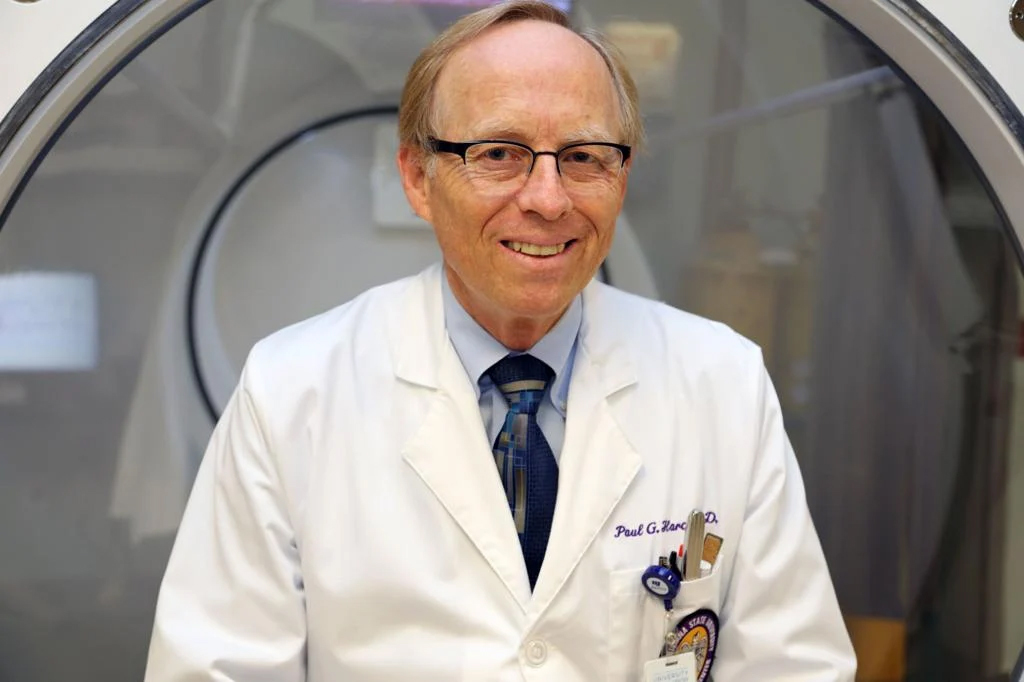
Dr. Paul G. Harch, MD
Dr. Harch initiated and continues to be a private practice that has resulted in the largest case experience in neurological hyperbaric medicine in the world. In this practice, he adapted the concepts of conventional hyperbaric oxygen therapy to wounds in the central nervous system, which spawned the subsequent academic and research practice. Harch HBOT is the best place to receive oxygen therapy treatments, and patients have traveled from more than 50 countries to be treated by Dr. Harch himself.
Harch HBOT – Hyperbaric Oxygen Therapy Clinic
5216 Lapalco Blvd.
Marrero, LA
504-309-4948
hbot@hbot.com
https://hbot.com/
Recent HBOT News
Rehabilitation of the patients with osteoarthritis.
Under the term “osteoarthritis” (OA) is currently meant a clinical syndrome resulting from the combined effect of articular pain and disordered functional activity leading to the deterioration of the quality of life of the patients. The principal objective of rehabilitation of the patients presenting with GA in which all patients with this condition are in need practically after each next aggravation of the pathological process is to relive pain syndrome and restore the functional ability of the joints lost or deteriorated after each exacerbation in order to eventually improve the quality of life of the patients experiencing the constantly progressing degenerative process in the musculoskeletal system.
A rare case of primary necrotising fasciitis of the breast: combined use of hyperbaric oxygen and negative pressure wound therapy to conserve the breast. Review of literature.
Abstract: Necrotising fasciitis is a rare but potentially fatal disease. It is even more unusual as a primary disease of the breast. Surgical treatment is required in order to gain control over the spreading infection and mastectomy is reported to be the most common...
Clinical Trial – Hyperbaric Oxygen Therapy for Hematopoietic Progenitor Cell Collection in Poor Mobilizers
This is a pilot study to evaluate the efficacy of hyperbaric oxygen therapy (HBO2) for
mobilizing hematopoietic progenitor cells from bone marrow to blood. These cells are needed
for patients to undergo bone marrow transplantation and some patients fail to respond to
current best chemotherapy. HBO2 has been shown to trigger stem cell mobilization in other
patient populations and we plan to investigate whether this intervention can act in concert
with chemotherapeutic agents to allow poor mobilizer patients to achieve successful bone
marrow transplantation. Twenty patients will be identified by participating hematologists who
have failed to respond adequately to chemotherapy. When it is deemed appropriate to attempt
an additional stem cell mobilization protocol, these patients will be administered
chemotherapy as determined by their primary treating hematologist and additionally receive
daily HBO2 (2.5 atmospheres absolute [ATA] for 90 minutes) for 3-8 days. At intervals, blood
samples will be obtained as is the normal transplantation protocol practice to assess whether
adequate stem cells are present in blood for the patient to proceed with transplantation. The
project is anticipated to take one year to complete.