
HBOT Conversations:
Dr. Paul Harch & Birth Injuries/ Cerebral Palsy
Dr. Paul G. Harch, M.D. has used hyperbaric oxygen therapy to treat more than 100 different conditions, including stroke, dementia, autism, and traumatic brain injury. His goal is to help his patients get their lives back using hyperbaric oxygen therapy.
He is the author of The Oxygen Revolution and is considered an International expert and pioneer in the field of Hyperbaric Oxygen Therapy (HBOT). His informative, and comprehensive guide on HBOT has helped countless souls better understand what HBOT is and how it directly affects the body at the genetic level.
This episode on birth injuries with a strong focus on Cerebral Palsy (CP) is the fifth in a nine episode series that will be released weekly with Dr. Harch.
Watch the Podcast
In episode 5 of 9, host Edward di Girolamo speaks with world renowned HBOT expert, Dr. Paul G. Harch about birth injuries and Cerebral Palsy (Chapter 5 of his book, The Oxygen Revolution).
In Dr. Harch’s book he describes the trip down the birth canal as one of the most high-risk journeys any human will ever make. Dr. Harch educates us on how traumatic birth experiences can trigger Cerebral Palsy diagnoses in young infants, and how premature babies are at great risk for Cerebral Palsy since they are born with the center of the brain undeveloped, still very fragile and prone to spontaneous bleeding.
Every day desperate parents around the world seek alternative healing therapies for their children with cerebral palsy. Dr. Harch dives deep into the use of Hyperbaric Oxygen Therapy (HBOT) for the treatment of Cerebral Palsy and other neurological birth disorders, and explains the reasons why parents should embrace this therapy. Essentially, Dr. Harch describes Cerebral Palsy as a wound to the brain, so it should respond to Hyperbaric Oxygen Therapy the same way as other brain injuries. He confers that it absolutely does.
Dr. Harch reveals success stories of CP children who have had found hope and new life from Hyperbarics. In response to these stories and hearing that it works to heal and ease life-long debilitating CP symptoms, di Girolamo wants to know why more parents aren’t seeking out HBOT to help their cerebral palsy children? Harch relays that there’s too much inconsistent medical literature out there, and in many ways it’s just plain wrong. For example, a parent asks their doctor, “How about HBOT to treat Cerebral Palsy?”— the doctor might be unfamiliar with the therapy, so he/she checks the online medical database for HBOT and CP. Unfortunately this doctor will likely find some skewed data, leading the doctor to respond with “so….. I don’t think it’ll help”. Although, as Dr. Harch explains, the exact opposite is what’s true; HBOT absolutely helps CP patients.
One example given is that a well respected peer-reviewed medical journal, The Lancet, published medical literature on HBOT and CP announcing there was no proven benefit to use Hyperbaric Oxygen Therapy to treat Cerebral Palsy. But, the inconsistency there was that the control group was defined as a placebo, and that was not right. In response, Dr. Pierre Marois and his team, released a retrospective study on HBOT in the treatment of Cerebral Palsy that showed studies and numerous reports demonstrating the positive effects of Hyperbaric Oxygen Therapy (HBOT) in children with Cerebral Palsy.
Dr. Harch suggests our viewers dive into his 2021 presentation at the Team Luke3 Hope for Minds pediatric brain injury conference. Dr. Harch provided a summarization of all of the science showing that Hyperbaric Oxygen Therapy had extremely positive effects on every stage of the stem cell process. Additionally, Dr. Proefrock’s presentation from the same conference, “Current Trends in Naturopathic Treatment of Pediatric Neurological Injury” reveals stem cell data for children in the midst of HBOT treatment; showing that the children who have had Hyperbaric treatments produced 4x the amount of stem cells compared to those who did not.
Dr. Harch explains the roadblock for using Hyperbaric Oxygen for treatment of CP is still extremely difficult to get around, and he references the 2012 article by Novak and Badawai, Last breath: effectiveness of hyperbaric oxygen treatment for Cerebral Palsy as an example. In this article, they concluded that “Hyperbaric Oxygen does not have a clinically important effect on gross motor and self-care function in children with Cerebral Palsy.” Dr. Harch clarifies why they were wrong on the science, and how information like that is what’s preventing the average medical doctor to recommend HBOT for Cerebral Palsy.
di Girolamo and Dr. Harch urges viewers to find out for themselves if HBOT could be a good therapy for them or their loved one(s) living with CP. If you would like to dive into the world of Hyperbaric Oxygen Therapy for the treatment of Cerebral Palsy, HBOT News encourages you to find a licensed Hyperbaric Oxygen Therapy facility with hard mono-chambers or hard multi-place chambers, and act on this responsibly. Just like anything in the world of modern medicine, you can be injured or do more harm than good if HBOT is not administered correctly.
All of the data and success stories Dr. Harch reveals paints a much different picture than what the medical industry is showing us. Go try Hyperbaric Oxygen Therapy sooner than later to treat, heal, and ease the symptoms of Cerebral Palsy. We trust that HBOT can also change your life!
Subscribe Now, It’s Free !
Guest
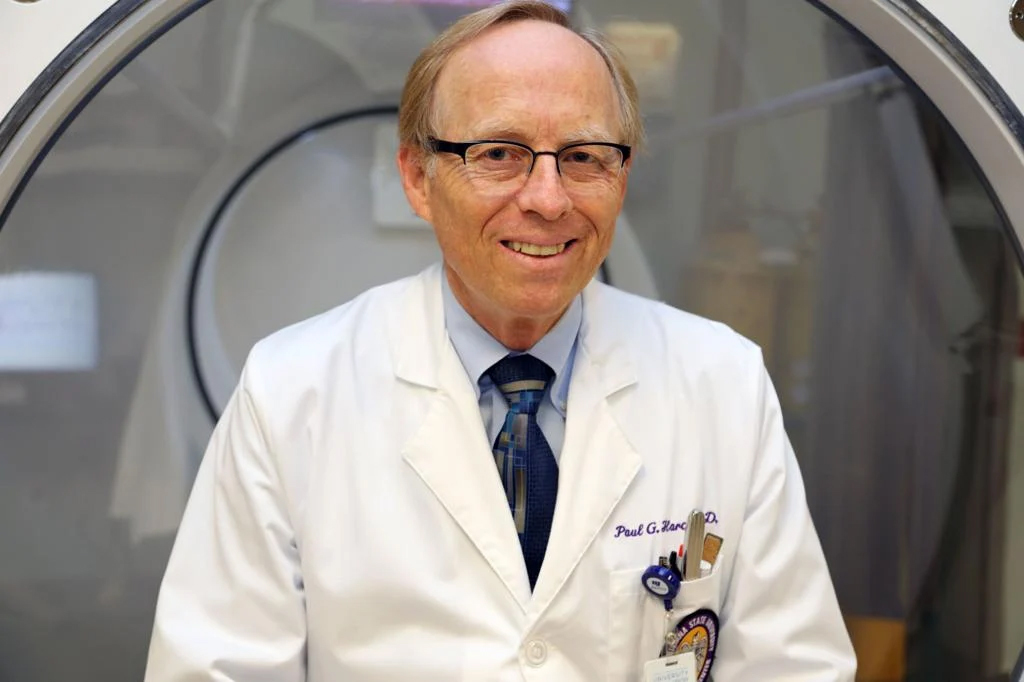
Dr. Paul G. Harch, MD
Dr. Harch initiated and continues to be a private practice that has resulted in the largest case experience in neurological hyperbaric medicine in the world. In this practice, he adapted the concepts of conventional hyperbaric oxygen therapy to wounds in the central nervous system, which spawned the subsequent academic and research practice. Harch HBOT is the best place to receive oxygen therapy treatments, and patients have traveled from more than 50 countries to be treated by Dr. Harch himself.
Harch HBOT – Hyperbaric Oxygen Therapy Clinic
5216 Lapalco Blvd.
Marrero, LA
504-309-4948
hbot@hbot.com
https://hbot.com/
Recent HBOT News
Clinical Trial – The Effects of Intravenous Dexmedetomidine on Spinal Anesthesia Using Low Dose Diluted Bupivacaine for Transurethral Resection of Prostate
Dexmedetomidine is a new selective and potent alpha-2 agonist. It has centrally acting
anesthetic properties. It has been known that intrathecal addition of alpha-2 adrenergic
agents result in prolongation of the duration of the sensory and motor blockade induced by
hyperbaric bupivacaine. But the effects of intravenous dexmedetomidine on the spinal block
was not evaluated. The aim of study is to assess the effect of intravenous dexmedetomidine on
the low-dose spinal anesthesia for the transurethral surgery.
Phase II trial of radiotherapy after hyperbaric oxygenation with multiagent chemotherapy (procarbazine, nimustine, and vincristine) for high-grade gliomas: long-term results.
Abstract: To analyze the long-term results of a Phase II trial of radiotherapy given immediately after hyperbaric oxygenation (HBO) with multiagent chemotherapy in adults with high-grade gliomas. Patients with histologically confirmed high-grade gliomas were...
Clinical Trial – The Regeneration Effects of Derma-PACE Shockwave in Chronic Diabetic Ulcers
Management of chronic diabetic foot skin ulcers require multidisciplinary approaches
including diabetic control, wound care, antibiotic, shoe wear off-loading, and surgery in
selected cases. The results are inconsistent and irregular, and most studies reported
unsatisfactory results. Many adjunctive therapies are implemented in the care of chronic
diabetic foot ulcers including hyperbaric oxygen therapy (HBO), ultrasound, recombinant human
platelet-derived growth factor-BB (rPDGF-BB), vacuum assisted wound closure (VAWC) and
acellular matrix. HBO is the most commonly utilized at the investigators institution. Mixed
results of HBO in chronic diabetic foot ulcers are reported. Several studies reported that
the beneficial effects of HBO, but none showed universal success. Therefore, the development
of a new effective method of treatment for chronic diabetic ulcers is extremely valuable.
Extracorporeal shockwave therapy (ESWT) acts as mechanotransduction that produces the
therapeutic benefits through complex biological pathways including neovascularization and
tissue regeneration. ESWT also showed bacteriostatic effects in experiments. Some studies
reported the effectiveness of ESWT in acute and chronic soft tissue wounds. Others reported
effectiveness of ESWT in chronic ulcers with 50% completely healed with 6 sessions of
treatment. With this background, it appears that ESWT may be effective in the treatment of
chronic diabetic foot ulcers. The purpose of this study is to evaluate the efficacy of ESWT
in chronic foot ulcers, and to compared with that treated with HBO, and to study the
molecular and blood flow perfusion before and after ESWT.