
HBOT Conversations:
Dr. Paul Harch & Burns
Dr. Paul G. Harch is a world-renowned Hyperbaric Oxygen Therapy (HBOT) expert. His comprehensive guide on HBOT, The Oxygen Revolution, has proven to be an extremely powerful resource to help the average person better understand the healing powers of hyperbarics.
Throughout his 30+ years of using hyperbaric oxygen therapy at his clinic, Harch Hyperbarics, Dr. Harch continues to heal his patients from the inside out. He has treated more than 100 different conditions with HBOT, delivering a brand-new lease on life for patients who previously had no to very little hope.
This episode on Inflammation is the first in a 9 episode series that will be released weekly with Dr. Harch.
Watch the Podcast
In episode 2 of 9, host Edward di Girolamo speaks with world renowned HBOT expert, Dr. Paul G. Harch on thermal burns, FDA approvals, the misguidance of physicians towards HBOT and insurance coverage. di Girolamo immediately stresses that he wants to better understand what the roadblock is, why are more burn victims not using Hyperbaric Oxygen Therapy? Dr. Harch explains that it’s simple, they don’t know about it.
di Girolamo tells a story about his journey to educate a doctor in Galvenston, TX who oversees a handful of hospitals known to treat youth burn victims. He spent time chatting with the doctor via phone, and educating the physician that the FDA has now cleared hyperbaric oxygen as a treatment for thermal burns. During the conversation, di Girolamo outlined the benefits of HBOT as a better and more painless treatment option for these children. The doctor stated that he was excited and interested; and welcomed di Girolamo to send him a copy of UHMS’s referenced research on thermal burns that ultimately led to the FDA clearance. The research by Dr. Cianci, “Adjunctive hyperbaric oxygen therapy in the treatment of thermal burns” was overnighted and received/signed for. After that, the Galveston, TX doctor refused to take di Girolamo’s calls. di Girolamo later discovered that this particular doctor was also the head of the plastic surgery unit. He believes that the doctor’s hesitation to embrace Hyperbaric Oxygen Therapy, a potentially safer and painless recovery method for youth burn victims, had everything to do with the reduction of plastic surgeries the hospital would have seen.
Dr. Harch stresses that the timing of this conversation about thermal burns is impeccable; it was only a few months ago that he had given a lecture on this. He reviewed all of the literature on hyperbaric oxygen in burns and part of the problem was the randomized trials. Every doctor in medicine wants randomized trials. There’s some real positive information that exists and there’s neutral information – it’s mixed. But, yet there are many articles out there that support it, and the animal literature is overwhelming for burns. Harch explains that one of the key things to using HBOT to treat thermal burns is that the therapy is most effective when it’s done almost immediately to treat the inflammatory part of the burn injury; the reperfusion injury. If you get to it early enough, HBOT can deliver a dramatic improvement. However, even if it’s delayed hyperbaric oxygen therapy still has many positive qualities of healing, because it reduces swelling in every traumatic and injurious condition. There is literature and science to support this in just about every organ system where it’s been applied.
Harch continues to educate on using HBOT for thermal burns and stresses that if used immediately after an acute burn, it can reduce swelling. This reduction in swelling will prevent the progression from second degree, deep second degree, to third degree. It’s when it gets to third degree that burn patients have to cut off the skin and are in need of a skin graft, which is very painful plastic surgery process with horrendous scarring. Hyperbaric oxygen therapy has the evidence to support this, and the ability to reduce the swelling and prevent that deep second to third degree conversion. Harch tells us that if a burn patient can do that, then the number of debridements, surgeries, and skin graftings is reduced.
But, then the question remains….. who is going to pay for the Hyperbaric Oxygen Therapy?! Harch explains that Medicare and Medicaid do not want to pay for it unless they have multiple randomized trials or a multi-center randomized trial proving it. Harch stresses that he has strong feelings on the arbitrary nature in which decisions are made by insurance companies on what they reimburse or don’t reimburse for. He is quoted as saying “that decision needs to be taken out of the hands of doctors and put in the hands of the lay public. Informed public people who can determine what they want to spend their money on as a medical therapy. Not what’s dictated to them by now a medical profession and industry that is so conflicted.”
As the topic of insurance flourishes, Harch explains that there’s no quick fix to get the insurance companies to cover hyperbaric oxygen therapy (especially for head injuries), but he has been very focused on this for the last 15 years trying to conclusively show that HBOT works for at least one chronic neurological diagnosis. Roughly 30-plus years ago Harch spent a good ten years looking at hyperbaric oxygen therapy for any chronic brain-based condition, as there had already been a lot of evidence that HBOT was lifesaving in acute severe comatose traumatic brain injury patients. It was discovered that there was a 50% reduction in mortality with just a few hyperbaric treatments in the first few days. Harch states that there is now incredible data published out of Germany, the US, China, and multiple countries on this topic. But even though the data exists, the series of studies have been very controversial, because it goes back to this definition of Hyperbaric Oxygen Therapy, the control groups that they used it in, and so on.
Harch explains that he ultimately summed up all of this evidence on chronic brain-based conditions into a systematic review. And, as mentioned before with the burn victims, doctors want to see randomized trials. So, he got six randomized trials of hyperbaric oxygen therapy in chronic persistent pulse concussion syndrome of mild traumatic brain injury, with the conclusion of the article being that it meets the highest level of evidence that’s been identified by multiple medical evidentiary grading systems. It’s a grade A practice recommendation, which means this therapy should be delivered unless there’s a compelling reason not to for the patient.
So if an insurance company will not pay for HBOT (such as for a TBI or brain injury in this case), this systematic review could be taken to the appeal process to show the randomized trials, and the evidence that is required. Harch stresses HBOT and insurance is still going to be a fight until it’s completely adopted – but right now the Hyperbaric Oxygen Therapy Committee of the Medical Society that makes that FDA list is considering mild traumatic brain injury persistent post-concussion syndrome as a new indication. And if they follow the evidence, there shouldn’t be any other conclusion but to put it on that list. If it happens, it’ll be the first neurological indication and that will make it easier for other neurological diagnosis to follow.
Harch stresses that if you’re in a fight with the insurance company to get Hyperbaric Oxygen Therapy approved for your condition, or if you expect a fight, consider videotaping the before and after of the patient. He references Eden Carlson, the 2- year old who faced a near-death drowning incident and received hyperbaric oxygen therapy at Harch Hyperbarics. Harch stresses how powerful the videos are of Eden with her undeniable healing using HBOT. Harch reminds patients to document the real situation – what has happened to you, and include a simple questionnaires outcome; get evaluated by your pediatrician, doctor, occupational therapist, whoever they are… have them evaluate you before and then do the same after HBOT treatments. Those types of doctors are independent, they don’t have any skin in the game with hyperbaric oxygen, so when you can show that independent evaluators are documenting improvement in a condition that is chronic (especially one that has been unchanging for some period of time), it’s prima facie evidence.
The topic of the medical profession being misled comes up, and di Giromalo gives Dr. Harch credit for being so kind to the medical profession in his book, The Oxygen Revolution. Harch discusses yes, he was kind but the reality is that people are suffering because of the lack of application. So, he felt it was important to add to the Third Edition his experience in medical school regarding a very ignorant statement he received from a resident when he asked about HBOT for a patient; Dr. Harch discusses this more in depth in Episode 1 – Inflammation. Passionately, Harch states that it should be a criminal act for these doctors to deny someone the possibility of getting better based on pure ignorance.
di Girolamo questions if HBOT could threaten the doctors’ paychecks and maybe that’s where the disconnect is? Then he asks if it’s all about reimbursement and competition? di Girolamo emphasizes that if the data exists that HBOT heals naturally with oxygen and pressure, why is the medical industry so misled and unwilling to learn about such a natural God-given medical healing process? Harch shares his thoughts on all topics and agrees that the disconnect is a big problem, and it absolutely is playing a factor in why HBOT is not available to more patients.
di Girolamo stresses that we need to look at the spirit of humanity here, encourage patient advocacy and take the Hippocratic Oath to the highest level where all doctors are giving the patients every single option for healing – including Hyperbaric Oxygen Therapy. Dr. Harch agrees that the goal is achievable and we are on the right path by using platforms like HBOT News to deliver the message of what HBOT is, where you can get it, and that you absolutely can save your life by doing nothing more than breathing.
Guest
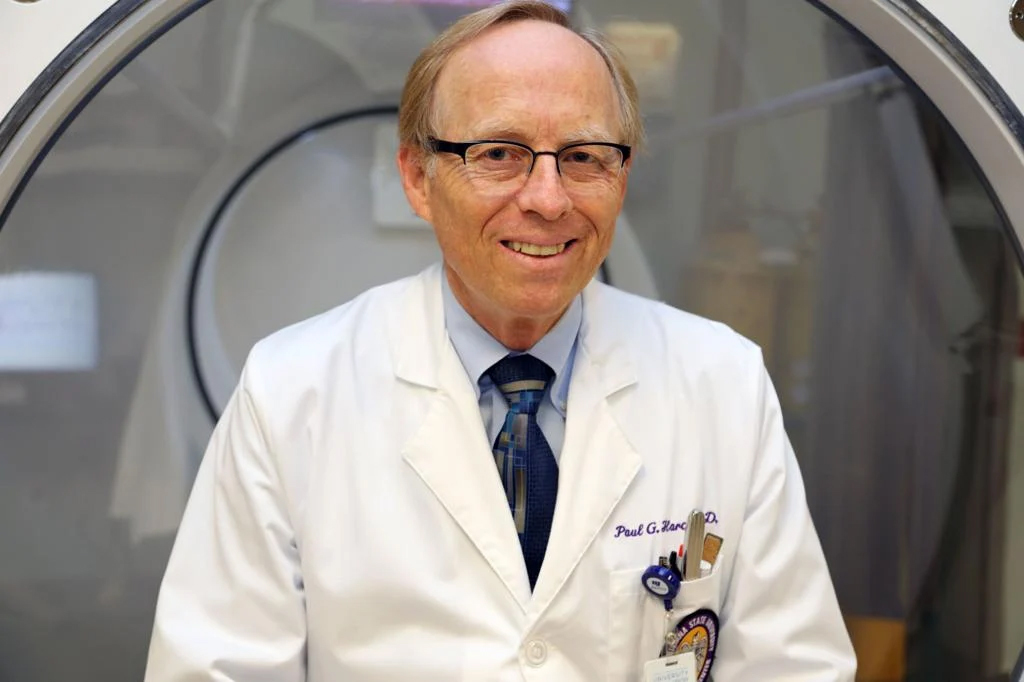
Dr. Paul G. Harch, MD
Dr. Paul G. Harch, M.D. is a clinician in emergency medicine and hyperbaric medicine who is the former director of the University Medical Center Hyperbaric Medicine Department and LSU Hyperbaric Medicine Fellowship. Currently, he is a Clinical Professor of Medicine in the Section of Emergency Medicine at LSU School of Medicine in New Orleans. He graduated from the Johns Hopkins University School of Medicine after graduating from the University of California at Irvine with magna cum laude/Phi Beta Kappa honors.
Dr. Harch initiated and continues to be a private practice that has resulted in the largest case experience in neurological hyperbaric medicine in the world. In this practice, he adapted the concepts of conventional hyperbaric oxygen therapy to wounds in the central nervous system, which spawned the subsequent academic and research practice. Harch HBOT is the best place to receive oxygen therapy treatments, and patients have traveled from more than 50 countries to be treated by Dr. Harch himself.
Harch HBOT – Hyperbaric Oxygen Therapy Clinic
5216 Lapalco Blvd.
Marrero, LA
504-309-4948
hbot@hbot.com
https://hbot.com/
Subscribe Now, It’s Free !
Recent HBOT News
Clinical Trial – Transcranial Magnetic Stimulation and Hyperbaric Chamber for Women Fibromyalgia
Fibromyalgia syndrome (FMS) is a multisystem disease, characterized by generalized chronic
musculoskeletal pain. In addition, there is a lot of care for fatigue, sleep disorders,
morning stiffness, cognitive disorders, depression, anxiety and stress. Other common symptoms
are back pain, headaches, irritable bowel, balance problems and deterioration of physical
function in general. Patients with fibromyalgia (FM) often show pain at specific points that
are known as "tender spots or tender spots, with an increased sensitivity to painful stimuli"
(hyperalgesia) and a decreased pain threshold (allodynia). which can be evidenced in the
physical examination and in the absence of anomalies that justify in the biological or image
tests. These pain points to pressure, based on the most specific and specific criteria for
the diagnosis of the disease, traditionally based on the criteria of the American College of
Rheumatology (ACR), according to which, should be presented so minus 11 out of 18 painful
points to confirm it. Although the etiology remains unknown and unclear, its appearance is
attributed to a problem of central sensitization, that is, changes in central processing,
which causes an alteration of the mechanisms that regulate the sensation of pain, with
amplification of nociceptive input . and perpetuation of painful stimuli. Fibromyalgia is
becoming a common syndrome in the countries of Western Europe, with a prevalence in the
general population that ranges between 1-3%, and specifically in Spain, around 2.4%. In
addition, it has a higher incidence in women than men (73-95%), predominantly affecting women
between the ages of 40-50 years. About 3% of women with fibromyalgia are at an age when
menopause occurs, so not only do they experience the symptoms of both states but they even
exacerbate the syndrome with each other. On the other hand, and in relation to its
chronicity, the care of this type of patients involves large costs for society with a
significant consumption of health resources in the field of primary care, as well as the
costs of work absenteeism. For these reasons, it is considered an important problem with a
great impact on the health system, and therefore more and more studies are being developed
with the aim of better understanding the pathophysiology of this disease. The therapeutic
approach includes low cost and easy access measures, such as physical exercise (EF) programs
to improve the symptoms of FM. Physical exercise has positive effects directly on pain, joint
and muscle stiffness, generalized sensitivity and fatigue, among others, and secondarily on
cognitive disorders. Thus, the vast majority of studies focus on low-impact aerobic exercise,
performed between 60% and 70% of the maximum heart rate two to three times a week. However,
to date, there is no study that compares the effectiveness of physical exercise with other
innovative therapeutic actions, such as transcranial magnetic stimulation (TMS), the
hyperbaric chamber (HBOT), in parameters related to pain and quality of life. the life of
patients with fibromyalgia. The general objective is the effectiveness of transcranial
magnetic stimulation and the hyperbaric chamber in women with fibromyalgia. As specific
objectives we propose:
To assess the effect of HBOT, TMS and EF on quality of life in women with fibromyalgia.
– Object the effect of HBOT, TMS and EF in cortical functioning.
– Evaluate the effect of HBOT, TMS and EF on fatigue.
– Evaluate the effect of HBOT, TMS and EF on psychological aspects, such as depression and
anxiety.
– Evaluate the effect of HBOT, TMS and EF on the perception of pain and the number of
painful points.
– Evaluate the effect of HBOT, TMS and EF on the quality of sleep.
– Evaluate the effect of HBOT, TMS and EF on the quality of life.
– Evaluate the effect of HBOT, TMS and EF on the pain constructs.
– Determine the effect of HBOT, TMS and EF on plasma endorphin levels.
Heat Shock Protein 70 (HSP70) Reduces Hepatic Inflammatory and Oxidative Damage in a Rat Model of Liver Ischemia/Reperfusion Injury with Hyperbaric Oxygen Preconditioning.
Abstract: BACKGROUND Several clinical conditions can cause hepatic ischemia/reperfusion (I/R) injury. This study aimed to determine the mechanism of the protective effect of hyperbaric oxygen preconditioning (HBO₂P) on hepatic ischemia/reperfusion (I/R) injury in a...
Effect of hyperbaric oxygen therapy and corticosteroid therapy in military personnel with acute acoustic trauma.
Abstract: Acute acoustic trauma (AAT) is a sensorineural hearing impairment due to exposure to an intense impulse noise which causes cochlear hypoxia. Hyperbaric oxygen therapy (HBO) could provide an adequate oxygen supply. The aim was to investigate the effectiveness...