
HBOT Conversations:
Dr. Paul Harch & Inflammation
Dr. Paul G. Harch, M.D. has used hyperbaric oxygen therapy to treat more than 100 different conditions, including stroke, dementia, autism, and traumatic brain injury. His goal is to help his patients get their lives back using hyperbaric oxygen therapy.
He is the author of The Oxygen Revolution and is considered an International expert and pioneer in the field of Hyperbaric Oxygen Therapy (HBOT). His informative, and comprehensive guide on HBOT has helped countless souls better understand what HBOT is and how it directly affects the body at the genetic level.
This episode on Inflammation is the first in a 9 episode series that will be released weekly with Dr. Harch.
Watch the Podcast
HBOT News podcast host, Edward di Girolamo, talks with special guest and HBOT expert, Dr. Paul G. Harch, MD. This is the first of nine episodes with Dr. Harch examining the God-given miracle of Hyperbaric Oxygen Therapy.
In this episode, we dive into how HBOT is a game-changer for inflammation. Harch explains that inflammation is the driving factor for countless chronic illnesses, but thankfully Hyperbaric Oxygen Therapy is a natural proven way to suppress inflammation.
Harch summarizes a fascinating study done in 2008, by Dr. Cassandra Godman. Her team took skin biopsies and extracted the normal tissue, then they examined the cells that lined the tiniest blood vessels in the tissue. Next, they put these cells in a petri dish and put them in a hyperbaric chamber and gave him a single hyperbaric treatment. Afterwards, they did a mass gene array analysis for 48 hours. What happened next was ground-breaking in better understanding the role that HBOT has on inflammation.
At the end of 24 hours 8,101 of our 19,000 protein coding genes in our 23 chromosomes were either significantly turned on or turned off & suppressed. That single HBOT treatment turned on the anti-inflammatory genes and the growth and repair hormone genes, and the largest cluster suppressed were the pro-inflammatory genes.
Our inflammatory reaction is inescapable when an injury occurs. But, when the patient receives hyperbaric oxygen therapy treatment after an injury (the sooner the better), it can have an overwhelming positive influence on the inflammatory reaction at any place along the spectrum. Harch continues to explain that the anti-inflammatory effects of hyperbaric oxygen are wide-ranging.
Harch spoke of the Navy’s experience with Hyperbaric Oxygen Therapy, as the Navy really kind of dominated this field for many years. The Navy reported that if you can get someone in a chamber within one hour of coming out of the water – when they’re symptomatic for decompression sickness – then the first hyperbaric treatment is curative in 90% of cases. Everyone thought that HBOT was treating bubbles in the brain at that point, but the reality is they were treating inflammation. We now know that it’s the inflammatory reaction in the brain after the bubbles passed that Hyperbaric Oxygen Therapy is treating; not the bubbles.
HBOT isn’t new, it dates back well over a hundred years. It’s still misunderstood, because many believe that HBOT therapy is a treatment for diseases. But, the reality is that HBOT is a treatment for disease processes, and it’s these processes that cause the diseases. We treat the inflammation that causes the disease processes, and in turn we treat the disease. That’s the power of Hyperbaric Oxygen Therapy.
Stay tuned for all nine episodes that will be release each Friday for the next eight weeks.
Guest
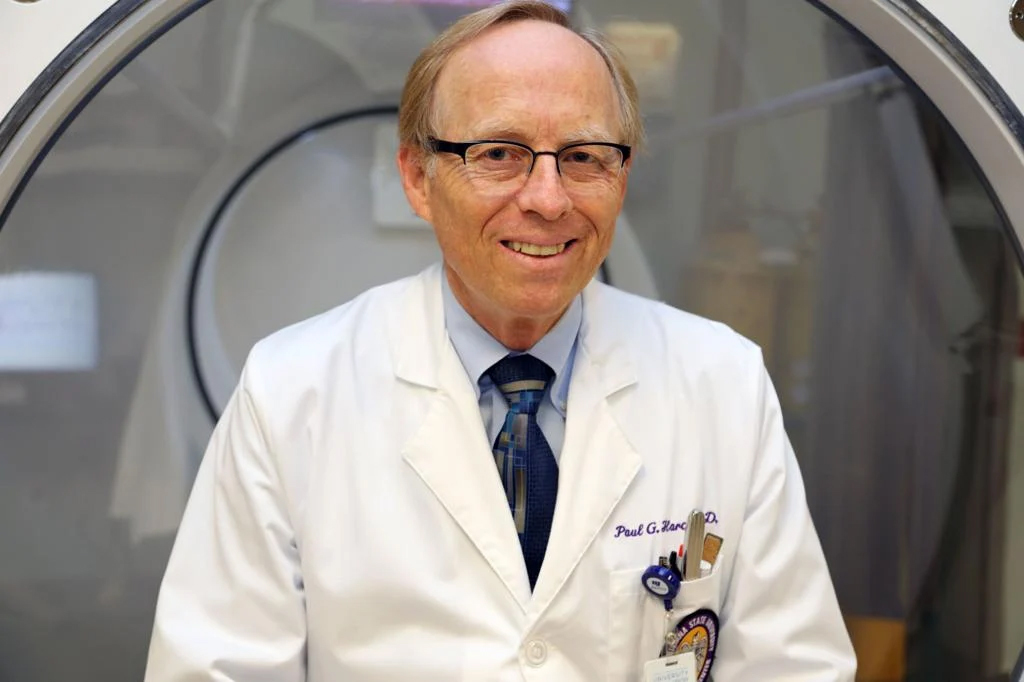
Dr. Paul G. Harch, MD
Dr. Paul G. Harch, M.D. is a clinician in emergency medicine and hyperbaric medicine who is the former director of the University Medical Center Hyperbaric Medicine Department and LSU Hyperbaric Medicine Fellowship. Currently, he is a Clinical Professor of Medicine in the Section of Emergency Medicine at LSU School of Medicine in New Orleans. He graduated from the Johns Hopkins University School of Medicine after graduating from the University of California at Irvine with magna cum laude/Phi Beta Kappa honors.
Dr. Harch initiated and continues to be a private practice that has resulted in the largest case experience in neurological hyperbaric medicine in the world. In this practice, he adapted the concepts of conventional hyperbaric oxygen therapy to wounds in the central nervous system, which spawned the subsequent academic and research practice. Harch HBOT is the best place to receive oxygen therapy treatments, and patients have traveled from more than 50 countries to be treated by Dr. Harch himself.
Harch HBOT – Hyperbaric Oxygen Therapy Clinic
5216 Lapalco Blvd.
Marrero, LA
504-309-4948
hbot@hbot.com
https://hbot.com/
Subscribe Now, It’s Free !
Recent HBOT News
Can a pin-tract infection cause an acute generalized soft tissue infection and a compartment syndrome?
Abstract: A patient who developed soft tissue infection and osteomyelitis secondary to pin tract infection after skeletal traction was evaluated. Tibial traction was performed on a patient who had exposed to a femoral pertrochanteric fracture after falling from a tree...
Clinical Trial – Hyperbaric Oxygen in Lower Leg Trauma
Study hypothesis :Hyperbaric Oxygen may prevent complications and improve outcomes in severe
lower limb trauma. We propose to investigate this hypothesis by conducting an International
multi centre randomised control trial of standard trauma/orthopaedic care with or without a
concurrent course of hyperbaric oxygen treatments.
Clinical Trial – Can Erythropoietin Protect the Cerebral Blood Flow and Oxygenation During Simulated Dive?
During facial cooling and especially during breath hold, can mammals – and also humans –
elicit a so called dive reflex, causing bradycardia, peripheral vasoconstriction and
centralization of blood flow to brain, lungs and heart but the reflex is suppressed by
physical activity. The dive reflex can be elicited by breath hold alone and will be more
pronounced during simultaneously facial cooling, but not by stimulation of other skin
receptors.
The dive reflex has an oxygen conserving effect, because of intense vasoconstriction in both
viscera and muscles, and simultaneously with reduction in cardiac output (CO). Therefore
plasma lactate will rise, to compensate for the lesser regional blood flow. If one
hyperventilates with 100 % oxygen, then the reflex can still be elicited, but it is more
pronounced during asphyxia. Experienced sports divers, who has been diving for more than 7-10
years have reduced post apnea acidosis and oxidational stress, but probably also less
sensitivity for progressive hypoxia and hypercapnia, because these individuals have a more
pronounced dive reflex.
Transcranial Doppler ultrasonography (TCD) gives a reproducibly value for brain perfusion by
continuously non-invasive real-time sampling. A single piezo-electrical transducer sends and
collects ultrasound through the temporal region of the scull, where it is the thinnest.
Hereby can the blood flow of arteria cerebri anterior, media (MCA) and posterior and
basilaris be estimated.
With TCD it can be shown that the cerebral blood flow rises in MCA in healthy subjects during
facial cooling, with normal ventilation, when resting in a supine position without affecting
the systemic blood pressure. Single Photon Emission Computerized Tomography (SPECT)-scanning
during normo-baric and hyperbaric pressure of professional divers breathing 100 % oxygen has
shown to reduce the cerebral blood flow in several regions of the brain.
But it is yet unknown how brain blood flow and metabolism are affected by an "face immersion
dive" and simultaneously prolonged physical activity, and hence a rise in lactate under
hyperbaric pressure (3 meters), breathing atmospheric air, similar to the circumstances for
trained scuba divers work.
Presumably it will cause a fall in brain blood flow and in time cognitive deficits.
Erythropoietin (rhEPO) is a well known drug, used as doping in sports for about 15 years. So
far the only known enhancement in athletic achievement by rhEPO is caused by peripheral
improvements and especially blood capability to transport oxygen to the working muscles; this
has been documented by a rise in haematocrit. rhEPO has also a neuroprotective effect on
neurons in patients with neuron damage caused by cerebral hypoxic ischeamia.
rhEPO work also on a series of cerebral mechanisms, including enhanced motor and spatial
learning and more. Enhanced motor learning may improve the professional divers choices during
work and may be also physical performance and mechanical efficiency. Intravenous injection of
rhEPO will increase rhEPO in cerebrospinal fluids, since rhEPO is capable of crossing blood
brain. All together this may indicate that rhEPO, not only works on physical performance, but
also has effects on the brain. rhEPO has also an effect on the condition of cancer and
dialysis patients, not only explained by merely increased hematocrit.
This project will add new knowledge in the understanding of the mechanisms of clinical use of
rhEPO.
The purpose of this study is to investigate, how brain blood flow and metabolism are affected
by face immersion dive and simultaneously breath hold during normo-baric and hyperbaric
pressure (3 m depth) when breathing atmospheric air in trained sports divers. IL-6, HSP-72,
lactate, ammonium and body-temperature will be measured. Brain and muscle oxygenation will be
measured by near-infrared spectroscopi (NIRS). Furthermore we will investigate whether a
small dose of rhEPO affects mentioned parameters during simulated dive in pressure chamber
with facial cooling.
Hypothesis Brain blood flow in trained divers will be diminished during prolonged physical
activity during simultaneously face immersion dive and breath hold under hyperbaric pressure.
There will be a release of IL-6 and HSP-72. Pretreatment with a small amount of rhEPO before
prolonged physical activity during simulated dive has a protective effect on brain blood flow
and oxygenation.