
HBOT Conversations:
Dr. Paul Harch & Inflammation
Dr. Paul G. Harch, M.D. has used hyperbaric oxygen therapy to treat more than 100 different conditions, including stroke, dementia, autism, and traumatic brain injury. His goal is to help his patients get their lives back using hyperbaric oxygen therapy.
He is the author of The Oxygen Revolution and is considered an International expert and pioneer in the field of Hyperbaric Oxygen Therapy (HBOT). His informative, and comprehensive guide on HBOT has helped countless souls better understand what HBOT is and how it directly affects the body at the genetic level.
This episode on Inflammation is the first in a 9 episode series that will be released weekly with Dr. Harch.
Watch the Podcast
HBOT News podcast host, Edward di Girolamo, talks with special guest and HBOT expert, Dr. Paul G. Harch, MD. This is the first of nine episodes with Dr. Harch examining the God-given miracle of Hyperbaric Oxygen Therapy.
In this episode, we dive into how HBOT is a game-changer for inflammation. Harch explains that inflammation is the driving factor for countless chronic illnesses, but thankfully Hyperbaric Oxygen Therapy is a natural proven way to suppress inflammation.
Harch summarizes a fascinating study done in 2008, by Dr. Cassandra Godman. Her team took skin biopsies and extracted the normal tissue, then they examined the cells that lined the tiniest blood vessels in the tissue. Next, they put these cells in a petri dish and put them in a hyperbaric chamber and gave him a single hyperbaric treatment. Afterwards, they did a mass gene array analysis for 48 hours. What happened next was ground-breaking in better understanding the role that HBOT has on inflammation.
At the end of 24 hours 8,101 of our 19,000 protein coding genes in our 23 chromosomes were either significantly turned on or turned off & suppressed. That single HBOT treatment turned on the anti-inflammatory genes and the growth and repair hormone genes, and the largest cluster suppressed were the pro-inflammatory genes.
Our inflammatory reaction is inescapable when an injury occurs. But, when the patient receives hyperbaric oxygen therapy treatment after an injury (the sooner the better), it can have an overwhelming positive influence on the inflammatory reaction at any place along the spectrum. Harch continues to explain that the anti-inflammatory effects of hyperbaric oxygen are wide-ranging.
Harch spoke of the Navy’s experience with Hyperbaric Oxygen Therapy, as the Navy really kind of dominated this field for many years. The Navy reported that if you can get someone in a chamber within one hour of coming out of the water – when they’re symptomatic for decompression sickness – then the first hyperbaric treatment is curative in 90% of cases. Everyone thought that HBOT was treating bubbles in the brain at that point, but the reality is they were treating inflammation. We now know that it’s the inflammatory reaction in the brain after the bubbles passed that Hyperbaric Oxygen Therapy is treating; not the bubbles.
HBOT isn’t new, it dates back well over a hundred years. It’s still misunderstood, because many believe that HBOT therapy is a treatment for diseases. But, the reality is that HBOT is a treatment for disease processes, and it’s these processes that cause the diseases. We treat the inflammation that causes the disease processes, and in turn we treat the disease. That’s the power of Hyperbaric Oxygen Therapy.
Stay tuned for all nine episodes that will be release each Friday for the next eight weeks.
Guest
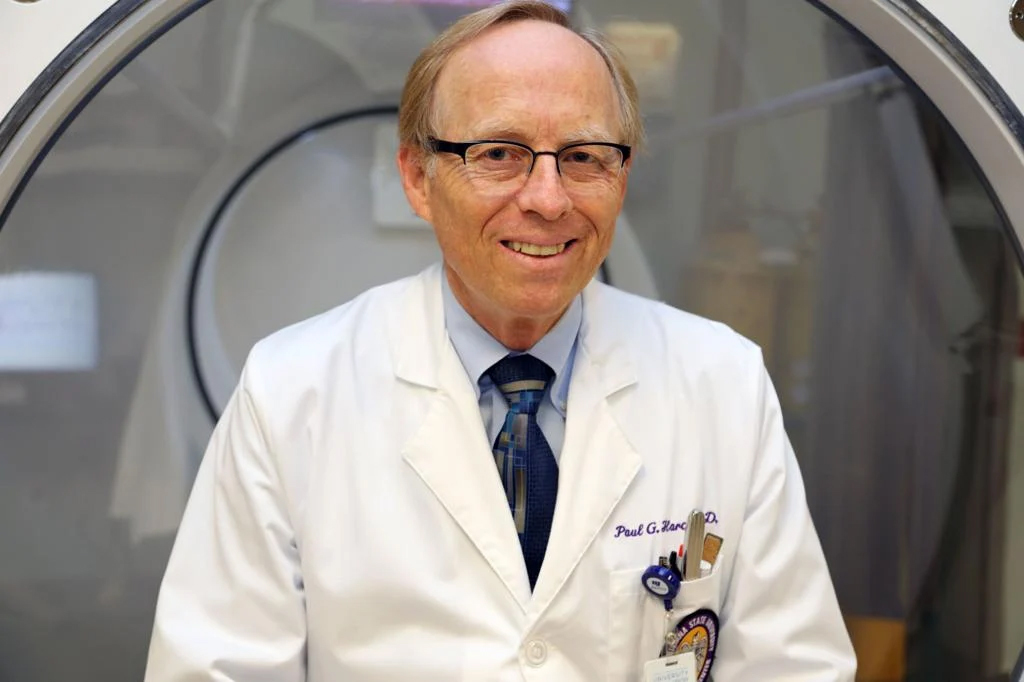
Dr. Paul G. Harch, MD
Dr. Paul G. Harch, M.D. is a clinician in emergency medicine and hyperbaric medicine who is the former director of the University Medical Center Hyperbaric Medicine Department and LSU Hyperbaric Medicine Fellowship. Currently, he is a Clinical Professor of Medicine in the Section of Emergency Medicine at LSU School of Medicine in New Orleans. He graduated from the Johns Hopkins University School of Medicine after graduating from the University of California at Irvine with magna cum laude/Phi Beta Kappa honors.
Dr. Harch initiated and continues to be a private practice that has resulted in the largest case experience in neurological hyperbaric medicine in the world. In this practice, he adapted the concepts of conventional hyperbaric oxygen therapy to wounds in the central nervous system, which spawned the subsequent academic and research practice. Harch HBOT is the best place to receive oxygen therapy treatments, and patients have traveled from more than 50 countries to be treated by Dr. Harch himself.
Harch HBOT – Hyperbaric Oxygen Therapy Clinic
5216 Lapalco Blvd.
Marrero, LA
504-309-4948
hbot@hbot.com
https://hbot.com/
Subscribe Now, It’s Free !
Recent HBOT News
Senate VA Committee Passes Legislation on Hyperbaric Oxygen Therapy
Back in October 2019, at Senator Cramer’s invitation, VA Secretary Robert Wilkie and the Senator toured Healing with Hyperbarics of North Dakota, a Fargo-based HBOT clinic. Cramer states, “The primary point of the federal government is the defense of our nation. Part...
Clinical Trial – the Use of Magnesium Sulfate for Prevention of Postspinal Shivering
Shivering is an unpleasant experience after spinal anesthesia. Shivering is defined as an
involuntary, repetitive activity of skeletal muscles. The mechanisms of shivering in patients
undergoing surgery are mainly intraoperative heat loss, increased sympathetic tone, pain, and
systemic release of pyrogens. Spinal anesthesia significantly impairs the thermoregulation
system by inhibiting tonic vasoconstriction, which plays a significant role in temperature
regulation. Spinal anesthesia also causes redistribution of core heat from the trunk (below
the block level) to the peripheral tissues. These two effects predispose patients to
hypothermia and shivering. The median incidence of shivering related to regional anesthesia
observed in a review of 21 studies is 55%. Shivering increases oxygen consumption, lactic
acidosis, carbon dioxide production, and metabolic rate by up to 400%. Therefore, shivering
may cause problems in patients with low cardiac and pulmonary reserves. The best way to avoid
these intraoperative and postoperative shivering-induced increases in hemodynamic and
metabolic demands is to prevent shivering in the first place. Although magnesium is among
several pharmacological agents used for the treatment of shivering, its effects on prevention
of shivering during central neuraxial blockade have not been evaluated to date. Henceforth,
the aim of this study was to evaluate the effect of magnesiume on shivering during spinal
anesthesia.
Aim:
to compare the efficacy of intravenous versus intrathecal magnesium sulphate for prevention
of post spinal shivering in adult patients undergoing elective lower limb orthopedic
surgeries.
Clinical Trial – Comparing the Effects of Levobupivacaine and Bupivacaine in Saddle Spinal Anesthesia
İn this study; it was aimed to investigate the effects of equipotent doses of hyperbaric
bupivacaine and hyperbaric levobupivacaine in outpatient anorectal surgery under saddle
block. Sixty patients between the age of 18- 50 and in the risk group of ASA I-II included in
the study. 7,5 mg of 0,5% hyperbaric bupivacaine or 7,5 mg of 0,5% hyperbaric levobupivacaine
injected into the intrathecal space in sitting position through L4-L5 or L5-S1 intervertebral
space in 30 seconds. All patients kept in sitting position for 5 minutes with aid after
intrathecal injection and than layed in supine position, finally they positioned in prone
jack-knife. Hemodynamic parameters like NIBP, HR, SpO2, sensory and motor block
characteristics, duration of analgesia, time of first voiding, mobilization time, patient and
surgeon satisfaction, adverse effects and discharge time were recorded during and after
surgery.