
HBOT Conversations:
Dr. Paul Harch & Inflammation
Dr. Paul G. Harch, M.D. has used hyperbaric oxygen therapy to treat more than 100 different conditions, including stroke, dementia, autism, and traumatic brain injury. His goal is to help his patients get their lives back using hyperbaric oxygen therapy.
He is the author of The Oxygen Revolution and is considered an International expert and pioneer in the field of Hyperbaric Oxygen Therapy (HBOT). His informative, and comprehensive guide on HBOT has helped countless souls better understand what HBOT is and how it directly affects the body at the genetic level.
This episode on Inflammation is the first in a 9 episode series that will be released weekly with Dr. Harch.
Watch the Podcast
HBOT News podcast host, Edward di Girolamo, talks with special guest and HBOT expert, Dr. Paul G. Harch, MD. This is the first of nine episodes with Dr. Harch examining the God-given miracle of Hyperbaric Oxygen Therapy.
In this episode, we dive into how HBOT is a game-changer for inflammation. Harch explains that inflammation is the driving factor for countless chronic illnesses, but thankfully Hyperbaric Oxygen Therapy is a natural proven way to suppress inflammation.
Harch summarizes a fascinating study done in 2008, by Dr. Cassandra Godman. Her team took skin biopsies and extracted the normal tissue, then they examined the cells that lined the tiniest blood vessels in the tissue. Next, they put these cells in a petri dish and put them in a hyperbaric chamber and gave him a single hyperbaric treatment. Afterwards, they did a mass gene array analysis for 48 hours. What happened next was ground-breaking in better understanding the role that HBOT has on inflammation.
At the end of 24 hours 8,101 of our 19,000 protein coding genes in our 23 chromosomes were either significantly turned on or turned off & suppressed. That single HBOT treatment turned on the anti-inflammatory genes and the growth and repair hormone genes, and the largest cluster suppressed were the pro-inflammatory genes.
Our inflammatory reaction is inescapable when an injury occurs. But, when the patient receives hyperbaric oxygen therapy treatment after an injury (the sooner the better), it can have an overwhelming positive influence on the inflammatory reaction at any place along the spectrum. Harch continues to explain that the anti-inflammatory effects of hyperbaric oxygen are wide-ranging.
Harch spoke of the Navy’s experience with Hyperbaric Oxygen Therapy, as the Navy really kind of dominated this field for many years. The Navy reported that if you can get someone in a chamber within one hour of coming out of the water – when they’re symptomatic for decompression sickness – then the first hyperbaric treatment is curative in 90% of cases. Everyone thought that HBOT was treating bubbles in the brain at that point, but the reality is they were treating inflammation. We now know that it’s the inflammatory reaction in the brain after the bubbles passed that Hyperbaric Oxygen Therapy is treating; not the bubbles.
HBOT isn’t new, it dates back well over a hundred years. It’s still misunderstood, because many believe that HBOT therapy is a treatment for diseases. But, the reality is that HBOT is a treatment for disease processes, and it’s these processes that cause the diseases. We treat the inflammation that causes the disease processes, and in turn we treat the disease. That’s the power of Hyperbaric Oxygen Therapy.
Stay tuned for all nine episodes that will be release each Friday for the next eight weeks.
Guest
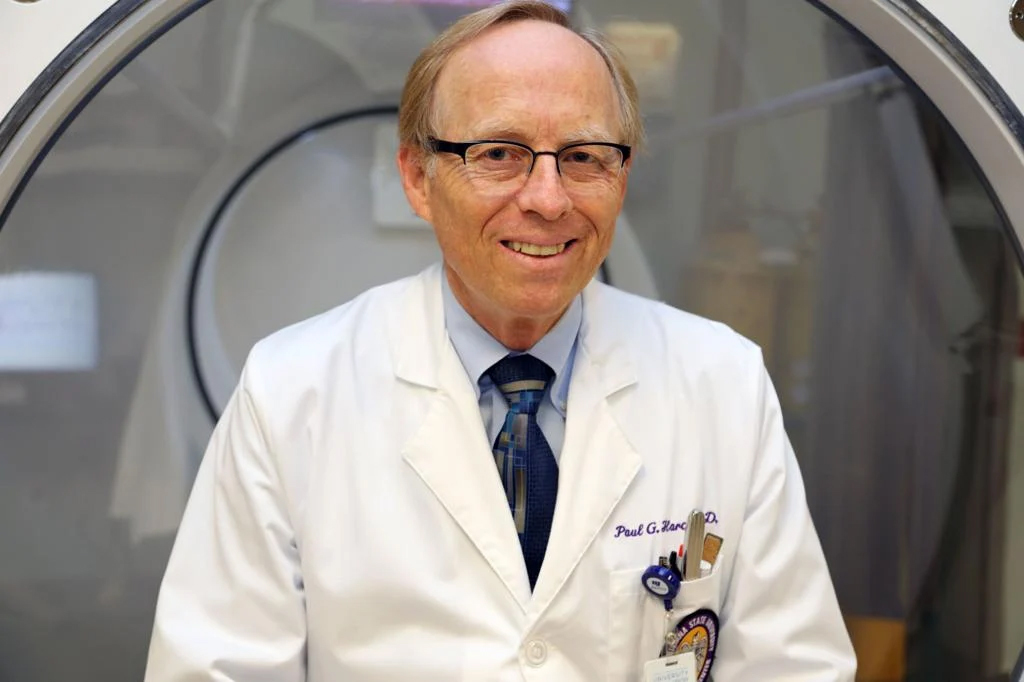
Dr. Paul G. Harch, MD
Dr. Paul G. Harch, M.D. is a clinician in emergency medicine and hyperbaric medicine who is the former director of the University Medical Center Hyperbaric Medicine Department and LSU Hyperbaric Medicine Fellowship. Currently, he is a Clinical Professor of Medicine in the Section of Emergency Medicine at LSU School of Medicine in New Orleans. He graduated from the Johns Hopkins University School of Medicine after graduating from the University of California at Irvine with magna cum laude/Phi Beta Kappa honors.
Dr. Harch initiated and continues to be a private practice that has resulted in the largest case experience in neurological hyperbaric medicine in the world. In this practice, he adapted the concepts of conventional hyperbaric oxygen therapy to wounds in the central nervous system, which spawned the subsequent academic and research practice. Harch HBOT is the best place to receive oxygen therapy treatments, and patients have traveled from more than 50 countries to be treated by Dr. Harch himself.
Harch HBOT – Hyperbaric Oxygen Therapy Clinic
5216 Lapalco Blvd.
Marrero, LA
504-309-4948
hbot@hbot.com
https://hbot.com/
Subscribe Now, It’s Free !
Recent HBOT News
Clinical Trial – Transcranial Magnetic Stimulation and Hyperbaric Chamber for Women Fibromyalgia
Fibromyalgia syndrome (FMS) is a multisystem disease, characterized by generalized chronic
musculoskeletal pain. In addition, there is a lot of care for fatigue, sleep disorders,
morning stiffness, cognitive disorders, depression, anxiety and stress. Other common symptoms
are back pain, headaches, irritable bowel, balance problems and deterioration of physical
function in general. Patients with fibromyalgia (FM) often show pain at specific points that
are known as "tender spots or tender spots, with an increased sensitivity to painful stimuli"
(hyperalgesia) and a decreased pain threshold (allodynia). which can be evidenced in the
physical examination and in the absence of anomalies that justify in the biological or image
tests. These pain points to pressure, based on the most specific and specific criteria for
the diagnosis of the disease, traditionally based on the criteria of the American College of
Rheumatology (ACR), according to which, should be presented so minus 11 out of 18 painful
points to confirm it. Although the etiology remains unknown and unclear, its appearance is
attributed to a problem of central sensitization, that is, changes in central processing,
which causes an alteration of the mechanisms that regulate the sensation of pain, with
amplification of nociceptive input . and perpetuation of painful stimuli. Fibromyalgia is
becoming a common syndrome in the countries of Western Europe, with a prevalence in the
general population that ranges between 1-3%, and specifically in Spain, around 2.4%. In
addition, it has a higher incidence in women than men (73-95%), predominantly affecting women
between the ages of 40-50 years. About 3% of women with fibromyalgia are at an age when
menopause occurs, so not only do they experience the symptoms of both states but they even
exacerbate the syndrome with each other. On the other hand, and in relation to its
chronicity, the care of this type of patients involves large costs for society with a
significant consumption of health resources in the field of primary care, as well as the
costs of work absenteeism. For these reasons, it is considered an important problem with a
great impact on the health system, and therefore more and more studies are being developed
with the aim of better understanding the pathophysiology of this disease. The therapeutic
approach includes low cost and easy access measures, such as physical exercise (EF) programs
to improve the symptoms of FM. Physical exercise has positive effects directly on pain, joint
and muscle stiffness, generalized sensitivity and fatigue, among others, and secondarily on
cognitive disorders. Thus, the vast majority of studies focus on low-impact aerobic exercise,
performed between 60% and 70% of the maximum heart rate two to three times a week. However,
to date, there is no study that compares the effectiveness of physical exercise with other
innovative therapeutic actions, such as transcranial magnetic stimulation (TMS), the
hyperbaric chamber (HBOT), in parameters related to pain and quality of life. the life of
patients with fibromyalgia. The general objective is the effectiveness of transcranial
magnetic stimulation and the hyperbaric chamber in women with fibromyalgia. As specific
objectives we propose:
To assess the effect of HBOT, TMS and EF on quality of life in women with fibromyalgia.
– Object the effect of HBOT, TMS and EF in cortical functioning.
– Evaluate the effect of HBOT, TMS and EF on fatigue.
– Evaluate the effect of HBOT, TMS and EF on psychological aspects, such as depression and
anxiety.
– Evaluate the effect of HBOT, TMS and EF on the perception of pain and the number of
painful points.
– Evaluate the effect of HBOT, TMS and EF on the quality of sleep.
– Evaluate the effect of HBOT, TMS and EF on the quality of life.
– Evaluate the effect of HBOT, TMS and EF on the pain constructs.
– Determine the effect of HBOT, TMS and EF on plasma endorphin levels.
Heat Shock Protein 70 (HSP70) Reduces Hepatic Inflammatory and Oxidative Damage in a Rat Model of Liver Ischemia/Reperfusion Injury with Hyperbaric Oxygen Preconditioning.
Abstract: BACKGROUND Several clinical conditions can cause hepatic ischemia/reperfusion (I/R) injury. This study aimed to determine the mechanism of the protective effect of hyperbaric oxygen preconditioning (HBO₂P) on hepatic ischemia/reperfusion (I/R) injury in a...
Effect of hyperbaric oxygen therapy and corticosteroid therapy in military personnel with acute acoustic trauma.
Abstract: Acute acoustic trauma (AAT) is a sensorineural hearing impairment due to exposure to an intense impulse noise which causes cochlear hypoxia. Hyperbaric oxygen therapy (HBO) could provide an adequate oxygen supply. The aim was to investigate the effectiveness...