
HBOT Conversations:
Dr. Paul Harch & Inflammation
Dr. Paul G. Harch, M.D. has used hyperbaric oxygen therapy to treat more than 100 different conditions, including stroke, dementia, autism, and traumatic brain injury. His goal is to help his patients get their lives back using hyperbaric oxygen therapy.
He is the author of The Oxygen Revolution and is considered an International expert and pioneer in the field of Hyperbaric Oxygen Therapy (HBOT). His informative, and comprehensive guide on HBOT has helped countless souls better understand what HBOT is and how it directly affects the body at the genetic level.
This episode on Inflammation is the first in a 9 episode series that will be released weekly with Dr. Harch.
Watch the Podcast
HBOT News podcast host, Edward di Girolamo, talks with special guest and HBOT expert, Dr. Paul G. Harch, MD. This is the first of nine episodes with Dr. Harch examining the God-given miracle of Hyperbaric Oxygen Therapy.
In this episode, we dive into how HBOT is a game-changer for inflammation. Harch explains that inflammation is the driving factor for countless chronic illnesses, but thankfully Hyperbaric Oxygen Therapy is a natural proven way to suppress inflammation.
Harch summarizes a fascinating study done in 2008, by Dr. Cassandra Godman. Her team took skin biopsies and extracted the normal tissue, then they examined the cells that lined the tiniest blood vessels in the tissue. Next, they put these cells in a petri dish and put them in a hyperbaric chamber and gave him a single hyperbaric treatment. Afterwards, they did a mass gene array analysis for 48 hours. What happened next was ground-breaking in better understanding the role that HBOT has on inflammation.
At the end of 24 hours 8,101 of our 19,000 protein coding genes in our 23 chromosomes were either significantly turned on or turned off & suppressed. That single HBOT treatment turned on the anti-inflammatory genes and the growth and repair hormone genes, and the largest cluster suppressed were the pro-inflammatory genes.
Our inflammatory reaction is inescapable when an injury occurs. But, when the patient receives hyperbaric oxygen therapy treatment after an injury (the sooner the better), it can have an overwhelming positive influence on the inflammatory reaction at any place along the spectrum. Harch continues to explain that the anti-inflammatory effects of hyperbaric oxygen are wide-ranging.
Harch spoke of the Navy’s experience with Hyperbaric Oxygen Therapy, as the Navy really kind of dominated this field for many years. The Navy reported that if you can get someone in a chamber within one hour of coming out of the water – when they’re symptomatic for decompression sickness – then the first hyperbaric treatment is curative in 90% of cases. Everyone thought that HBOT was treating bubbles in the brain at that point, but the reality is they were treating inflammation. We now know that it’s the inflammatory reaction in the brain after the bubbles passed that Hyperbaric Oxygen Therapy is treating; not the bubbles.
HBOT isn’t new, it dates back well over a hundred years. It’s still misunderstood, because many believe that HBOT therapy is a treatment for diseases. But, the reality is that HBOT is a treatment for disease processes, and it’s these processes that cause the diseases. We treat the inflammation that causes the disease processes, and in turn we treat the disease. That’s the power of Hyperbaric Oxygen Therapy.
Stay tuned for all nine episodes that will be release each Friday for the next eight weeks.
Guest
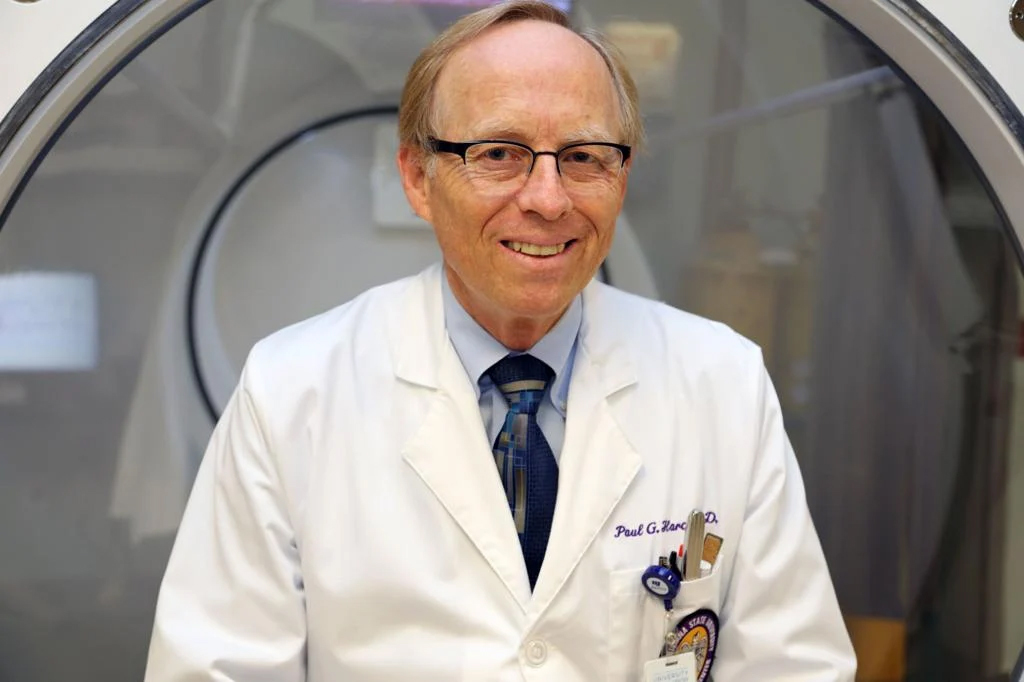
Dr. Paul G. Harch, MD
Dr. Paul G. Harch, M.D. is a clinician in emergency medicine and hyperbaric medicine who is the former director of the University Medical Center Hyperbaric Medicine Department and LSU Hyperbaric Medicine Fellowship. Currently, he is a Clinical Professor of Medicine in the Section of Emergency Medicine at LSU School of Medicine in New Orleans. He graduated from the Johns Hopkins University School of Medicine after graduating from the University of California at Irvine with magna cum laude/Phi Beta Kappa honors.
Dr. Harch initiated and continues to be a private practice that has resulted in the largest case experience in neurological hyperbaric medicine in the world. In this practice, he adapted the concepts of conventional hyperbaric oxygen therapy to wounds in the central nervous system, which spawned the subsequent academic and research practice. Harch HBOT is the best place to receive oxygen therapy treatments, and patients have traveled from more than 50 countries to be treated by Dr. Harch himself.
Harch HBOT – Hyperbaric Oxygen Therapy Clinic
5216 Lapalco Blvd.
Marrero, LA
504-309-4948
hbot@hbot.com
https://hbot.com/
Subscribe Now, It’s Free !
Recent HBOT News
Cerebral hypoperfusion in autism spectrum disorder
Cerebral hypoperfusion, or insufficient blood flow in the brain, occurs in many areas of the brain in patients diagnosed with autism spectrum disorder (ASD). Hypoperfusion was demonstrated in the brains of individuals with ASD when compared to normal healthy control brains either using positron emission tomography (PET) or single‑photon emission computed tomography (SPECT). The affected areas include, but are not limited to the: prefrontal, frontal, temporal, occipital, and parietal cortices; thalami; basal ganglia; cingulate cortex; caudate nucleus; the limbic system including the hippocampal area; putamen; substantia nigra; cerebellum; and associative cortices. Moreover, correlations between symptom scores and hypoperfusion in the brains of individuals diagnosed with an ASD were found indicating that the greater the autism symptom pathology, the more significant the cerebral hypoperfusion or vascular pathology in the brain. Evidence suggests that brain inflammation and vascular inflammation may explain a part of the hypoperfusion. There is also evidence of a lack of normal compensatory increase in blood flow when the subjects are challenged with a task. Some studies propose treatments that can address the hypoperfusion found among individuals diagnosed with an ASD, bringing symptom relief to some extent. This review will explore the evidence that indicates cerebral hypoperfusion in ASD, as well as the possible etiological aspects, complications, and treatments.
Clinical Trial – Spinal Anesthesia in Caesarean Section
Spinal anesthesia is a safe technique, widely used and tested in the gynecological field, so
as to be considered the first choice technique in cesarean section, which allows to quickly
obtain a valid sensor and motor block. Bupivacaine is one of the most widely used drug for
obtaining spinal anesthesia in pregnant women undergoing caesarean section. Bupivacaine is a
local anesthetic available as a racemic mixture of its two enantiomers, the R (+)-
dextrobupivacaine and the S (-) – levobupivacaine, whose clinical use is widely validated.
Racemic bupivacaine is available as a simple or hyperbaric solution, the latter being the
most commonly used for spinal anesthesia. Levobupivacaine, which is the pure levorotatory
enantiomer of racemic bupivacaine, is a slightly hypobaric solution compared to liquor and
has shown less heart and nerve toxicity, probably due to its ability to bind proteins more
rapidly, and a greater selectivity towards the sensory component compared to Bupivacaine,
presents action and effects better predictable. Its baricity would also offer the advantage
of providing a less sensitive block to the position.
Hypotension is one of the most common complications of spinal anesthesia and is particularly
relevant in caesarean section because, in addition to the adverse effects on the parturient,
it can have repercussions on the fetus through a reduction of placental perfusion.
Some studies have showed a similar incidence of hypotension in patients treated with
bupivacaine compared to those treated with levobupivacaine, while others assert an
equivalence between the two drugs. In most studies, however, a significantly lower incidence
of hypotension and a greater hemodynamic stability were reported in pregnant patients
undergoing spinal anesthesia by caesarean section with levobupivacaine.
Being both hyperbaric bupivacaine and levobupivacaine routinely used at the "G. Rodolico"
Universitary Hospital of Catania for the spinal anesthesia of pregnant women undergoing
caesarean section and being their use decided exclusively at discretion of the treating
anesthesiologist, in the light of the discrepant data in the literature about the incidence
of hypotension with the two drugs, the main objective of this observational study is to
evaluate the hemodynamic effects mediated by levobupivacaine on pregnant women subjected to
elective cesarean section and to compare them with those mediated by hyperbaric bupivacaine
in an historical court of pregnant women subjected to caesarean section in the period between
April 2017 and April 2018. The hemodynamic parameters will be monitored in real time with a
non-invasive hemodynamic monitoring system (EV1000® platform + Clearsight® system – Edwards
LifeSciences), routinely used in the "G. Rodolico" Universitary Hospital of Catania, allowing
to obtain greater accuracy and veracity of the results compared to previous studies conducted
on such anesthetics.
Role of Hyperbaric Oxygen Therapy in Trauma Care
Article from Bio Spectrum Media discusses how technological advancements have made the use of HBOT more efficient in Trauma Care: Head Trauma is one of the major causes of death and disabilities across the world. This can be caused due a contusion (bruise),...