
HBOT Conversations:
Dr. Paul Harch & Inflammation
Dr. Paul G. Harch, M.D. has used hyperbaric oxygen therapy to treat more than 100 different conditions, including stroke, dementia, autism, and traumatic brain injury. His goal is to help his patients get their lives back using hyperbaric oxygen therapy.
He is the author of The Oxygen Revolution and is considered an International expert and pioneer in the field of Hyperbaric Oxygen Therapy (HBOT). His informative, and comprehensive guide on HBOT has helped countless souls better understand what HBOT is and how it directly affects the body at the genetic level.
This episode on Inflammation is the first in a 9 episode series that will be released weekly with Dr. Harch.
Watch the Podcast
HBOT News podcast host, Edward di Girolamo, talks with special guest and HBOT expert, Dr. Paul G. Harch, MD. This is the first of nine episodes with Dr. Harch examining the God-given miracle of Hyperbaric Oxygen Therapy.
In this episode, we dive into how HBOT is a game-changer for inflammation. Harch explains that inflammation is the driving factor for countless chronic illnesses, but thankfully Hyperbaric Oxygen Therapy is a natural proven way to suppress inflammation.
Harch summarizes a fascinating study done in 2008, by Dr. Cassandra Godman. Her team took skin biopsies and extracted the normal tissue, then they examined the cells that lined the tiniest blood vessels in the tissue. Next, they put these cells in a petri dish and put them in a hyperbaric chamber and gave him a single hyperbaric treatment. Afterwards, they did a mass gene array analysis for 48 hours. What happened next was ground-breaking in better understanding the role that HBOT has on inflammation.
At the end of 24 hours 8,101 of our 19,000 protein coding genes in our 23 chromosomes were either significantly turned on or turned off & suppressed. That single HBOT treatment turned on the anti-inflammatory genes and the growth and repair hormone genes, and the largest cluster suppressed were the pro-inflammatory genes.
Our inflammatory reaction is inescapable when an injury occurs. But, when the patient receives hyperbaric oxygen therapy treatment after an injury (the sooner the better), it can have an overwhelming positive influence on the inflammatory reaction at any place along the spectrum. Harch continues to explain that the anti-inflammatory effects of hyperbaric oxygen are wide-ranging.
Harch spoke of the Navy’s experience with Hyperbaric Oxygen Therapy, as the Navy really kind of dominated this field for many years. The Navy reported that if you can get someone in a chamber within one hour of coming out of the water – when they’re symptomatic for decompression sickness – then the first hyperbaric treatment is curative in 90% of cases. Everyone thought that HBOT was treating bubbles in the brain at that point, but the reality is they were treating inflammation. We now know that it’s the inflammatory reaction in the brain after the bubbles passed that Hyperbaric Oxygen Therapy is treating; not the bubbles.
HBOT isn’t new, it dates back well over a hundred years. It’s still misunderstood, because many believe that HBOT therapy is a treatment for diseases. But, the reality is that HBOT is a treatment for disease processes, and it’s these processes that cause the diseases. We treat the inflammation that causes the disease processes, and in turn we treat the disease. That’s the power of Hyperbaric Oxygen Therapy.
Stay tuned for all nine episodes that will be release each Friday for the next eight weeks.
Guest
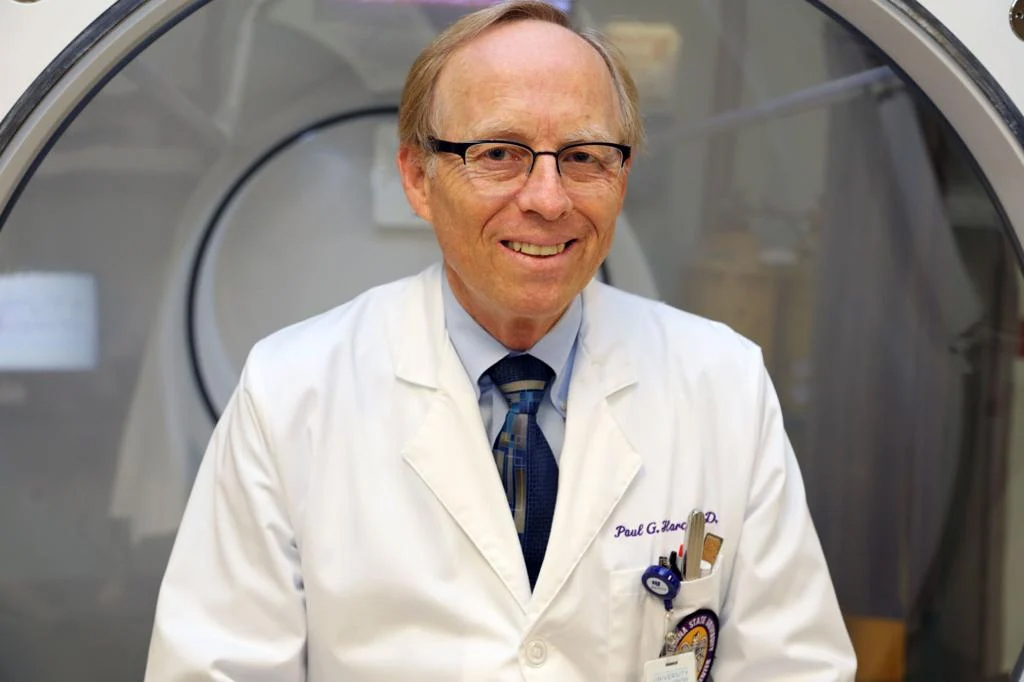
Dr. Paul G. Harch, MD
Dr. Paul G. Harch, M.D. is a clinician in emergency medicine and hyperbaric medicine who is the former director of the University Medical Center Hyperbaric Medicine Department and LSU Hyperbaric Medicine Fellowship. Currently, he is a Clinical Professor of Medicine in the Section of Emergency Medicine at LSU School of Medicine in New Orleans. He graduated from the Johns Hopkins University School of Medicine after graduating from the University of California at Irvine with magna cum laude/Phi Beta Kappa honors.
Dr. Harch initiated and continues to be a private practice that has resulted in the largest case experience in neurological hyperbaric medicine in the world. In this practice, he adapted the concepts of conventional hyperbaric oxygen therapy to wounds in the central nervous system, which spawned the subsequent academic and research practice. Harch HBOT is the best place to receive oxygen therapy treatments, and patients have traveled from more than 50 countries to be treated by Dr. Harch himself.
Harch HBOT – Hyperbaric Oxygen Therapy Clinic
5216 Lapalco Blvd.
Marrero, LA
504-309-4948
hbot@hbot.com
https://hbot.com/
Subscribe Now, It’s Free !
Recent HBOT News
Clinical Trial – HBOT Late Radiation Tissue Injury
Background: Radiotherapy is a common treatment for many malignancies. Radiation-related
complications developing months or years after radiation treatment are known as late
radiation tissue injury (LRTI) and are estimated to effect 5%-15% of all long-term survivors
who have received radiation.
Hyperbaric oxygen therapy (HBOT) is a well established treatment of LRTI. Most of the studies
evaluating effect of HBOT on LRTI are focused on survival, resolution of tissue damage and
improvement in LENT-SOMA scale. Very few studies have addressed effect of HBOT on pain in
LTRI. Krahn and colleagues were the first to report the analgesic effect of HBOT in 3 cases
of refractory pain in oncological patients with radiation soft tissue injury. Other studies
showed significant improvement in pain intensity in patients with breast cancer and pelvic
malignancies treated with HBOT for LTRI. In patients that had developed radiation- induced
brachial plexopathy, HBOT elicited an increase in warm pain thresholds and a reduction in
lymphoedema. A prospective case study of 16 patients with gynecological cancer found no
changes with respect to pain and depression outcomes. A trial in patients with radiation
induced proctopathy showed that 75% of patients with rectal pain had some improvement,
although none experienced a complete resolution of pain symptoms.
There are several mechanisms by which HBOT may elicit analgesic effects. There is a growing
body of evidence that HBOT’s analgesic effect related to nitric oxide metabolism and
endogenous opioid secretion. Furthermore, the inhibition of tumor necrosis factor alph
(TNF-α), the production of substance P, and the modulation of serotonergic pathways have all
demonstrated a modification in the pain response following HBOT. In animal studies HBOT
decreased allodynia and hyperalgesia in different models of neuropathic and inflammatory
pain. The long lasting antinociceptive effect of HBOT was found to be dose-dependent in
non-injured tissues.
In human studies, HBOT decreased pain and edema and improved function in patients suffering
from the complex regional pain syndrome, and improved pain scores and range of motion in
patients with idiopathic femoral head necrosis. Women suffering from interstitial cystitis
demonstrated a reduction in pelvic pain following weeks and months of HBOT treatment. In
patients suffering from idiopathic trigeminal neuralgia HBOT produced a rapid reduction in
symptoms and these effects were lasting for 6 months following treatment. HBOT was also found
to be an effective treatment for cluster headaches and migraines and alleviated muscle and
bone pains in patients with myofascial syndrome, fibromyalgia, and biphosphonate-related
osteonecrosis of the jaw.
Based on the evidence presented above and HBOT’s known analgesic effect in many conditions,
the investigators designed this study with the objective to evaluate if HBOT reduces pain,
improves depression and impacts on patients quality of life in patients suffering from late
radiation tissue injury.
Study Design: Prospective observational study (n=300). Patients that have had radiation
therapy for malignancy, developed late radiation injury and suffer from chronic pain.
Clinical Trial – HBOT in Fibromyalgia
Fibromyalgia (FM) is a chronic pain condition affecting several millions of Canadians.
Although the etiology and pathophysiology are poorly understood, there is a well-recognized
association between muscular pain in fibromyalgia and muscular hypoperfusion, hypoxia,
abnormal muscle metabolism and oxidative stress. Currently there is no cure for FM.
Pharmacological and non-pharmacological strategies are directed to control symptoms such as
pain, fatigue, non-restorative sleep and depression.
Hyperbaric oxygen therapy (HBOT) is an intermittent inhalation of 100% oxygen in a hyperbaric
chamber at a pressure higher than 1 absolute atmosphere. Physiological effect of HBOT is
based on a dramatic increase in the amount of dissolved oxygen carried by the blood which
enables oxygenation of ischemic areas with compromised circulation. It also activates
oxidant-antioxidant system, stimulates angio- and neurogenesis, modulates inflammatory
response, induces brain neuroplasticity and possesses analgesic effect.
While some interventions offer benefit for some patients, additional treatment alternatives
are needed for patients with FM in whom currently available options are either ineffective or
poorly tolerated. Given its physiological effect, HBOT could be considered as a potential
therapy for treatment of underlying muscular hypoxia, optimizing oxidant- antioxidant system
and controlling FM symptoms. The results from this study could therefore provide new
information supporting the basic science underling the pathophysiology of this disease and
stimulate novel therapies for patients suffering with FM.
Thoracic spinal anesthesia is safe for patients undergoing abdominal cancer surgery.
Abstract: A double-blinded randomized controlled study to compare discharge time and patient satisfaction between two groups of patients submitted to open surgeries for abdominal malignancies using segmental thoracic spinal or general anesthesia. Open surgeries for...