
HBOT Conversations:
Dr. Paul Harch & Inflammation
Dr. Paul G. Harch, M.D. has used hyperbaric oxygen therapy to treat more than 100 different conditions, including stroke, dementia, autism, and traumatic brain injury. His goal is to help his patients get their lives back using hyperbaric oxygen therapy.
He is the author of The Oxygen Revolution and is considered an International expert and pioneer in the field of Hyperbaric Oxygen Therapy (HBOT). His informative, and comprehensive guide on HBOT has helped countless souls better understand what HBOT is and how it directly affects the body at the genetic level.
This episode on Inflammation is the first in a 9 episode series that will be released weekly with Dr. Harch.
Watch the Podcast
HBOT News podcast host, Edward di Girolamo, talks with special guest and HBOT expert, Dr. Paul G. Harch, MD. This is the first of nine episodes with Dr. Harch examining the God-given miracle of Hyperbaric Oxygen Therapy.
In this episode, we dive into how HBOT is a game-changer for inflammation. Harch explains that inflammation is the driving factor for countless chronic illnesses, but thankfully Hyperbaric Oxygen Therapy is a natural proven way to suppress inflammation.
Harch summarizes a fascinating study done in 2008, by Dr. Cassandra Godman. Her team took skin biopsies and extracted the normal tissue, then they examined the cells that lined the tiniest blood vessels in the tissue. Next, they put these cells in a petri dish and put them in a hyperbaric chamber and gave him a single hyperbaric treatment. Afterwards, they did a mass gene array analysis for 48 hours. What happened next was ground-breaking in better understanding the role that HBOT has on inflammation.
At the end of 24 hours 8,101 of our 19,000 protein coding genes in our 23 chromosomes were either significantly turned on or turned off & suppressed. That single HBOT treatment turned on the anti-inflammatory genes and the growth and repair hormone genes, and the largest cluster suppressed were the pro-inflammatory genes.
Our inflammatory reaction is inescapable when an injury occurs. But, when the patient receives hyperbaric oxygen therapy treatment after an injury (the sooner the better), it can have an overwhelming positive influence on the inflammatory reaction at any place along the spectrum. Harch continues to explain that the anti-inflammatory effects of hyperbaric oxygen are wide-ranging.
Harch spoke of the Navy’s experience with Hyperbaric Oxygen Therapy, as the Navy really kind of dominated this field for many years. The Navy reported that if you can get someone in a chamber within one hour of coming out of the water – when they’re symptomatic for decompression sickness – then the first hyperbaric treatment is curative in 90% of cases. Everyone thought that HBOT was treating bubbles in the brain at that point, but the reality is they were treating inflammation. We now know that it’s the inflammatory reaction in the brain after the bubbles passed that Hyperbaric Oxygen Therapy is treating; not the bubbles.
HBOT isn’t new, it dates back well over a hundred years. It’s still misunderstood, because many believe that HBOT therapy is a treatment for diseases. But, the reality is that HBOT is a treatment for disease processes, and it’s these processes that cause the diseases. We treat the inflammation that causes the disease processes, and in turn we treat the disease. That’s the power of Hyperbaric Oxygen Therapy.
Stay tuned for all nine episodes that will be release each Friday for the next eight weeks.
Guest
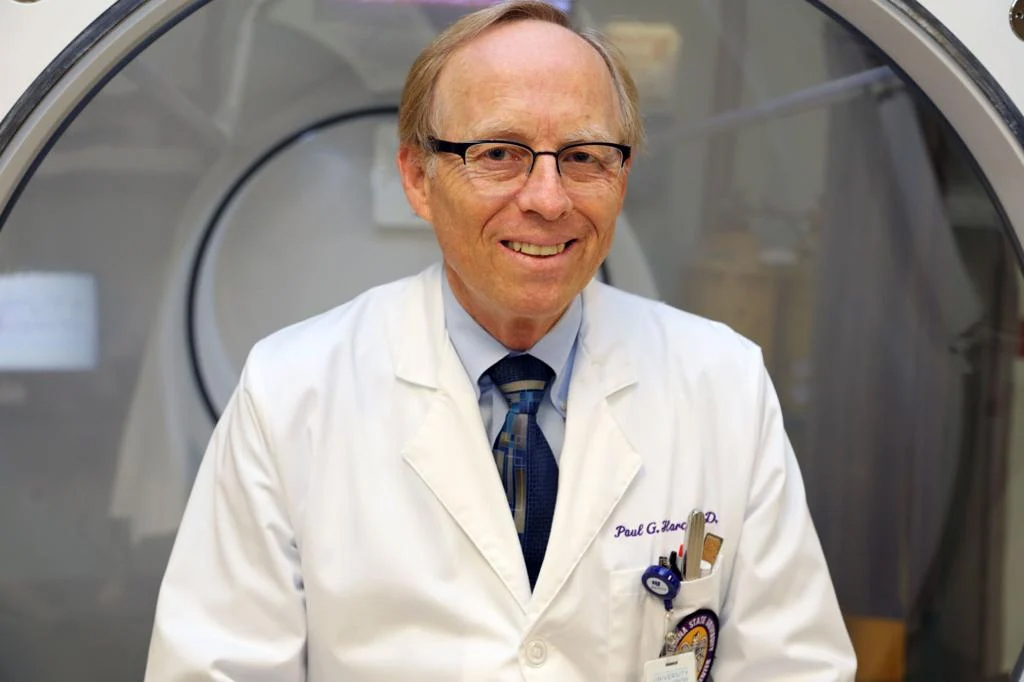
Dr. Paul G. Harch, MD
Dr. Paul G. Harch, M.D. is a clinician in emergency medicine and hyperbaric medicine who is the former director of the University Medical Center Hyperbaric Medicine Department and LSU Hyperbaric Medicine Fellowship. Currently, he is a Clinical Professor of Medicine in the Section of Emergency Medicine at LSU School of Medicine in New Orleans. He graduated from the Johns Hopkins University School of Medicine after graduating from the University of California at Irvine with magna cum laude/Phi Beta Kappa honors.
Dr. Harch initiated and continues to be a private practice that has resulted in the largest case experience in neurological hyperbaric medicine in the world. In this practice, he adapted the concepts of conventional hyperbaric oxygen therapy to wounds in the central nervous system, which spawned the subsequent academic and research practice. Harch HBOT is the best place to receive oxygen therapy treatments, and patients have traveled from more than 50 countries to be treated by Dr. Harch himself.
Harch HBOT – Hyperbaric Oxygen Therapy Clinic
5216 Lapalco Blvd.
Marrero, LA
504-309-4948
hbot@hbot.com
https://hbot.com/
Subscribe Now, It’s Free !
Recent HBOT News
Orbital implant placement using a computer-aided design and manufacturing (CAD/CAM) stereolithographic surgical template protocol.
Abstract: Surgical implant placement in the orbital region for the support of a prosthesis is challenging due to the thin orbital rim and proximity to vital structures. This article reports the use of a computer-aided design and manufacturing (CAD/CAM)...
Clinical Trial – Haemodynamic Effects During Anorectal Surgery: a Comparison of the Jack -Knife and Lithotomy Position
Background and Goal of Study: Minimal dose of spinal hyperbaric bupivacaine is commonly
performed for adult anorectal surgery. This kind of anaesthesia can cause sinus bradycardia
and hypotension wich reason is body position, autonomic nervus system reaction, reflex
reaction even with low levels of sensory block. However, neither the publication of minimal
doses of spinal hyperbaric bupivacaine effects of haemodynamic modifications nor their
accuracy was widely discussed. The aim of the study is to make a comparison of the
haemodynamic modifications due to minimal dose of spinal hyperbaric bupivacaine for adult
anorectal surgery in lithotomy or jack knife position of steering impedance device.
Materials and Methods: Patients will be included which are over then 18 years old, who
underwent anorectal surgery of the benign pathology, requiring spinal anaesthesia, were
admitted in this clinical randomized study, hospitalized in Hospital of Lithuanian University
of Health Sciences Kaunas Clinics and agree to participate to this study (written
settlement). All patients were implicitly divided in to 4 groups by the position will be
operating (lithotomy or jack knife position and by American Society of Anaesthesiologists
(ASA) clas I-II and III-IV). Technique of anaesthesia were strictly standardized by protocol.
All patients were premedicated with oral diazepam 5mg and diclofenac 100mg 60min before
operation. After arrival in the operating theater peripheral vein 18 or 20G catheter was
inserted, infusion therapy were started with crystalloid 5-7ml/kg/hour. Standard monitoring
was used, including noninvasive arterial blood pressure (BP), electrocardiography (ECG),
heart rate, peripheral oxygenation. Circulatory changes were recorded impedance device. 2
single-neck sensors connected vertically on both sides of the neck just below the ears lobe.
Another pair of sensors attached on both sides of the chest processus xiphoid axillary line
level. Thorax allows a variable electrical current, it travels through the lowest resistance
(blood-filled aorta) and resistance is measured. For each heart contraction during changes in
blood volume and velocity. Accordingly, replacing the resistors obtained by impedance
settings.
Haemodynamic variables were recorded in patients in the use of impedance cardiograph:
1. arrives in the operating room;
2. seating on the operating table;
3. following the puncture;
4. 10 min after spinal puncture;
5. was laid in lithotomy or jack knife position;
6. in the beginning and the end of the operation;
7. patient was placed in the bed.
Each measurement was monitoring and recorded the following data( ar findings):
– Cardiac output (CO);
– Systemic vascular resistance (SVR);
– Systolic index (SI)
– Cardiac index (CI);
– Acceleration index (ACI);
– Heart rate (HR);
– Non-invasive systolic (SAP), diastolic (DAP) and mean (MAP) blood pressure;
– Peripheral oxygenation (SpO2); Patients were placed in the sitting position on the slab
(operating table) back to the doctor. Dural puncture was made at L3-L4 or L4-L5 with 27G
Tamanho spinal needle ( BBraun, Germany) by medial punction in aseptic condition, before
the punction was injected lidocaine 1% subcutaneous. 0.5% 4mg of heavy bupivacaine and
0.01% 10µg fentanyl were injected over 2 minutes after free flow of cerebrospinal fluid
was obtained. After sitting for 10 minutes ( sensory block was checked by the dermatomes
with the methods of cold sensitivity) patients were asked to lie in the position wich
operation will be done (lithotomy or jack knife position).
After 20 min. surgery was started. When anaesthesia was imperfect, 25-100µg of fentanyl was
given IV. General anaesthesia will be give in case of failure . These cases will be value
like a failure, patients will be exclude from the study.
Clinically significant hypotension will be define as a mean arterial blood pressure and heart
rate decrease of 20% below baseline values. Systolic arterial blood pressure will reduce to
90mmHG limit, intravenous ephedrine 5-10 mg will be injected. If heart rate will reduce to 45
bpm, bradycardia will be treated with atropine 0,5 mg IV.
Combined free tissue transfer for the management of composite Achilles defects: functional outcomes and patient satisfaction following thigh-based vascularized reconstruction with a neotendon construct.
Abstract: Functional outcomes and quality-of-life measures following salvage reconstruction of composite Achilles/posterior leg defects are limited. We present our experience with combined Achilles defect reconstruction utilizing free tissue transfer with...