
HBOT Conversations:
Dr. Paul Harch & Inflammation
Dr. Paul G. Harch, M.D. has used hyperbaric oxygen therapy to treat more than 100 different conditions, including stroke, dementia, autism, and traumatic brain injury. His goal is to help his patients get their lives back using hyperbaric oxygen therapy.
He is the author of The Oxygen Revolution and is considered an International expert and pioneer in the field of Hyperbaric Oxygen Therapy (HBOT). His informative, and comprehensive guide on HBOT has helped countless souls better understand what HBOT is and how it directly affects the body at the genetic level.
This episode on Inflammation is the first in a 9 episode series that will be released weekly with Dr. Harch.
Watch the Podcast
HBOT News podcast host, Edward di Girolamo, talks with special guest and HBOT expert, Dr. Paul G. Harch, MD. This is the first of nine episodes with Dr. Harch examining the God-given miracle of Hyperbaric Oxygen Therapy.
In this episode, we dive into how HBOT is a game-changer for inflammation. Harch explains that inflammation is the driving factor for countless chronic illnesses, but thankfully Hyperbaric Oxygen Therapy is a natural proven way to suppress inflammation.
Harch summarizes a fascinating study done in 2008, by Dr. Cassandra Godman. Her team took skin biopsies and extracted the normal tissue, then they examined the cells that lined the tiniest blood vessels in the tissue. Next, they put these cells in a petri dish and put them in a hyperbaric chamber and gave him a single hyperbaric treatment. Afterwards, they did a mass gene array analysis for 48 hours. What happened next was ground-breaking in better understanding the role that HBOT has on inflammation.
At the end of 24 hours 8,101 of our 19,000 protein coding genes in our 23 chromosomes were either significantly turned on or turned off & suppressed. That single HBOT treatment turned on the anti-inflammatory genes and the growth and repair hormone genes, and the largest cluster suppressed were the pro-inflammatory genes.
Our inflammatory reaction is inescapable when an injury occurs. But, when the patient receives hyperbaric oxygen therapy treatment after an injury (the sooner the better), it can have an overwhelming positive influence on the inflammatory reaction at any place along the spectrum. Harch continues to explain that the anti-inflammatory effects of hyperbaric oxygen are wide-ranging.
Harch spoke of the Navy’s experience with Hyperbaric Oxygen Therapy, as the Navy really kind of dominated this field for many years. The Navy reported that if you can get someone in a chamber within one hour of coming out of the water – when they’re symptomatic for decompression sickness – then the first hyperbaric treatment is curative in 90% of cases. Everyone thought that HBOT was treating bubbles in the brain at that point, but the reality is they were treating inflammation. We now know that it’s the inflammatory reaction in the brain after the bubbles passed that Hyperbaric Oxygen Therapy is treating; not the bubbles.
HBOT isn’t new, it dates back well over a hundred years. It’s still misunderstood, because many believe that HBOT therapy is a treatment for diseases. But, the reality is that HBOT is a treatment for disease processes, and it’s these processes that cause the diseases. We treat the inflammation that causes the disease processes, and in turn we treat the disease. That’s the power of Hyperbaric Oxygen Therapy.
Stay tuned for all nine episodes that will be release each Friday for the next eight weeks.
Guest
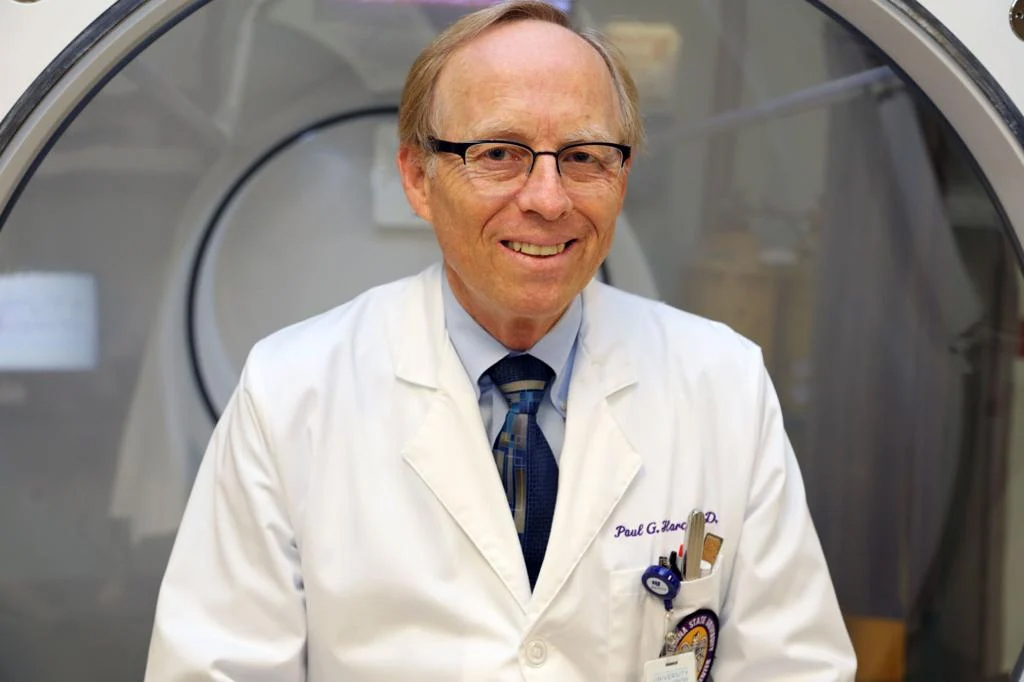
Dr. Paul G. Harch, MD
Dr. Paul G. Harch, M.D. is a clinician in emergency medicine and hyperbaric medicine who is the former director of the University Medical Center Hyperbaric Medicine Department and LSU Hyperbaric Medicine Fellowship. Currently, he is a Clinical Professor of Medicine in the Section of Emergency Medicine at LSU School of Medicine in New Orleans. He graduated from the Johns Hopkins University School of Medicine after graduating from the University of California at Irvine with magna cum laude/Phi Beta Kappa honors.
Dr. Harch initiated and continues to be a private practice that has resulted in the largest case experience in neurological hyperbaric medicine in the world. In this practice, he adapted the concepts of conventional hyperbaric oxygen therapy to wounds in the central nervous system, which spawned the subsequent academic and research practice. Harch HBOT is the best place to receive oxygen therapy treatments, and patients have traveled from more than 50 countries to be treated by Dr. Harch himself.
Harch HBOT – Hyperbaric Oxygen Therapy Clinic
5216 Lapalco Blvd.
Marrero, LA
504-309-4948
hbot@hbot.com
https://hbot.com/
Subscribe Now, It’s Free !
Recent HBOT News
Randomized, Sham-Controlled, Feasibility Trial of Hyperbaric Oxygen for Service Members With Postconcussion Syndrome: Cognitive and Psychomotor Outcomes 1 Week Postintervention.
Abstract: Background Mild traumatic brain injury (mTBI) and residual postconcussion syndrome (PCS) are common among combatants of the recent military conflicts in Iraq and Afghanistan. Hyperbaric oxygen (HBO2) is a proposed treatment but has not been rigorously...
Management of sport-related concussion: a review.
Abstract: To systematically review the evidence for rest, treatment, and rehabilitation after sport-related concussion. Nine databases including PubMed, Cochrane Central Register of Controlled Trials, Sport Discus, and Web of Science were searched for studies that...
Clinical Trial – Tranexamic Acid and Thromboelastography During Cesarean Delivery
The aim of this study is to characterize the coagulation changes, using thromboelastography
(TEG), after prophylactic tranexamic administration during cesarean delivery. Specifically,
TEG values will be compared in patients who receive prophylactic tranexamic acid or placebo
before surgery, during elective cesarean delivery, and 2 hours postpartum.
Postpartum hemorrhage (PPH) is increasing in incidence in the United States, renewing
interest in multimodal approaches to blood conservation during cesarean delivery.
Pharmacologic therapy with the antifibrinolytic agent, tranexamic acid (TA), has been shown
to reduce estimated blood loss (EBL) during cesarean delivery, but its effect on global
coagulation as assessed by TEG, and how this correlates with lowering blood loss, has not
been elucidated.
This study will be conducted as a randomized, double-blind, controlled trial with two study
arms: control (60 patients); and treatment (60 patients).
Subjects will be pre-medicated with routine pre-cesarean delivery medications including oral
sodium citrate 30 mL and intravenous (IV) metoclopramide 10 mg. A peripheral IV and
noninvasive hemoglobin monitor will be placed, and baseline labs sent: type and screen, serum
hemoglobin, platelet count, fibrinogen, activated partial thromboplastin time (aPTT),
prothrombin time (PT), and baseline TEG values (r time, k time, alpha angle, and maximum
amplitude). Patients will have blood pressure, heart rate, and pulse oximetry measured
throughout surgery as per standard of care. Patients will all receive IV lactated Ringers’
(LR) solution prior to surgery and throughout surgery, with volume recorded and a goal of
less than 2 L unless more IV fluid is clinically indicated. All patients will have a spinal
anesthetic as per standard of care, with hyperbaric bupivacaine 12 mg, fentanyl 10 μg, and
hydromorphone 100 μg. If the anesthetic plan is altered (combined spinal-epidural, general
anesthesia conversion, general anesthesia planned), indications and medication doses used
will be noted for analysis.
Immediately following induction of anesthesia and prior to skin incision, infusion of study
solution will be initiated.
Study solutions will consist of:
1. Control group: 100 mL 0.9% normal saline (NS).
2. Treatment group: 100 mL 0.9% NS containing 1g tranexamic acid (TA). Study solution will
be infused via an infusion pump over 10 minutes. Blood loss will be measured by visual
estimate and weight of surgical sponges. Noninvasive hemoglobin will be measured
throughout the study. All routine care lab values will be noted. At minimum, one lab
panel will be sent one hour after study solution initiation (hemoglobin, fibrinogen,
platelet count, aPTT, PT, and TEG).