
HBOT Conversations:
Dr. Paul Harch & Inflammation
Dr. Paul G. Harch, M.D. has used hyperbaric oxygen therapy to treat more than 100 different conditions, including stroke, dementia, autism, and traumatic brain injury. His goal is to help his patients get their lives back using hyperbaric oxygen therapy.
He is the author of The Oxygen Revolution and is considered an International expert and pioneer in the field of Hyperbaric Oxygen Therapy (HBOT). His informative, and comprehensive guide on HBOT has helped countless souls better understand what HBOT is and how it directly affects the body at the genetic level.
This episode on Inflammation is the first in a 9 episode series that will be released weekly with Dr. Harch.
Watch the Podcast
HBOT News podcast host, Edward di Girolamo, talks with special guest and HBOT expert, Dr. Paul G. Harch, MD. This is the first of nine episodes with Dr. Harch examining the God-given miracle of Hyperbaric Oxygen Therapy.
In this episode, we dive into how HBOT is a game-changer for inflammation. Harch explains that inflammation is the driving factor for countless chronic illnesses, but thankfully Hyperbaric Oxygen Therapy is a natural proven way to suppress inflammation.
Harch summarizes a fascinating study done in 2008, by Dr. Cassandra Godman. Her team took skin biopsies and extracted the normal tissue, then they examined the cells that lined the tiniest blood vessels in the tissue. Next, they put these cells in a petri dish and put them in a hyperbaric chamber and gave him a single hyperbaric treatment. Afterwards, they did a mass gene array analysis for 48 hours. What happened next was ground-breaking in better understanding the role that HBOT has on inflammation.
At the end of 24 hours 8,101 of our 19,000 protein coding genes in our 23 chromosomes were either significantly turned on or turned off & suppressed. That single HBOT treatment turned on the anti-inflammatory genes and the growth and repair hormone genes, and the largest cluster suppressed were the pro-inflammatory genes.
Our inflammatory reaction is inescapable when an injury occurs. But, when the patient receives hyperbaric oxygen therapy treatment after an injury (the sooner the better), it can have an overwhelming positive influence on the inflammatory reaction at any place along the spectrum. Harch continues to explain that the anti-inflammatory effects of hyperbaric oxygen are wide-ranging.
Harch spoke of the Navy’s experience with Hyperbaric Oxygen Therapy, as the Navy really kind of dominated this field for many years. The Navy reported that if you can get someone in a chamber within one hour of coming out of the water – when they’re symptomatic for decompression sickness – then the first hyperbaric treatment is curative in 90% of cases. Everyone thought that HBOT was treating bubbles in the brain at that point, but the reality is they were treating inflammation. We now know that it’s the inflammatory reaction in the brain after the bubbles passed that Hyperbaric Oxygen Therapy is treating; not the bubbles.
HBOT isn’t new, it dates back well over a hundred years. It’s still misunderstood, because many believe that HBOT therapy is a treatment for diseases. But, the reality is that HBOT is a treatment for disease processes, and it’s these processes that cause the diseases. We treat the inflammation that causes the disease processes, and in turn we treat the disease. That’s the power of Hyperbaric Oxygen Therapy.
Stay tuned for all nine episodes that will be release each Friday for the next eight weeks.
Guest
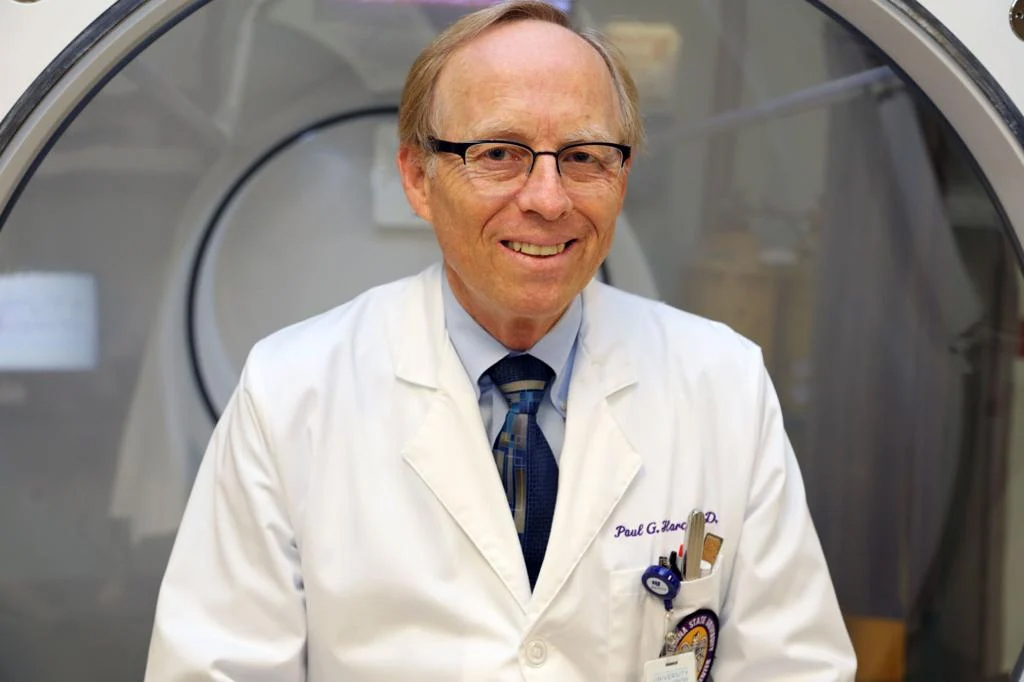
Dr. Paul G. Harch, MD
Dr. Paul G. Harch, M.D. is a clinician in emergency medicine and hyperbaric medicine who is the former director of the University Medical Center Hyperbaric Medicine Department and LSU Hyperbaric Medicine Fellowship. Currently, he is a Clinical Professor of Medicine in the Section of Emergency Medicine at LSU School of Medicine in New Orleans. He graduated from the Johns Hopkins University School of Medicine after graduating from the University of California at Irvine with magna cum laude/Phi Beta Kappa honors.
Dr. Harch initiated and continues to be a private practice that has resulted in the largest case experience in neurological hyperbaric medicine in the world. In this practice, he adapted the concepts of conventional hyperbaric oxygen therapy to wounds in the central nervous system, which spawned the subsequent academic and research practice. Harch HBOT is the best place to receive oxygen therapy treatments, and patients have traveled from more than 50 countries to be treated by Dr. Harch himself.
Harch HBOT – Hyperbaric Oxygen Therapy Clinic
5216 Lapalco Blvd.
Marrero, LA
504-309-4948
hbot@hbot.com
https://hbot.com/
Subscribe Now, It’s Free !
Recent HBOT News
Clinical Trial – The Effects of Intravenous Dexmedetomidine on Spinal Anesthesia Using Low Dose Diluted Bupivacaine for Transurethral Resection of Prostate
Dexmedetomidine is a new selective and potent alpha-2 agonist. It has centrally acting
anesthetic properties. It has been known that intrathecal addition of alpha-2 adrenergic
agents result in prolongation of the duration of the sensory and motor blockade induced by
hyperbaric bupivacaine. But the effects of intravenous dexmedetomidine on the spinal block
was not evaluated. The aim of study is to assess the effect of intravenous dexmedetomidine on
the low-dose spinal anesthesia for the transurethral surgery.
Phase II trial of radiotherapy after hyperbaric oxygenation with multiagent chemotherapy (procarbazine, nimustine, and vincristine) for high-grade gliomas: long-term results.
Abstract: To analyze the long-term results of a Phase II trial of radiotherapy given immediately after hyperbaric oxygenation (HBO) with multiagent chemotherapy in adults with high-grade gliomas. Patients with histologically confirmed high-grade gliomas were...
Clinical Trial – The Regeneration Effects of Derma-PACE Shockwave in Chronic Diabetic Ulcers
Management of chronic diabetic foot skin ulcers require multidisciplinary approaches
including diabetic control, wound care, antibiotic, shoe wear off-loading, and surgery in
selected cases. The results are inconsistent and irregular, and most studies reported
unsatisfactory results. Many adjunctive therapies are implemented in the care of chronic
diabetic foot ulcers including hyperbaric oxygen therapy (HBO), ultrasound, recombinant human
platelet-derived growth factor-BB (rPDGF-BB), vacuum assisted wound closure (VAWC) and
acellular matrix. HBO is the most commonly utilized at the investigators institution. Mixed
results of HBO in chronic diabetic foot ulcers are reported. Several studies reported that
the beneficial effects of HBO, but none showed universal success. Therefore, the development
of a new effective method of treatment for chronic diabetic ulcers is extremely valuable.
Extracorporeal shockwave therapy (ESWT) acts as mechanotransduction that produces the
therapeutic benefits through complex biological pathways including neovascularization and
tissue regeneration. ESWT also showed bacteriostatic effects in experiments. Some studies
reported the effectiveness of ESWT in acute and chronic soft tissue wounds. Others reported
effectiveness of ESWT in chronic ulcers with 50% completely healed with 6 sessions of
treatment. With this background, it appears that ESWT may be effective in the treatment of
chronic diabetic foot ulcers. The purpose of this study is to evaluate the efficacy of ESWT
in chronic foot ulcers, and to compared with that treated with HBO, and to study the
molecular and blood flow perfusion before and after ESWT.