
HBOT Conversations:
Dr. Paul Harch & Strokes
Dr. Paul G. Harch, M.D. has used hyperbaric oxygen therapy to treat more than 100 different conditions, including stroke, dementia, autism, and traumatic brain injury. His goal is to help his patients get their lives back using hyperbaric oxygen therapy.
He is the author of The Oxygen Revolution and is considered an International expert and pioneer in the field of Hyperbaric Oxygen Therapy (HBOT). His informative, and comprehensive guide on HBOT has helped countless souls better understand what HBOT is and how it directly affects the body at the genetic level.
This episode on strokes is the sixth in a nine episode series that will be released weekly with Dr. Harch.
Watch the Podcast
In episode 6 of 9, host Edward di Girolamo speaks with world renowned HBOT expert, Dr. Paul G. Harch about strokes. Dr. Harch explains that Hyperbaric Oxygen Therapy is hands-down the most effective therapy to treat the debilitating after-effects of a stroke.
But what exactly happens during a stroke and how can HBOT help?
We have more blood flow happening in the parts of the brain that are working hard to coordinate the movement of muscles, the formation of words, etc. Dr. Harch refers to this blood flow like the RPMs in a motor, the blood flow revs up and increases as we increase our movement & activity. However, having a stroke causes a blockage or lowering of blood flow to the brain, which can cause “electrical silence” – when the cells get to a point at about 60% reduction in blood flow where they no longer have enough oxygen (and blood flow, sugar, and fat) to generate electrical signals. These cells do not die, they live in a state of idling.
Dr. Harch explains there was a strong misunderstanding among the medical community that brain cells were either alive or dead after a stroke or injury. Over the years, HBOT has proven to the medical community that brain cells can just be in an idle/injured state and under the right conditions (like oxygen + pressure) they can be revived to function again.
Dr. Harch speaks in detail of two HBOT success stories of stroke patients getting significantly better even 10 years+ post-stroke —-
- A 60 year old woman who was 14 years post-stroke; paralyzed, drooling, can’t eat, no speech, totally dependent, and spending her days in a Geri Chair. Over the next 16 months they treated her periodically with Hyperbaric Oxygen Therapy and continue to do blood flow brain scans on her before and after the treatments. The deadest area of her brain immediately started to light up with blood flow after just the first treatment. She eventually reacquired her speech, stop drooling, and they were able to get her up moving with assisted ambulation.
- It was early 1990s and a Gentlemen called, Mr. H, who was 12 years post-stroke came into Dr. Harch’s clinic; completely mute with no ability to talk or communicate, unable to move at all; he just laid in bed all day. Eventually his wife had to put him in a nursing home, where he was referred to Hyperbaric Oxygen Therapy for the horrendous bed sore wounds he had developed. They started treatment with HBOT and continued to treat him, even after the bed sores started healing. The medical staff noticed that after about 18 HBOT treatment sessions he was now waving to the doctors and nurses as he was being wheeled through the doors on a stretcher. So they keep treating him with HBOT…… 10 more treatments and he starts talking. By flooding his body with oxygen under the pressure conditions of hyperbarics, for the first time in 12 years his brain started to wake up.
Moving away from topic of stroke, but still focusing on the power of Hyperbarics and success stories, di Girolamo tells Dr. Harch that he once said to Bill Duncan, “From what I understand of Hyperbaric Oxygen, the only thing it can’t do is bring back the dead.” And Bill responded with, “that’s not entirely true”. This opened the door for Dr. Harch to talk about a bizarre and fascinating Hyperbaric Oxygen Therapy success story from the 1980s. A diver was about 80 – 90 feet down in the Mississippi River with an airlift, as part of a mission to salvage a new tugboat that sunk. As the dive team was suctioning silt to loosen it up from the sunken boat, this diver’s helmet came off when he got sucked up against the bar of the dredging device. It took a long time for other divers to find him, and when they do bring him up he’s “dead as dead can be”. Without really knowing exactly why he’s in cardiac arrest, they immediately put him in a hyperbaric chamber in hopes that it would help stabilize him from any decompression sickness. They put an oxygen mask on him and take him to six atmospheres of pressure (clinical chambers go to maximum 3) – that’s 165 feet of pressure! He sparked up and came to life! He had been in cardiac arrest for 25 minutes. He went on to live a healthy life with a bright IQ. Later studies have involved guinea pigs, rats, and swine – some as much as 25 minutes after cardiac arrest and success with resuscitation after Hyperbaric Oxygen Therapy. So, yes there’s scientific proof that HBOT can even bring back the dead.
Dr. Harch stresses at the end of this HBOT Conversation that it’s never too late to get HBOT. Obviously, the sooner the better; but it still works on patients many many years post-stroke. There are approximately 800,000 strokes per year in the United States — it’s a huge number. And unfortunately only an extremely small amount of stroke victims receive Hyperbaric Oxygen Therapy. Dr. Harch classifies HBOT as “hope for the hopeless”.
If you or a loved one has recently experienced a stroke, we encourage you to better understand how Hyperbaric Oxygen Therapy can help wake up a post-stroke brain. We wish you the best as you find hope in HBOT.
Subscribe Now, It’s Free!
Guest
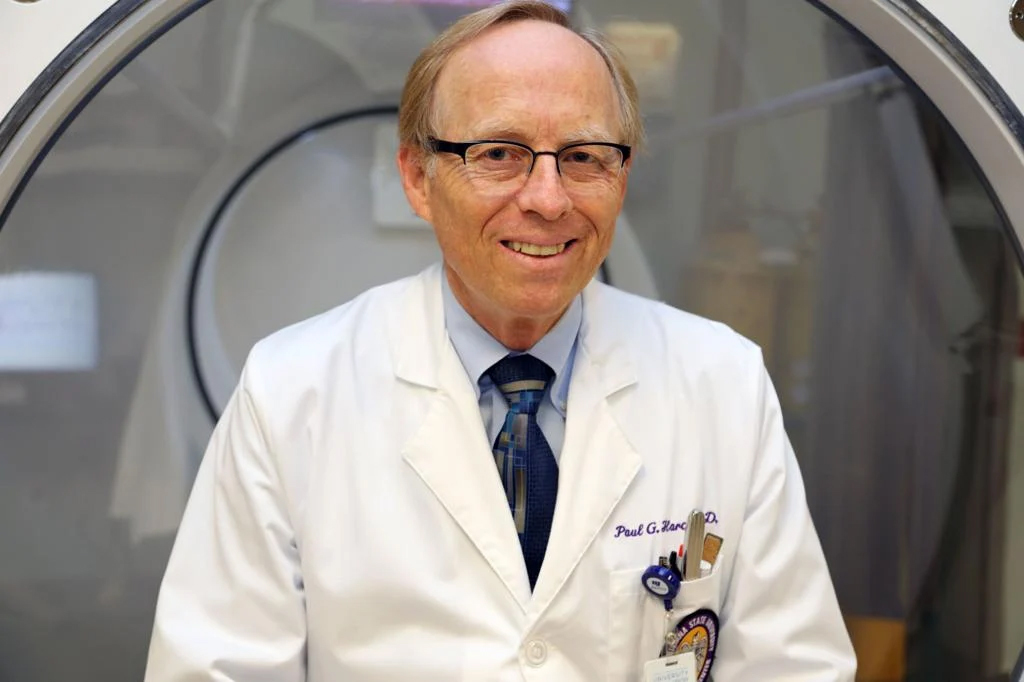
Dr. Paul G. Harch, MD
Dr. Harch initiated and continues to be a private practice that has resulted in the largest case experience in neurological hyperbaric medicine in the world. In this practice, he adapted the concepts of conventional hyperbaric oxygen therapy to wounds in the central nervous system, which spawned the subsequent academic and research practice. Harch HBOT is the best place to receive oxygen therapy treatments, and patients have traveled from more than 50 countries to be treated by Dr. Harch himself.
Harch HBOT – Hyperbaric Oxygen Therapy Clinic
5216 Lapalco Blvd.
Marrero, LA
504-309-4948
hbot@hbot.com
https://hbot.com/
Recent HBOT News
International Survey Regarding the Use of Rehabilitation Modalities in Horses.
Abstract: To define which biologic, electrophysical and other modalities are used in horses for injury or performance issues, a questionnaire regarding 38 modalities was distributed to eight veterinary groups. A total of 305 complete or partial responses were obtained...
Clinical Trial – Effects of Repetitive Hyperbaric Oxygen Therapy in Patients With Acute Ischaemic Stroke
Background and Rationale:
Cerebrovascular disease is always ranked at the top causes of death and most of hospitalized
acute stroke patients have ischemic stroke [1].
Although the mortality rate of acute ischemic stroke is less than that of hemorrhagic stroke
[1], it still results in patient disabilities and complications that often lead to
significant costs to individuals, families, and society.
Traditional treatment for acute ischemic stroke includes thrombolytic therapy by injecting
tissue plasminogen activator (t-PA) within three hours after onset of symptoms [2],
antiplatelets and/or anticoagulant agents administered within the first 48 hours. Clinically,
the narrow time window of thrombolytic therapy and coexisting contraindications limit the use
of t-PA [2]. Thus, searching for an effective supplemental treatment for acute ischemic
stroke is imperative.
Hyperbaric oxygen therapy (HBOT) is valuable in treating acute carbon monoxide poisoning
[3,4], air or gas embolism [5], facilitating wound healing [6] and has been used as an
adjuvant treatment for many neurological disorders that need further study as concussion [7]
, stroke [8,9], cerebral palsy [ 10],traumatic brain injury [ 11], cerebral air embolism
[12], Autism [13] and multiple sclerosis [14].
Indications of hyperbaric oxygen therapy recommended by undersea and hyperbaric medical
society (UHMS) [15] are 1.air or gas embolism [5], 2.carbon monoxide poisoning [3,4],
3.clostridial myositis and myonecrosis [16], 4.crush injury, compartment syndrome and other
acute traumatic ischemias [17], 5.decompression sickness [18], 6.arterial insufficiencies
[19], 7.severe anemia [20], 8.intracranial abscess [21], 9.necrotizing soft tissue infections
[22],10. refractory osteomyelitis [23], 11.delayed radiation injury [24], 12.compromised
grafts and flaps [25], 13.acute thermal burn injury [26] and 14.idiopathic sudden
sensorineural hearing loss [27].
Known mechanisms of HBOT-induced neuroprotection include enhancing neuronal viability via
increased tissue oxygen delivery to the area of diminished blood flow, reducing brain edema,
and improving metabolism after ischemia [28,29]. Furthermore, a recent study performed on a
rat suggested that upregulation of the expression of glial derived neurotrophic factor (GDNF)
and nerve growth factor (NGF) might underlie the effect of HBOT [30].
The effectiveness of use of Hyperbaric oxygen therapy in human ischemic stroke is still
controversial that need further evaluation.
Clinical Trial – Effect of Adjuvant Hyperbaric Oxygen Therapy on Bells Palsy Outcome
This is a randomized, single blinded, non-placebo controlled that will compare one group of
Bells Palsy patients receiving the current standard of care including oral corticosteroids
and oral antivirals against an experimental group receiving the current standard of care in
addition to hyperbaric oxygen therapy. Outcome assessment will be based on both objective
analyses of facial movements as well as subjective quality of life scales.