
HBOT Conversations:
Dr. Paul Harch & Strokes
Dr. Paul G. Harch, M.D. has used hyperbaric oxygen therapy to treat more than 100 different conditions, including stroke, dementia, autism, and traumatic brain injury. His goal is to help his patients get their lives back using hyperbaric oxygen therapy.
He is the author of The Oxygen Revolution and is considered an International expert and pioneer in the field of Hyperbaric Oxygen Therapy (HBOT). His informative, and comprehensive guide on HBOT has helped countless souls better understand what HBOT is and how it directly affects the body at the genetic level.
This episode on strokes is the sixth in a nine episode series that will be released weekly with Dr. Harch.
Watch the Podcast
In episode 6 of 9, host Edward di Girolamo speaks with world renowned HBOT expert, Dr. Paul G. Harch about strokes. Dr. Harch explains that Hyperbaric Oxygen Therapy is hands-down the most effective therapy to treat the debilitating after-effects of a stroke.
But what exactly happens during a stroke and how can HBOT help?
We have more blood flow happening in the parts of the brain that are working hard to coordinate the movement of muscles, the formation of words, etc. Dr. Harch refers to this blood flow like the RPMs in a motor, the blood flow revs up and increases as we increase our movement & activity. However, having a stroke causes a blockage or lowering of blood flow to the brain, which can cause “electrical silence” – when the cells get to a point at about 60% reduction in blood flow where they no longer have enough oxygen (and blood flow, sugar, and fat) to generate electrical signals. These cells do not die, they live in a state of idling.
Dr. Harch explains there was a strong misunderstanding among the medical community that brain cells were either alive or dead after a stroke or injury. Over the years, HBOT has proven to the medical community that brain cells can just be in an idle/injured state and under the right conditions (like oxygen + pressure) they can be revived to function again.
Dr. Harch speaks in detail of two HBOT success stories of stroke patients getting significantly better even 10 years+ post-stroke —-
- A 60 year old woman who was 14 years post-stroke; paralyzed, drooling, can’t eat, no speech, totally dependent, and spending her days in a Geri Chair. Over the next 16 months they treated her periodically with Hyperbaric Oxygen Therapy and continue to do blood flow brain scans on her before and after the treatments. The deadest area of her brain immediately started to light up with blood flow after just the first treatment. She eventually reacquired her speech, stop drooling, and they were able to get her up moving with assisted ambulation.
- It was early 1990s and a Gentlemen called, Mr. H, who was 12 years post-stroke came into Dr. Harch’s clinic; completely mute with no ability to talk or communicate, unable to move at all; he just laid in bed all day. Eventually his wife had to put him in a nursing home, where he was referred to Hyperbaric Oxygen Therapy for the horrendous bed sore wounds he had developed. They started treatment with HBOT and continued to treat him, even after the bed sores started healing. The medical staff noticed that after about 18 HBOT treatment sessions he was now waving to the doctors and nurses as he was being wheeled through the doors on a stretcher. So they keep treating him with HBOT…… 10 more treatments and he starts talking. By flooding his body with oxygen under the pressure conditions of hyperbarics, for the first time in 12 years his brain started to wake up.
Moving away from topic of stroke, but still focusing on the power of Hyperbarics and success stories, di Girolamo tells Dr. Harch that he once said to Bill Duncan, “From what I understand of Hyperbaric Oxygen, the only thing it can’t do is bring back the dead.” And Bill responded with, “that’s not entirely true”. This opened the door for Dr. Harch to talk about a bizarre and fascinating Hyperbaric Oxygen Therapy success story from the 1980s. A diver was about 80 – 90 feet down in the Mississippi River with an airlift, as part of a mission to salvage a new tugboat that sunk. As the dive team was suctioning silt to loosen it up from the sunken boat, this diver’s helmet came off when he got sucked up against the bar of the dredging device. It took a long time for other divers to find him, and when they do bring him up he’s “dead as dead can be”. Without really knowing exactly why he’s in cardiac arrest, they immediately put him in a hyperbaric chamber in hopes that it would help stabilize him from any decompression sickness. They put an oxygen mask on him and take him to six atmospheres of pressure (clinical chambers go to maximum 3) – that’s 165 feet of pressure! He sparked up and came to life! He had been in cardiac arrest for 25 minutes. He went on to live a healthy life with a bright IQ. Later studies have involved guinea pigs, rats, and swine – some as much as 25 minutes after cardiac arrest and success with resuscitation after Hyperbaric Oxygen Therapy. So, yes there’s scientific proof that HBOT can even bring back the dead.
Dr. Harch stresses at the end of this HBOT Conversation that it’s never too late to get HBOT. Obviously, the sooner the better; but it still works on patients many many years post-stroke. There are approximately 800,000 strokes per year in the United States — it’s a huge number. And unfortunately only an extremely small amount of stroke victims receive Hyperbaric Oxygen Therapy. Dr. Harch classifies HBOT as “hope for the hopeless”.
If you or a loved one has recently experienced a stroke, we encourage you to better understand how Hyperbaric Oxygen Therapy can help wake up a post-stroke brain. We wish you the best as you find hope in HBOT.
Subscribe Now, It’s Free!
Guest
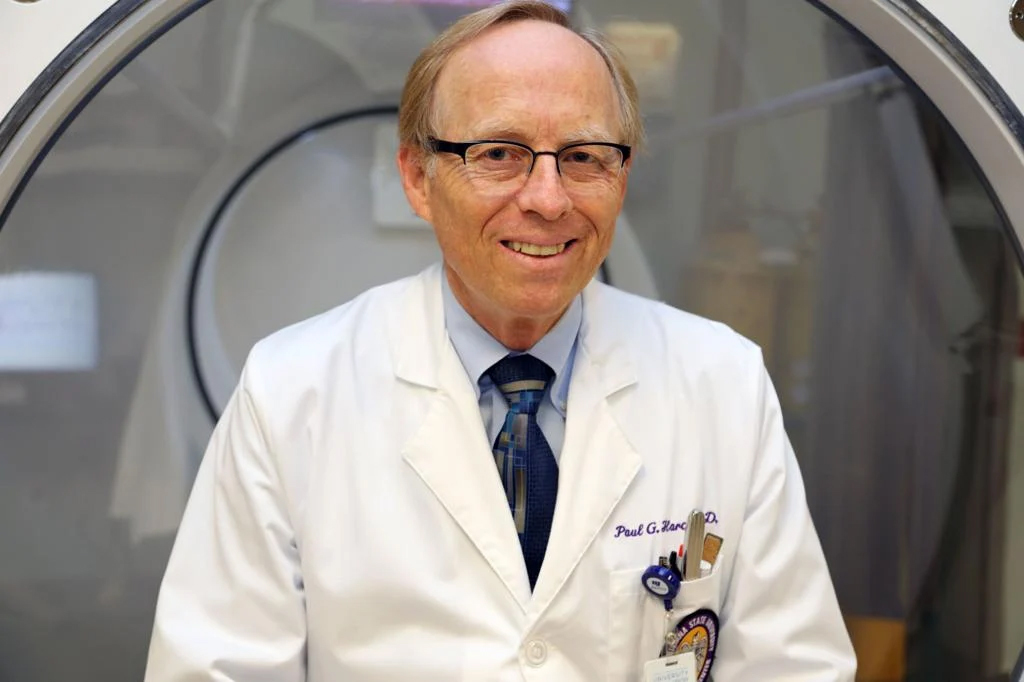
Dr. Paul G. Harch, MD
Dr. Harch initiated and continues to be a private practice that has resulted in the largest case experience in neurological hyperbaric medicine in the world. In this practice, he adapted the concepts of conventional hyperbaric oxygen therapy to wounds in the central nervous system, which spawned the subsequent academic and research practice. Harch HBOT is the best place to receive oxygen therapy treatments, and patients have traveled from more than 50 countries to be treated by Dr. Harch himself.
Harch HBOT – Hyperbaric Oxygen Therapy Clinic
5216 Lapalco Blvd.
Marrero, LA
504-309-4948
hbot@hbot.com
https://hbot.com/
Recent HBOT News
Clinical Trial – HBOT Late Radiation Tissue Injury
Background: Radiotherapy is a common treatment for many malignancies. Radiation-related
complications developing months or years after radiation treatment are known as late
radiation tissue injury (LRTI) and are estimated to effect 5%-15% of all long-term survivors
who have received radiation.
Hyperbaric oxygen therapy (HBOT) is a well established treatment of LRTI. Most of the studies
evaluating effect of HBOT on LRTI are focused on survival, resolution of tissue damage and
improvement in LENT-SOMA scale. Very few studies have addressed effect of HBOT on pain in
LTRI. Krahn and colleagues were the first to report the analgesic effect of HBOT in 3 cases
of refractory pain in oncological patients with radiation soft tissue injury. Other studies
showed significant improvement in pain intensity in patients with breast cancer and pelvic
malignancies treated with HBOT for LTRI. In patients that had developed radiation- induced
brachial plexopathy, HBOT elicited an increase in warm pain thresholds and a reduction in
lymphoedema. A prospective case study of 16 patients with gynecological cancer found no
changes with respect to pain and depression outcomes. A trial in patients with radiation
induced proctopathy showed that 75% of patients with rectal pain had some improvement,
although none experienced a complete resolution of pain symptoms.
There are several mechanisms by which HBOT may elicit analgesic effects. There is a growing
body of evidence that HBOT’s analgesic effect related to nitric oxide metabolism and
endogenous opioid secretion. Furthermore, the inhibition of tumor necrosis factor alph
(TNF-α), the production of substance P, and the modulation of serotonergic pathways have all
demonstrated a modification in the pain response following HBOT. In animal studies HBOT
decreased allodynia and hyperalgesia in different models of neuropathic and inflammatory
pain. The long lasting antinociceptive effect of HBOT was found to be dose-dependent in
non-injured tissues.
In human studies, HBOT decreased pain and edema and improved function in patients suffering
from the complex regional pain syndrome, and improved pain scores and range of motion in
patients with idiopathic femoral head necrosis. Women suffering from interstitial cystitis
demonstrated a reduction in pelvic pain following weeks and months of HBOT treatment. In
patients suffering from idiopathic trigeminal neuralgia HBOT produced a rapid reduction in
symptoms and these effects were lasting for 6 months following treatment. HBOT was also found
to be an effective treatment for cluster headaches and migraines and alleviated muscle and
bone pains in patients with myofascial syndrome, fibromyalgia, and biphosphonate-related
osteonecrosis of the jaw.
Based on the evidence presented above and HBOT’s known analgesic effect in many conditions,
the investigators designed this study with the objective to evaluate if HBOT reduces pain,
improves depression and impacts on patients quality of life in patients suffering from late
radiation tissue injury.
Study Design: Prospective observational study (n=300). Patients that have had radiation
therapy for malignancy, developed late radiation injury and suffer from chronic pain.
Clinical Trial – HBOT in Fibromyalgia
Fibromyalgia (FM) is a chronic pain condition affecting several millions of Canadians.
Although the etiology and pathophysiology are poorly understood, there is a well-recognized
association between muscular pain in fibromyalgia and muscular hypoperfusion, hypoxia,
abnormal muscle metabolism and oxidative stress. Currently there is no cure for FM.
Pharmacological and non-pharmacological strategies are directed to control symptoms such as
pain, fatigue, non-restorative sleep and depression.
Hyperbaric oxygen therapy (HBOT) is an intermittent inhalation of 100% oxygen in a hyperbaric
chamber at a pressure higher than 1 absolute atmosphere. Physiological effect of HBOT is
based on a dramatic increase in the amount of dissolved oxygen carried by the blood which
enables oxygenation of ischemic areas with compromised circulation. It also activates
oxidant-antioxidant system, stimulates angio- and neurogenesis, modulates inflammatory
response, induces brain neuroplasticity and possesses analgesic effect.
While some interventions offer benefit for some patients, additional treatment alternatives
are needed for patients with FM in whom currently available options are either ineffective or
poorly tolerated. Given its physiological effect, HBOT could be considered as a potential
therapy for treatment of underlying muscular hypoxia, optimizing oxidant- antioxidant system
and controlling FM symptoms. The results from this study could therefore provide new
information supporting the basic science underling the pathophysiology of this disease and
stimulate novel therapies for patients suffering with FM.
Thoracic spinal anesthesia is safe for patients undergoing abdominal cancer surgery.
Abstract: A double-blinded randomized controlled study to compare discharge time and patient satisfaction between two groups of patients submitted to open surgeries for abdominal malignancies using segmental thoracic spinal or general anesthesia. Open surgeries for...