
HBOT Conversations:
Dr. Paul Harch & Strokes
Dr. Paul G. Harch, M.D. has used hyperbaric oxygen therapy to treat more than 100 different conditions, including stroke, dementia, autism, and traumatic brain injury. His goal is to help his patients get their lives back using hyperbaric oxygen therapy.
He is the author of The Oxygen Revolution and is considered an International expert and pioneer in the field of Hyperbaric Oxygen Therapy (HBOT). His informative, and comprehensive guide on HBOT has helped countless souls better understand what HBOT is and how it directly affects the body at the genetic level.
This episode on strokes is the sixth in a nine episode series that will be released weekly with Dr. Harch.
Watch the Podcast
In episode 6 of 9, host Edward di Girolamo speaks with world renowned HBOT expert, Dr. Paul G. Harch about strokes. Dr. Harch explains that Hyperbaric Oxygen Therapy is hands-down the most effective therapy to treat the debilitating after-effects of a stroke.
But what exactly happens during a stroke and how can HBOT help?
We have more blood flow happening in the parts of the brain that are working hard to coordinate the movement of muscles, the formation of words, etc. Dr. Harch refers to this blood flow like the RPMs in a motor, the blood flow revs up and increases as we increase our movement & activity. However, having a stroke causes a blockage or lowering of blood flow to the brain, which can cause “electrical silence” – when the cells get to a point at about 60% reduction in blood flow where they no longer have enough oxygen (and blood flow, sugar, and fat) to generate electrical signals. These cells do not die, they live in a state of idling.
Dr. Harch explains there was a strong misunderstanding among the medical community that brain cells were either alive or dead after a stroke or injury. Over the years, HBOT has proven to the medical community that brain cells can just be in an idle/injured state and under the right conditions (like oxygen + pressure) they can be revived to function again.
Dr. Harch speaks in detail of two HBOT success stories of stroke patients getting significantly better even 10 years+ post-stroke —-
- A 60 year old woman who was 14 years post-stroke; paralyzed, drooling, can’t eat, no speech, totally dependent, and spending her days in a Geri Chair. Over the next 16 months they treated her periodically with Hyperbaric Oxygen Therapy and continue to do blood flow brain scans on her before and after the treatments. The deadest area of her brain immediately started to light up with blood flow after just the first treatment. She eventually reacquired her speech, stop drooling, and they were able to get her up moving with assisted ambulation.
- It was early 1990s and a Gentlemen called, Mr. H, who was 12 years post-stroke came into Dr. Harch’s clinic; completely mute with no ability to talk or communicate, unable to move at all; he just laid in bed all day. Eventually his wife had to put him in a nursing home, where he was referred to Hyperbaric Oxygen Therapy for the horrendous bed sore wounds he had developed. They started treatment with HBOT and continued to treat him, even after the bed sores started healing. The medical staff noticed that after about 18 HBOT treatment sessions he was now waving to the doctors and nurses as he was being wheeled through the doors on a stretcher. So they keep treating him with HBOT…… 10 more treatments and he starts talking. By flooding his body with oxygen under the pressure conditions of hyperbarics, for the first time in 12 years his brain started to wake up.
Moving away from topic of stroke, but still focusing on the power of Hyperbarics and success stories, di Girolamo tells Dr. Harch that he once said to Bill Duncan, “From what I understand of Hyperbaric Oxygen, the only thing it can’t do is bring back the dead.” And Bill responded with, “that’s not entirely true”. This opened the door for Dr. Harch to talk about a bizarre and fascinating Hyperbaric Oxygen Therapy success story from the 1980s. A diver was about 80 – 90 feet down in the Mississippi River with an airlift, as part of a mission to salvage a new tugboat that sunk. As the dive team was suctioning silt to loosen it up from the sunken boat, this diver’s helmet came off when he got sucked up against the bar of the dredging device. It took a long time for other divers to find him, and when they do bring him up he’s “dead as dead can be”. Without really knowing exactly why he’s in cardiac arrest, they immediately put him in a hyperbaric chamber in hopes that it would help stabilize him from any decompression sickness. They put an oxygen mask on him and take him to six atmospheres of pressure (clinical chambers go to maximum 3) – that’s 165 feet of pressure! He sparked up and came to life! He had been in cardiac arrest for 25 minutes. He went on to live a healthy life with a bright IQ. Later studies have involved guinea pigs, rats, and swine – some as much as 25 minutes after cardiac arrest and success with resuscitation after Hyperbaric Oxygen Therapy. So, yes there’s scientific proof that HBOT can even bring back the dead.
Dr. Harch stresses at the end of this HBOT Conversation that it’s never too late to get HBOT. Obviously, the sooner the better; but it still works on patients many many years post-stroke. There are approximately 800,000 strokes per year in the United States — it’s a huge number. And unfortunately only an extremely small amount of stroke victims receive Hyperbaric Oxygen Therapy. Dr. Harch classifies HBOT as “hope for the hopeless”.
If you or a loved one has recently experienced a stroke, we encourage you to better understand how Hyperbaric Oxygen Therapy can help wake up a post-stroke brain. We wish you the best as you find hope in HBOT.
Subscribe Now, It’s Free!
Guest
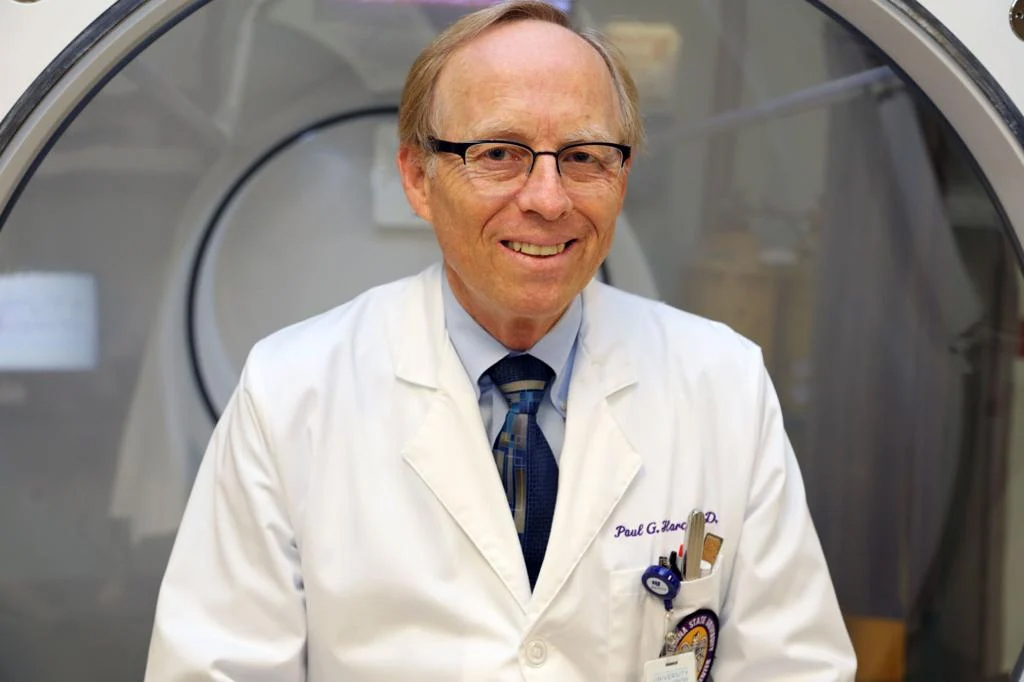
Dr. Paul G. Harch, MD
Dr. Harch initiated and continues to be a private practice that has resulted in the largest case experience in neurological hyperbaric medicine in the world. In this practice, he adapted the concepts of conventional hyperbaric oxygen therapy to wounds in the central nervous system, which spawned the subsequent academic and research practice. Harch HBOT is the best place to receive oxygen therapy treatments, and patients have traveled from more than 50 countries to be treated by Dr. Harch himself.
Harch HBOT – Hyperbaric Oxygen Therapy Clinic
5216 Lapalco Blvd.
Marrero, LA
504-309-4948
hbot@hbot.com
https://hbot.com/
Recent HBOT News
Clinical Trial – The Effects of Intravenous Dexmedetomidine on Spinal Anesthesia Using Low Dose Diluted Bupivacaine for Transurethral Resection of Prostate
Dexmedetomidine is a new selective and potent alpha-2 agonist. It has centrally acting
anesthetic properties. It has been known that intrathecal addition of alpha-2 adrenergic
agents result in prolongation of the duration of the sensory and motor blockade induced by
hyperbaric bupivacaine. But the effects of intravenous dexmedetomidine on the spinal block
was not evaluated. The aim of study is to assess the effect of intravenous dexmedetomidine on
the low-dose spinal anesthesia for the transurethral surgery.
Phase II trial of radiotherapy after hyperbaric oxygenation with multiagent chemotherapy (procarbazine, nimustine, and vincristine) for high-grade gliomas: long-term results.
Abstract: To analyze the long-term results of a Phase II trial of radiotherapy given immediately after hyperbaric oxygenation (HBO) with multiagent chemotherapy in adults with high-grade gliomas. Patients with histologically confirmed high-grade gliomas were...
Clinical Trial – The Regeneration Effects of Derma-PACE Shockwave in Chronic Diabetic Ulcers
Management of chronic diabetic foot skin ulcers require multidisciplinary approaches
including diabetic control, wound care, antibiotic, shoe wear off-loading, and surgery in
selected cases. The results are inconsistent and irregular, and most studies reported
unsatisfactory results. Many adjunctive therapies are implemented in the care of chronic
diabetic foot ulcers including hyperbaric oxygen therapy (HBO), ultrasound, recombinant human
platelet-derived growth factor-BB (rPDGF-BB), vacuum assisted wound closure (VAWC) and
acellular matrix. HBO is the most commonly utilized at the investigators institution. Mixed
results of HBO in chronic diabetic foot ulcers are reported. Several studies reported that
the beneficial effects of HBO, but none showed universal success. Therefore, the development
of a new effective method of treatment for chronic diabetic ulcers is extremely valuable.
Extracorporeal shockwave therapy (ESWT) acts as mechanotransduction that produces the
therapeutic benefits through complex biological pathways including neovascularization and
tissue regeneration. ESWT also showed bacteriostatic effects in experiments. Some studies
reported the effectiveness of ESWT in acute and chronic soft tissue wounds. Others reported
effectiveness of ESWT in chronic ulcers with 50% completely healed with 6 sessions of
treatment. With this background, it appears that ESWT may be effective in the treatment of
chronic diabetic foot ulcers. The purpose of this study is to evaluate the efficacy of ESWT
in chronic foot ulcers, and to compared with that treated with HBO, and to study the
molecular and blood flow perfusion before and after ESWT.