
HBOT Conversations:
Dr. Paul Harch & Traumatic Brain Injury
Dr. Paul G. Harch, M.D. has used hyperbaric oxygen therapy to treat more than 100 different conditions, including stroke, dementia, autism, and traumatic brain injury. His goal is to help his patients get their lives back using hyperbaric oxygen therapy.
He is the author of The Oxygen Revolution and is considered an International expert and pioneer in the field of Hyperbaric Oxygen Therapy (HBOT). His informative, and comprehensive guide on HBOT has helped countless souls better understand what HBOT is and how it directly affects the body at the genetic level.
This episode on Traumatic Brain Injury is the third in a nine episode series that will be released weekly with Dr. Harch.
Watch the Podcast
In episode 3 of 9, host Edward di Girolamo speaks with world renowned HBOT expert, Dr. Paul G. Harch on treating Traumatic Brain Injuries and PTSD with hyperbaric oxygen therapy.
di Girolamo starts the conversation telling a story about him, Sergeant Major Simon Lemay and retired Navy Captain Jim Hooker visiting the Durham VA, near Duke Hospital, in North Carolina. They had a sit-down meeting with three heads of the Psychiatry group at Veteran Affairs. They asked the question, “Does traumatic brain injury involve any sort of inflammation?” and the response they received was, “Next thing you’re going to tell me is that hyperbaric oxygen is good for every indication. And that’s when I glaze over and say I’m not interested in talking about it.” di Girolamo shakes his head at the negligence; and vocalizes his frustration that this powerful, natural anti-inflammatory treatment exists in hyperbaric oxygen therapy, and the VA won’t even consider learning more about the benefit of using it on veterans with a traumatic brain injury.
Harch agrees that the VA is completely oblivious to the evidence that HBOT works to treat inflammation and that inflammation absolutely exists as a result of PTSD and TBI. He explains that hyperbaric oxygen is highly effective for neurological applications, and it’s most effective in white matter diseases such as brain decompression illness, traumatic brain injury, and even in cases like multiple sclerosis and carbon monoxide poisoning.
Veteran suicides are a growing number that we must get under control. di Girolamo gives praise that at least the North Carolina Legislature acknowledged HBOT as an effective treatment for PTSD and TBI. Under Senate Bill 442 they allocated $150,000 to help veterans get 40 or more Hyperbaric Oxygen Therapy treatments. These veterans are improving like never before, lives are being saved and stories are being told. They are finally getting their lives back, thanks to the power of Hyperbaric Oxygen Therapy!
But, how will HBOT help the average person – sport athlete, car accident victim, etc – with a concussion or TBI? Dr. Harch refers to the brain like a head of broccoli sitting on its stem. If it’s shaken on the stem, then the torque forces cause the flimsy white matter tracks to be damaged and many of them can then divide, resulting in the formation of wounds. Essentially a bruise is formed on the brain…. and inflammation is present, even years later. But, when we expose that area to oxygen and pressure you now get gene stimulation, inhibition of inflammation, and stimulation of repair and growth of tissue. You start growing new axons, or nerve fibers, which is the cable transmission of neurons in the brain.
Dr. Harch stresses that if you or someone you know has recently had a brain injury, please find a hyperbaric facility as soon as possible. If done early enough, the brain does not need too many HBOT treatments to repair itself; but if you wait years, when you’re still having headaches and other post-concussive syndrome symptoms, it could take 40 or more HBOT treatments to reverse the damage. Dr. Harch exclaims with confidence that HBOT is a “Slam Dunk” for TBI and PTSD recovery and 99% of the time it will absolutely help every patient who comes through his doors.
Subscribe Now, It’s Free !
Guest
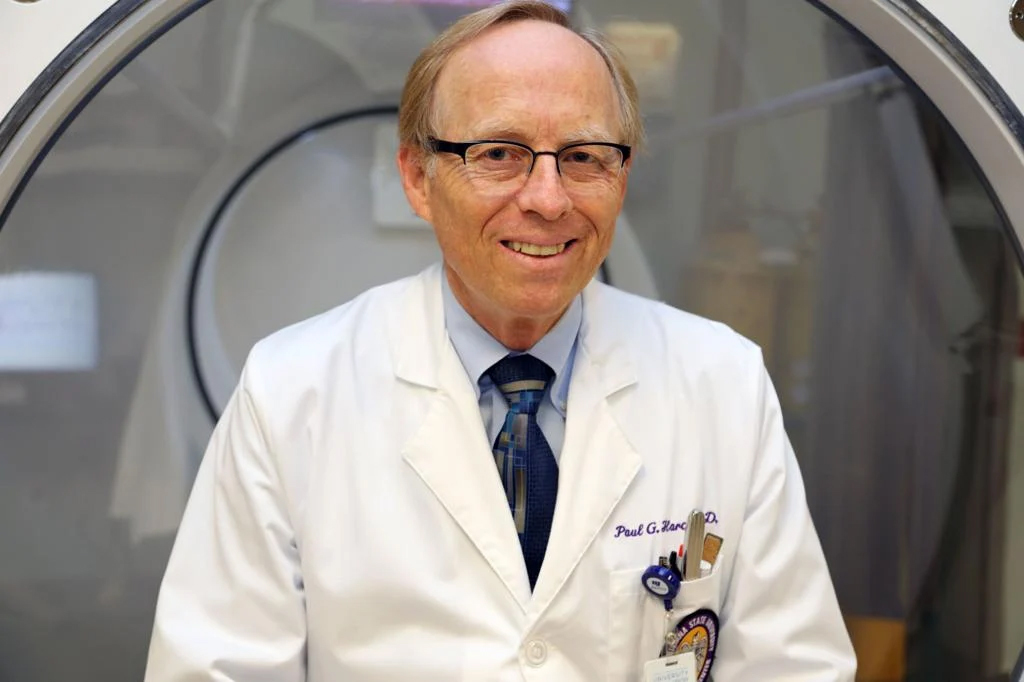
Dr. Paul G. Harch, MD
Dr. Paul G. Harch, M.D. is a clinician in emergency medicine and hyperbaric medicine who is the former director of the University Medical Center Hyperbaric Medicine Department and LSU Hyperbaric Medicine Fellowship. Currently, he is a Clinical Professor of Medicine in the Section of Emergency Medicine at LSU School of Medicine in New Orleans. He graduated from the Johns Hopkins University School of Medicine after graduating from the University of California at Irvine with magna cum laude/Phi Beta Kappa honors.
Dr. Harch initiated and continues to be a private practice that has resulted in the largest case experience in neurological hyperbaric medicine in the world. In this practice, he adapted the concepts of conventional hyperbaric oxygen therapy to wounds in the central nervous system, which spawned the subsequent academic and research practice. Harch HBOT is the best place to receive oxygen therapy treatments, and patients have traveled from more than 50 countries to be treated by Dr. Harch himself.
Harch HBOT – Hyperbaric Oxygen Therapy Clinic
5216 Lapalco Blvd.
Marrero, LA
504-309-4948
hbot@hbot.com
https://hbot.com/
Recent HBOT News
Clinical Trial – Measuring Cognitive Enhancement During Hyperbaric Oxygen Treatments
The aim of the current study was to examine the effect of short-term HBOT (hyperbaric oxygen
treatments) on a range of cognitive abilities. The current study examined whether there is a
HBOT-related short-term cognitive improvement and, if so, what specific cognitive abilities
are improved by the intervention.
Participants were randomized to perform cognitive tasks in one of two chambers with two
different clinical environments: (a) HBOT condition: (2 ATA (atmosphere absolute) 100% oxygen
for 90 minutes). (b) Control condition: in which the chamber was not pressurized (Normobaric
condition- 1 ATA for 90 minutes).

Hyperbaric oxygen therapy the latest in Lee Anlezark’s Parkinson’s fight
After receiving a Parkinson's Disease diagnosis in 2005, at the age of 49, Lee Anlezark is using hyperbaric oxygen therapy (HBOT) as a means to slow down the progression of the disease. Mr. Anlezark was so passionate in his beliefs that HBOT could help him, he paid...
Clinical Trial – Effects of HBO on Patients With DM
The purpose of this Research Study is:
1. To determine the reliability and performance of the Dexcom G6® continuous glucose
monitoring (CGM) system in patients with diabetes undergoing hyperbaric oxygen (HBO2)
exposure. The study-specific blood glucose meter and CGM system are approved by the FDA
(U.S. Food and Drug Administration).
2. To determine whether HBO2 exposure causes blood glucose to drop as a result of the
treatment.
3. To determine whether HBO2 causes a change in blood glucagon (a hormone that raises blood
glucose).
Investigators will be comparing changes in blood glucose and glucagon in volunteers with
diabetes who will be exposed to a single hyperbaric oxygen treatment (pressurization to 2.4
atmospheres absolute for 90 minutes) to a control period of 2 hours where volunteers will
simulate a hyperbaric treatment while sitting in an examination room breathing room air at
sea level pressure. Investigators will be measuring blood glucose with a variety of devices
including a continuous glucose monitor, two point-of-care glucometers, and the hospital
inpatient laboratory measurement of venous blood.