
HBOT Conversations:
Dr. Paul Harch & Traumatic Brain Injury
Dr. Paul G. Harch, M.D. has used hyperbaric oxygen therapy to treat more than 100 different conditions, including stroke, dementia, autism, and traumatic brain injury. His goal is to help his patients get their lives back using hyperbaric oxygen therapy.
He is the author of The Oxygen Revolution and is considered an International expert and pioneer in the field of Hyperbaric Oxygen Therapy (HBOT). His informative, and comprehensive guide on HBOT has helped countless souls better understand what HBOT is and how it directly affects the body at the genetic level.
This episode on Traumatic Brain Injury is the third in a nine episode series that will be released weekly with Dr. Harch.
Watch the Podcast
In episode 3 of 9, host Edward di Girolamo speaks with world renowned HBOT expert, Dr. Paul G. Harch on treating Traumatic Brain Injuries and PTSD with hyperbaric oxygen therapy.
di Girolamo starts the conversation telling a story about him, Sergeant Major Simon Lemay and retired Navy Captain Jim Hooker visiting the Durham VA, near Duke Hospital, in North Carolina. They had a sit-down meeting with three heads of the Psychiatry group at Veteran Affairs. They asked the question, “Does traumatic brain injury involve any sort of inflammation?” and the response they received was, “Next thing you’re going to tell me is that hyperbaric oxygen is good for every indication. And that’s when I glaze over and say I’m not interested in talking about it.” di Girolamo shakes his head at the negligence; and vocalizes his frustration that this powerful, natural anti-inflammatory treatment exists in hyperbaric oxygen therapy, and the VA won’t even consider learning more about the benefit of using it on veterans with a traumatic brain injury.
Harch agrees that the VA is completely oblivious to the evidence that HBOT works to treat inflammation and that inflammation absolutely exists as a result of PTSD and TBI. He explains that hyperbaric oxygen is highly effective for neurological applications, and it’s most effective in white matter diseases such as brain decompression illness, traumatic brain injury, and even in cases like multiple sclerosis and carbon monoxide poisoning.
Veteran suicides are a growing number that we must get under control. di Girolamo gives praise that at least the North Carolina Legislature acknowledged HBOT as an effective treatment for PTSD and TBI. Under Senate Bill 442 they allocated $150,000 to help veterans get 40 or more Hyperbaric Oxygen Therapy treatments. These veterans are improving like never before, lives are being saved and stories are being told. They are finally getting their lives back, thanks to the power of Hyperbaric Oxygen Therapy!
But, how will HBOT help the average person – sport athlete, car accident victim, etc – with a concussion or TBI? Dr. Harch refers to the brain like a head of broccoli sitting on its stem. If it’s shaken on the stem, then the torque forces cause the flimsy white matter tracks to be damaged and many of them can then divide, resulting in the formation of wounds. Essentially a bruise is formed on the brain…. and inflammation is present, even years later. But, when we expose that area to oxygen and pressure you now get gene stimulation, inhibition of inflammation, and stimulation of repair and growth of tissue. You start growing new axons, or nerve fibers, which is the cable transmission of neurons in the brain.
Dr. Harch stresses that if you or someone you know has recently had a brain injury, please find a hyperbaric facility as soon as possible. If done early enough, the brain does not need too many HBOT treatments to repair itself; but if you wait years, when you’re still having headaches and other post-concussive syndrome symptoms, it could take 40 or more HBOT treatments to reverse the damage. Dr. Harch exclaims with confidence that HBOT is a “Slam Dunk” for TBI and PTSD recovery and 99% of the time it will absolutely help every patient who comes through his doors.
Subscribe Now, It’s Free !
Guest
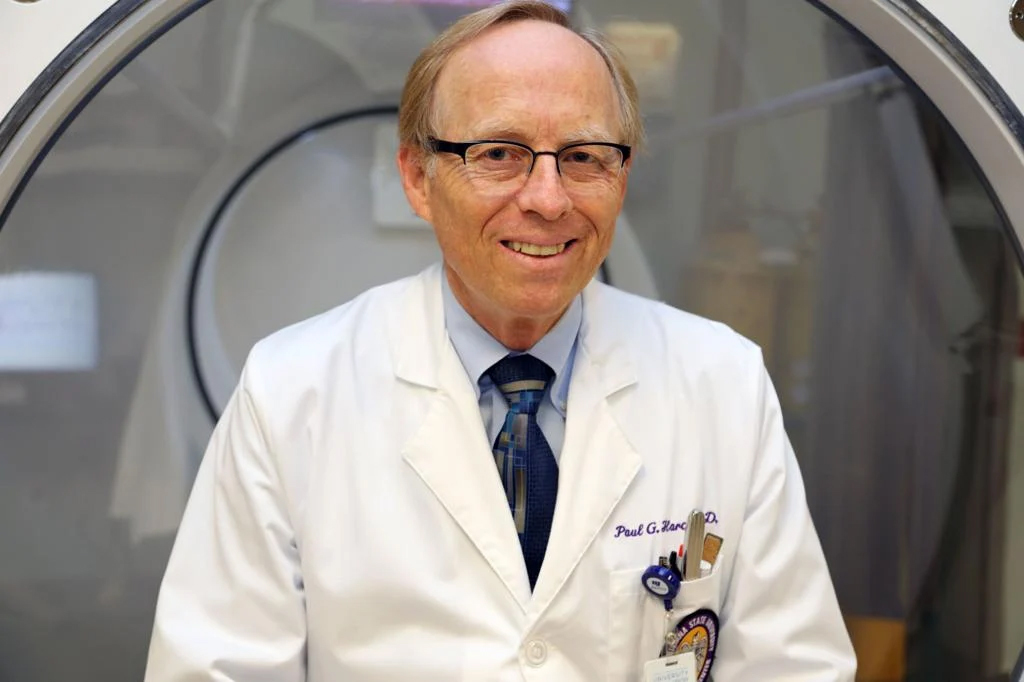
Dr. Paul G. Harch, MD
Dr. Paul G. Harch, M.D. is a clinician in emergency medicine and hyperbaric medicine who is the former director of the University Medical Center Hyperbaric Medicine Department and LSU Hyperbaric Medicine Fellowship. Currently, he is a Clinical Professor of Medicine in the Section of Emergency Medicine at LSU School of Medicine in New Orleans. He graduated from the Johns Hopkins University School of Medicine after graduating from the University of California at Irvine with magna cum laude/Phi Beta Kappa honors.
Dr. Harch initiated and continues to be a private practice that has resulted in the largest case experience in neurological hyperbaric medicine in the world. In this practice, he adapted the concepts of conventional hyperbaric oxygen therapy to wounds in the central nervous system, which spawned the subsequent academic and research practice. Harch HBOT is the best place to receive oxygen therapy treatments, and patients have traveled from more than 50 countries to be treated by Dr. Harch himself.
Harch HBOT – Hyperbaric Oxygen Therapy Clinic
5216 Lapalco Blvd.
Marrero, LA
504-309-4948
hbot@hbot.com
https://hbot.com/
Recent HBOT News
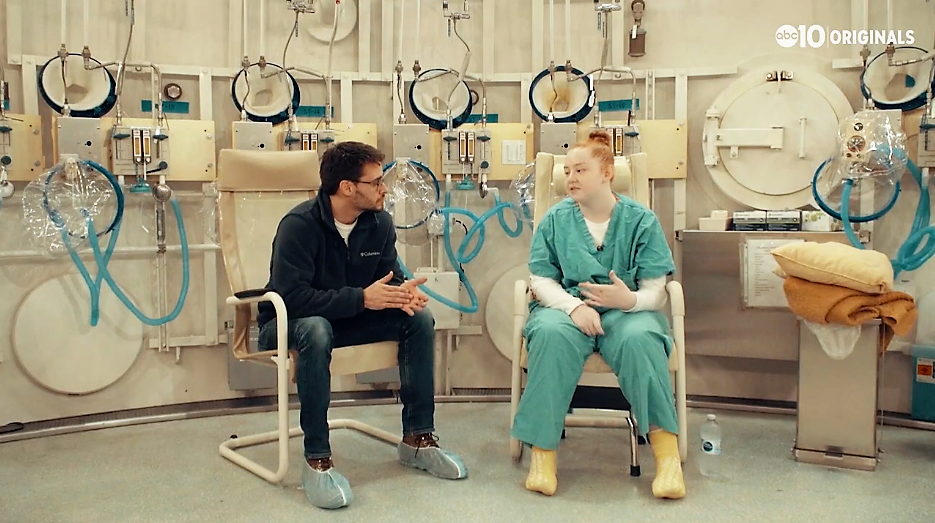
Healing under pressure: Inside a military hyperbaric chamber
At 16, she had a stroke. At 17, her town burned in the Camp Fire. Now, as her community rebuilds, she's healing thanks to hyperbaric therapy. SACRAMENTO, Calif — February 2, 2017, started off as an ordinary day for the Pipkin Family. Patrick and Stacey Pipkin just...
Clinical Trial – High-flow Oxygen for Vaso-occlusive Pain Crisis
Sickle cell disease (SCD) is characterized by recurrent vaso-occlusive pain crisis (VOC),
which may evolve to acute chest syndrome (ACS), the most common cause of death among adult
patients with SCD. Currently, there is no safe and effective treatment to abort VOC or
prevent secondary ACS. Management of VOC mostly involve a symptomatic approach including
hydration, analgesics, transfusion, and incentive spirometry, which was investigated in a
very limited number of patients (<30).
The polymerisation of HbS is one major feature in the pathogenesis of vaso-occlusion. Among
factors determining the rate and extent of HbS polymer formation, the hypoxic stimulus is one
of the most potent and readily alterable. Current guidelines recommend oxygen therapy in
patients with VOC in order to maintain a target oxygen saturation of 95%. Low-flow nasal
oxygen (LFNO) is routinely used to achieve this normoxia approach, particularly in patients
at risk of secondary ACS because they may experience acute desaturation. In contrast, various
case series suggest a potential beneficial role of intensified oxygen therapy targeting
hyperoxia for the management of VOC, particularly with the use of hyperbaric oxygen, but the
latter is difficult to implement in routine clinical practice.
A recent high-flow nasal oxygen (HFNO) technology allows the delivery of humidified gas at
high fraction of inspired oxygen (FiO2) through nasal cannula. The FiO2 can be adjusted up to
100% (allowing hyperoxia that may reverse sickling) and the flow can be increased up to 60
L/min (which generates positive airway pressure and dead space flushing, that may prevent
evolution of VOC towards ACS by alleviating atelectasis and opioid-induced hypercapnia). In
patients with acute respiratory failure, HFNO has been shown to improve patient's comfort,
oxygenation, and survival as compared to standard oxygen or non-invasive ventilation.
The aim of the present study is to test the efficacy and safety of HFNO for the management of
VOC and prevention of secondary ACS. The investigators will use a multi-arm multi-stage
(MAMS) design to achieve these goals. HFNO will be delivered through AIRVO 2 (Fisher and
Paykel Healthcare, New Zealand), a device that incorporates a turbine allowing its use in
hospital wards.
Clinical Trial – Hyperbaric Oxygen Therapy and Allogeneic Peripheral Blood Stem Cell (PBSC) Transplant
Subjects with Acute Myeloblastic Leukemia (AML) and myelodysplastic syndrome (MDS) who are
considered eligible for allogeneic stem cell transplant by the transplant team at WCI (Wilmot
Cancer Institute)will be enrolled in the study. Patients will receive Melphalan on day -2 and
HBO (Hyperbaric Oxygen) therapy on day 0 of the transplant. After neutrophil recovery is
documented, the patients will be seen in clinic at least weekly through day +100.