
HBOT Conversations:
Dr. Paul Harch & The Science Behind The Practice
Dr. Paul G. Harch, M.D. has used hyperbaric oxygen therapy to treat more than 100 different conditions, including stroke, dementia, autism, and traumatic brain injury. His goal is to help his patients get their lives back using hyperbaric oxygen therapy.
He is the author of The Oxygen Revolution and is considered an International expert and pioneer in the field of Hyperbaric Oxygen Therapy (HBOT). His informative, and comprehensive guide on HBOT has helped countless souls better understand what HBOT is and how it directly affects the body at the genetic level.
This episode on The Science Behind the Practice is the fourth in a nine episode series that will be released weekly with Dr. Harch.
Watch the Podcast
di Girolamo asks Dr. Harch to explain his background, and the road he had to take to get to where he is today.
In Episode 4, Dr. Harch tells a miraculous story of how his medical journey with Hyperbaric Oxygen Therapy fell into his lap during his surgical residency. It was during this internship when Dr, Harch was in a horrendous vehicle accident and nearly killed. This led to more than one medical leave of absence. While out on his second leave of absence after yet another surgery, his perspective changed; and he started to wonder what he wanted to do with his life.
After not finding fulfilment in an emergency medicine practice, Dr. Harch decided that he needed to follow his true passion and interest if he was going to have any chance of feeling accomplished, and changing lives.
Dr. Harch had a high level of interest in Navy divers and the extreme cases of brain decompression sickness. He started asking questions about how they were being treated for decompression sickness and why they were not getting better. Dr, Harch refers to the unbelievable cases that landed in his lap as his “Manna from Heaven”. Other doctors tossed these cases to the side, but Dr. Harch decided to try something different with these patients – he treated using lower doses of hyperbaric oxygen therapy. It totally reversed what was going on with these patients!
Even though his results were clinically astonishing, the Medical Societies were surprisingly not impressed or welcoming; forcing Dr. Harch to create more research documentation and do more clinical work to prove his success with hyperbaric oxygen therapy to treat chronic brain issues. During his journey to prove the results, he was implemental in successfully being able to show brain decompression illness on imaging. The imaging results were so dramatic after hyperbaric oxygen therapy that the radiologists didn’t even know how to read it! This is about the time when Dr. Harch’s road to patient care took a straight-shot towards healing a larger variety of indications with HBOT.
His goal today is the same as it was back then…. prove to everyone that Hyperbaric Oxygen Therapy WORKS! Dr. Harch has no plans to retire and stresses that he wants to see this all over the finish line.
Dr. Harch has used HBOT to change the lives of children and adults; but it was his own life that was also greatly changed by the power of hyperbarics. Hyperbaric Oxygen Therapy has allowed Dr. Harch to take the elements of oxygen and pressure, & implement them into healing protocols that have now saved countless lives.
Subscribe Now, It’s Free !
Guest
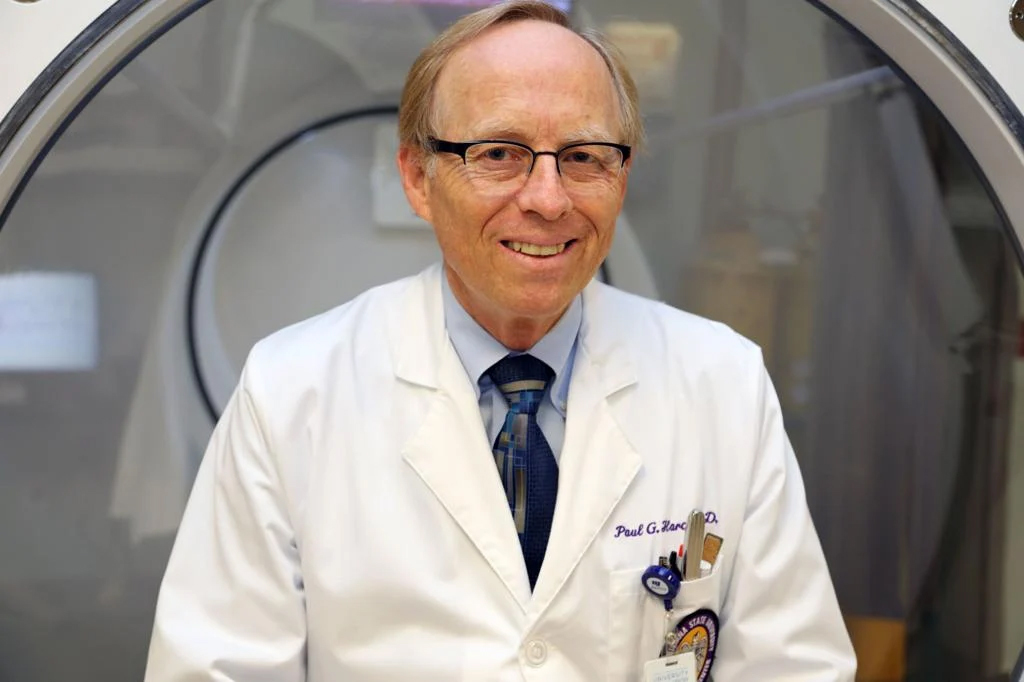
Dr. Paul G. Harch, MD
Dr. Harch initiated and continues to be a private practice that has resulted in the largest case experience in neurological hyperbaric medicine in the world. In this practice, he adapted the concepts of conventional hyperbaric oxygen therapy to wounds in the central nervous system, which spawned the subsequent academic and research practice. Harch HBOT is the best place to receive oxygen therapy treatments, and patients have traveled from more than 50 countries to be treated by Dr. Harch himself.
Harch HBOT – Hyperbaric Oxygen Therapy Clinic
5216 Lapalco Blvd.
Marrero, LA
504-309-4948
hbot@hbot.com
https://hbot.com/
Recent HBOT News

VEGF and bFGF induction by nitric oxide is associated with hyperbaric oxygen-induced angiogenesis and muscle regeneration
Abstract: Hyperbaric oxygen (HBO) treatment promotes early recovery from muscle injury. Reactive oxygen species (ROS) upregulation is a key mechanism of HBO, which produces high O2 content in tissues through increased dissolution of oxygen at high pressure. Nitric...
Clinical Trial – Postoperative Urinary Retention in Orthopedic Patients
The objective of this study is to compare the incidence of postoperative urinary retention
related to spinal anesthesia with morphine and spinal anesthesia associated with peripheral
blockade in orthopedic procedures of lower limbs. Secondary objectives are assessing the
incidence of nausea and vomiting; postoperative pain and opioid consumption at 24 hours after
surgery with each of the techniques. A total of 52 patients submitted to a lower limb
orthopedic procedure were randomized to the intervention groups: spinal anesthesia with
morphine versus spinal anesthesia without opioid associated with peripheral nerve block.
After surgery, bladder ultrasound will be performed in post-anesthesia care unit to identify
urinary retention and patients will be followed for 24 hours to assess outcomes.
Clinical Trial – Autonomic Modulation After Spinal Anesthesia With Depth of Anesthesia and Vital Signs.
Spinal anaesthesia has the advantage that produced nerve block by the injection of local
anaesthetic into cerebrospinal fluid (CSF). However, the greatest challenge in spinal
anaesthesia is to control the spread of local anaesthetic through the CSF to provide a block
which is adequate for the proposed surgery without unnecessary extensive spread, and
increased risk of complications.