
HBOT Conversations:
Dr. Paul Harch & The Science Behind The Practice
Dr. Paul G. Harch, M.D. has used hyperbaric oxygen therapy to treat more than 100 different conditions, including stroke, dementia, autism, and traumatic brain injury. His goal is to help his patients get their lives back using hyperbaric oxygen therapy.
He is the author of The Oxygen Revolution and is considered an International expert and pioneer in the field of Hyperbaric Oxygen Therapy (HBOT). His informative, and comprehensive guide on HBOT has helped countless souls better understand what HBOT is and how it directly affects the body at the genetic level.
This episode on The Science Behind the Practice is the fourth in a nine episode series that will be released weekly with Dr. Harch.
Watch the Podcast
di Girolamo asks Dr. Harch to explain his background, and the road he had to take to get to where he is today.
In Episode 4, Dr. Harch tells a miraculous story of how his medical journey with Hyperbaric Oxygen Therapy fell into his lap during his surgical residency. It was during this internship when Dr, Harch was in a horrendous vehicle accident and nearly killed. This led to more than one medical leave of absence. While out on his second leave of absence after yet another surgery, his perspective changed; and he started to wonder what he wanted to do with his life.
After not finding fulfilment in an emergency medicine practice, Dr. Harch decided that he needed to follow his true passion and interest if he was going to have any chance of feeling accomplished, and changing lives.
Dr. Harch had a high level of interest in Navy divers and the extreme cases of brain decompression sickness. He started asking questions about how they were being treated for decompression sickness and why they were not getting better. Dr, Harch refers to the unbelievable cases that landed in his lap as his “Manna from Heaven”. Other doctors tossed these cases to the side, but Dr. Harch decided to try something different with these patients – he treated using lower doses of hyperbaric oxygen therapy. It totally reversed what was going on with these patients!
Even though his results were clinically astonishing, the Medical Societies were surprisingly not impressed or welcoming; forcing Dr. Harch to create more research documentation and do more clinical work to prove his success with hyperbaric oxygen therapy to treat chronic brain issues. During his journey to prove the results, he was implemental in successfully being able to show brain decompression illness on imaging. The imaging results were so dramatic after hyperbaric oxygen therapy that the radiologists didn’t even know how to read it! This is about the time when Dr. Harch’s road to patient care took a straight-shot towards healing a larger variety of indications with HBOT.
His goal today is the same as it was back then…. prove to everyone that Hyperbaric Oxygen Therapy WORKS! Dr. Harch has no plans to retire and stresses that he wants to see this all over the finish line.
Dr. Harch has used HBOT to change the lives of children and adults; but it was his own life that was also greatly changed by the power of hyperbarics. Hyperbaric Oxygen Therapy has allowed Dr. Harch to take the elements of oxygen and pressure, & implement them into healing protocols that have now saved countless lives.
Subscribe Now, It’s Free !
Guest
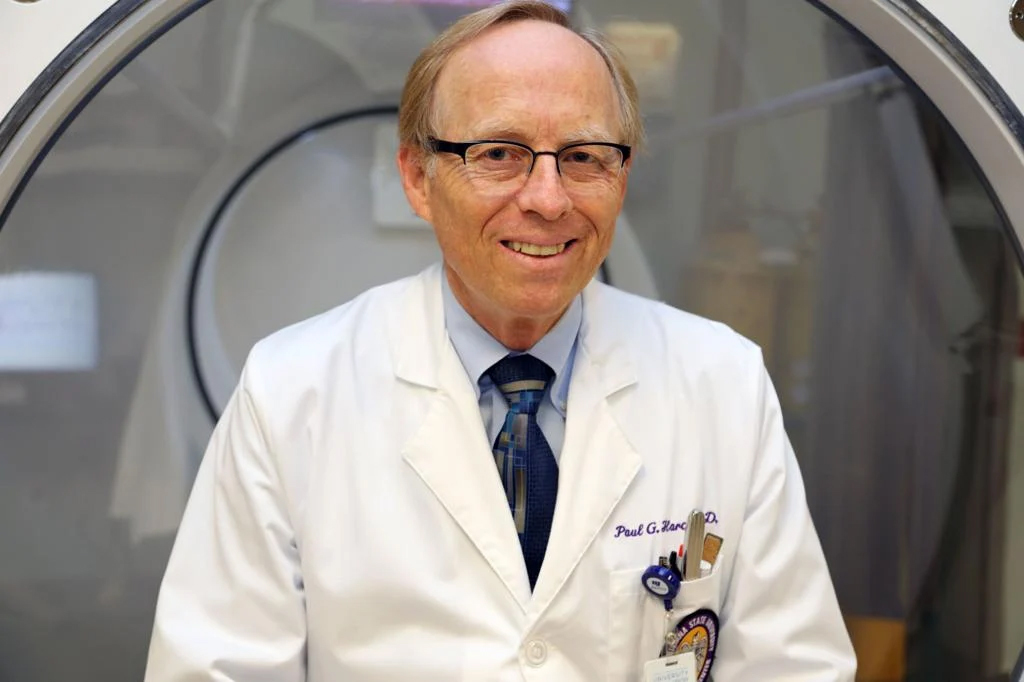
Dr. Paul G. Harch, MD
Dr. Harch initiated and continues to be a private practice that has resulted in the largest case experience in neurological hyperbaric medicine in the world. In this practice, he adapted the concepts of conventional hyperbaric oxygen therapy to wounds in the central nervous system, which spawned the subsequent academic and research practice. Harch HBOT is the best place to receive oxygen therapy treatments, and patients have traveled from more than 50 countries to be treated by Dr. Harch himself.
Harch HBOT – Hyperbaric Oxygen Therapy Clinic
5216 Lapalco Blvd.
Marrero, LA
504-309-4948
hbot@hbot.com
https://hbot.com/
Recent HBOT News
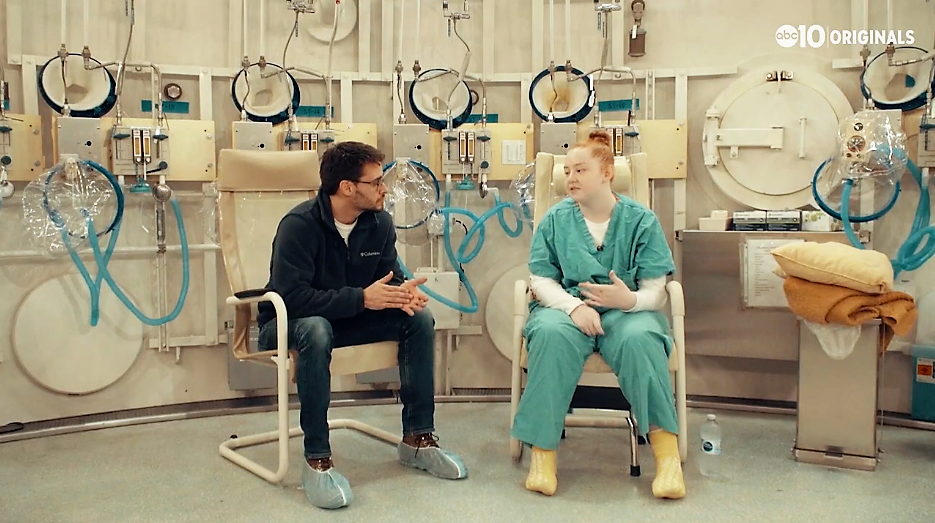
Healing under pressure: Inside a military hyperbaric chamber
At 16, she had a stroke. At 17, her town burned in the Camp Fire. Now, as her community rebuilds, she's healing thanks to hyperbaric therapy. SACRAMENTO, Calif — February 2, 2017, started off as an ordinary day for the Pipkin Family. Patrick and Stacey Pipkin just...
Clinical Trial – High-flow Oxygen for Vaso-occlusive Pain Crisis
Sickle cell disease (SCD) is characterized by recurrent vaso-occlusive pain crisis (VOC),
which may evolve to acute chest syndrome (ACS), the most common cause of death among adult
patients with SCD. Currently, there is no safe and effective treatment to abort VOC or
prevent secondary ACS. Management of VOC mostly involve a symptomatic approach including
hydration, analgesics, transfusion, and incentive spirometry, which was investigated in a
very limited number of patients (<30).
The polymerisation of HbS is one major feature in the pathogenesis of vaso-occlusion. Among
factors determining the rate and extent of HbS polymer formation, the hypoxic stimulus is one
of the most potent and readily alterable. Current guidelines recommend oxygen therapy in
patients with VOC in order to maintain a target oxygen saturation of 95%. Low-flow nasal
oxygen (LFNO) is routinely used to achieve this normoxia approach, particularly in patients
at risk of secondary ACS because they may experience acute desaturation. In contrast, various
case series suggest a potential beneficial role of intensified oxygen therapy targeting
hyperoxia for the management of VOC, particularly with the use of hyperbaric oxygen, but the
latter is difficult to implement in routine clinical practice.
A recent high-flow nasal oxygen (HFNO) technology allows the delivery of humidified gas at
high fraction of inspired oxygen (FiO2) through nasal cannula. The FiO2 can be adjusted up to
100% (allowing hyperoxia that may reverse sickling) and the flow can be increased up to 60
L/min (which generates positive airway pressure and dead space flushing, that may prevent
evolution of VOC towards ACS by alleviating atelectasis and opioid-induced hypercapnia). In
patients with acute respiratory failure, HFNO has been shown to improve patient's comfort,
oxygenation, and survival as compared to standard oxygen or non-invasive ventilation.
The aim of the present study is to test the efficacy and safety of HFNO for the management of
VOC and prevention of secondary ACS. The investigators will use a multi-arm multi-stage
(MAMS) design to achieve these goals. HFNO will be delivered through AIRVO 2 (Fisher and
Paykel Healthcare, New Zealand), a device that incorporates a turbine allowing its use in
hospital wards.
Clinical Trial – Hyperbaric Oxygen Therapy and Allogeneic Peripheral Blood Stem Cell (PBSC) Transplant
Subjects with Acute Myeloblastic Leukemia (AML) and myelodysplastic syndrome (MDS) who are
considered eligible for allogeneic stem cell transplant by the transplant team at WCI (Wilmot
Cancer Institute)will be enrolled in the study. Patients will receive Melphalan on day -2 and
HBO (Hyperbaric Oxygen) therapy on day 0 of the transplant. After neutrophil recovery is
documented, the patients will be seen in clinic at least weekly through day +100.