
HBOT Conversations:
Dr. Paul Harch & The Science Behind The Practice
Dr. Paul G. Harch, M.D. has used hyperbaric oxygen therapy to treat more than 100 different conditions, including stroke, dementia, autism, and traumatic brain injury. His goal is to help his patients get their lives back using hyperbaric oxygen therapy.
He is the author of The Oxygen Revolution and is considered an International expert and pioneer in the field of Hyperbaric Oxygen Therapy (HBOT). His informative, and comprehensive guide on HBOT has helped countless souls better understand what HBOT is and how it directly affects the body at the genetic level.
This episode on The Science Behind the Practice is the fourth in a nine episode series that will be released weekly with Dr. Harch.
Watch the Podcast
di Girolamo asks Dr. Harch to explain his background, and the road he had to take to get to where he is today.
In Episode 4, Dr. Harch tells a miraculous story of how his medical journey with Hyperbaric Oxygen Therapy fell into his lap during his surgical residency. It was during this internship when Dr, Harch was in a horrendous vehicle accident and nearly killed. This led to more than one medical leave of absence. While out on his second leave of absence after yet another surgery, his perspective changed; and he started to wonder what he wanted to do with his life.
After not finding fulfilment in an emergency medicine practice, Dr. Harch decided that he needed to follow his true passion and interest if he was going to have any chance of feeling accomplished, and changing lives.
Dr. Harch had a high level of interest in Navy divers and the extreme cases of brain decompression sickness. He started asking questions about how they were being treated for decompression sickness and why they were not getting better. Dr, Harch refers to the unbelievable cases that landed in his lap as his “Manna from Heaven”. Other doctors tossed these cases to the side, but Dr. Harch decided to try something different with these patients – he treated using lower doses of hyperbaric oxygen therapy. It totally reversed what was going on with these patients!
Even though his results were clinically astonishing, the Medical Societies were surprisingly not impressed or welcoming; forcing Dr. Harch to create more research documentation and do more clinical work to prove his success with hyperbaric oxygen therapy to treat chronic brain issues. During his journey to prove the results, he was implemental in successfully being able to show brain decompression illness on imaging. The imaging results were so dramatic after hyperbaric oxygen therapy that the radiologists didn’t even know how to read it! This is about the time when Dr. Harch’s road to patient care took a straight-shot towards healing a larger variety of indications with HBOT.
His goal today is the same as it was back then…. prove to everyone that Hyperbaric Oxygen Therapy WORKS! Dr. Harch has no plans to retire and stresses that he wants to see this all over the finish line.
Dr. Harch has used HBOT to change the lives of children and adults; but it was his own life that was also greatly changed by the power of hyperbarics. Hyperbaric Oxygen Therapy has allowed Dr. Harch to take the elements of oxygen and pressure, & implement them into healing protocols that have now saved countless lives.
Subscribe Now, It’s Free !
Guest
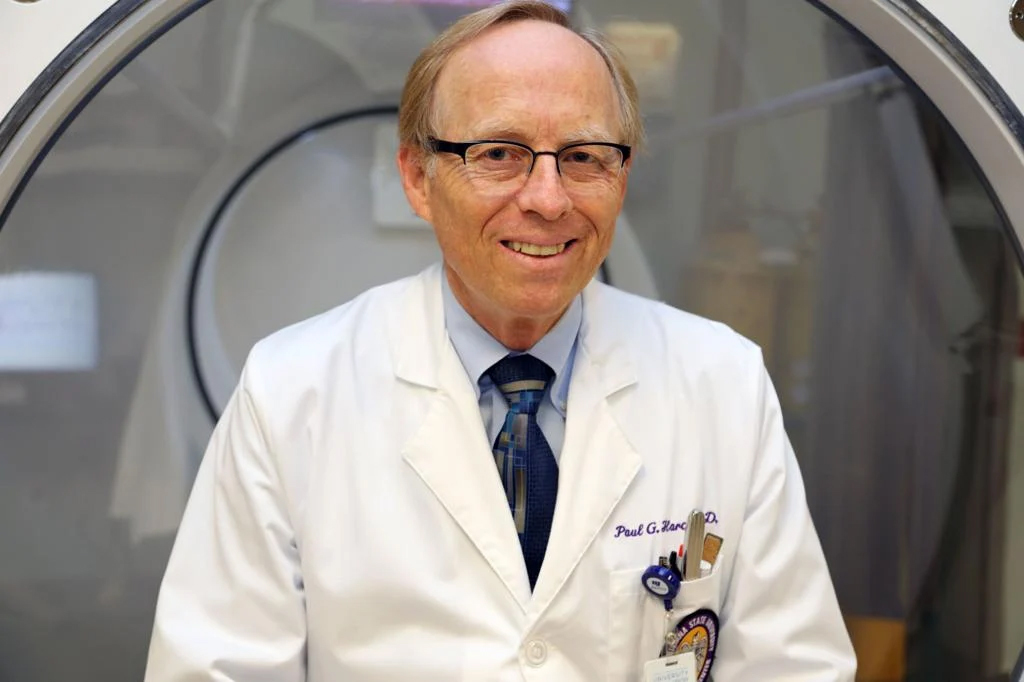
Dr. Paul G. Harch, MD
Dr. Harch initiated and continues to be a private practice that has resulted in the largest case experience in neurological hyperbaric medicine in the world. In this practice, he adapted the concepts of conventional hyperbaric oxygen therapy to wounds in the central nervous system, which spawned the subsequent academic and research practice. Harch HBOT is the best place to receive oxygen therapy treatments, and patients have traveled from more than 50 countries to be treated by Dr. Harch himself.
Harch HBOT – Hyperbaric Oxygen Therapy Clinic
5216 Lapalco Blvd.
Marrero, LA
504-309-4948
hbot@hbot.com
https://hbot.com/
Recent HBOT News
Cerebral hypoperfusion in autism spectrum disorder
Cerebral hypoperfusion, or insufficient blood flow in the brain, occurs in many areas of the brain in patients diagnosed with autism spectrum disorder (ASD). Hypoperfusion was demonstrated in the brains of individuals with ASD when compared to normal healthy control brains either using positron emission tomography (PET) or single‑photon emission computed tomography (SPECT). The affected areas include, but are not limited to the: prefrontal, frontal, temporal, occipital, and parietal cortices; thalami; basal ganglia; cingulate cortex; caudate nucleus; the limbic system including the hippocampal area; putamen; substantia nigra; cerebellum; and associative cortices. Moreover, correlations between symptom scores and hypoperfusion in the brains of individuals diagnosed with an ASD were found indicating that the greater the autism symptom pathology, the more significant the cerebral hypoperfusion or vascular pathology in the brain. Evidence suggests that brain inflammation and vascular inflammation may explain a part of the hypoperfusion. There is also evidence of a lack of normal compensatory increase in blood flow when the subjects are challenged with a task. Some studies propose treatments that can address the hypoperfusion found among individuals diagnosed with an ASD, bringing symptom relief to some extent. This review will explore the evidence that indicates cerebral hypoperfusion in ASD, as well as the possible etiological aspects, complications, and treatments.
Clinical Trial – Spinal Anesthesia in Caesarean Section
Spinal anesthesia is a safe technique, widely used and tested in the gynecological field, so
as to be considered the first choice technique in cesarean section, which allows to quickly
obtain a valid sensor and motor block. Bupivacaine is one of the most widely used drug for
obtaining spinal anesthesia in pregnant women undergoing caesarean section. Bupivacaine is a
local anesthetic available as a racemic mixture of its two enantiomers, the R (+)-
dextrobupivacaine and the S (-) – levobupivacaine, whose clinical use is widely validated.
Racemic bupivacaine is available as a simple or hyperbaric solution, the latter being the
most commonly used for spinal anesthesia. Levobupivacaine, which is the pure levorotatory
enantiomer of racemic bupivacaine, is a slightly hypobaric solution compared to liquor and
has shown less heart and nerve toxicity, probably due to its ability to bind proteins more
rapidly, and a greater selectivity towards the sensory component compared to Bupivacaine,
presents action and effects better predictable. Its baricity would also offer the advantage
of providing a less sensitive block to the position.
Hypotension is one of the most common complications of spinal anesthesia and is particularly
relevant in caesarean section because, in addition to the adverse effects on the parturient,
it can have repercussions on the fetus through a reduction of placental perfusion.
Some studies have showed a similar incidence of hypotension in patients treated with
bupivacaine compared to those treated with levobupivacaine, while others assert an
equivalence between the two drugs. In most studies, however, a significantly lower incidence
of hypotension and a greater hemodynamic stability were reported in pregnant patients
undergoing spinal anesthesia by caesarean section with levobupivacaine.
Being both hyperbaric bupivacaine and levobupivacaine routinely used at the "G. Rodolico"
Universitary Hospital of Catania for the spinal anesthesia of pregnant women undergoing
caesarean section and being their use decided exclusively at discretion of the treating
anesthesiologist, in the light of the discrepant data in the literature about the incidence
of hypotension with the two drugs, the main objective of this observational study is to
evaluate the hemodynamic effects mediated by levobupivacaine on pregnant women subjected to
elective cesarean section and to compare them with those mediated by hyperbaric bupivacaine
in an historical court of pregnant women subjected to caesarean section in the period between
April 2017 and April 2018. The hemodynamic parameters will be monitored in real time with a
non-invasive hemodynamic monitoring system (EV1000® platform + Clearsight® system – Edwards
LifeSciences), routinely used in the "G. Rodolico" Universitary Hospital of Catania, allowing
to obtain greater accuracy and veracity of the results compared to previous studies conducted
on such anesthetics.
Role of Hyperbaric Oxygen Therapy in Trauma Care
Article from Bio Spectrum Media discusses how technological advancements have made the use of HBOT more efficient in Trauma Care: Head Trauma is one of the major causes of death and disabilities across the world. This can be caused due a contusion (bruise),...