
HBOT Conversations:
Dr. Paul Harch & The Science Behind The Practice
Dr. Paul G. Harch, M.D. has used hyperbaric oxygen therapy to treat more than 100 different conditions, including stroke, dementia, autism, and traumatic brain injury. His goal is to help his patients get their lives back using hyperbaric oxygen therapy.
He is the author of The Oxygen Revolution and is considered an International expert and pioneer in the field of Hyperbaric Oxygen Therapy (HBOT). His informative, and comprehensive guide on HBOT has helped countless souls better understand what HBOT is and how it directly affects the body at the genetic level.
This episode on The Science Behind the Practice is the fourth in a nine episode series that will be released weekly with Dr. Harch.
Watch the Podcast
di Girolamo asks Dr. Harch to explain his background, and the road he had to take to get to where he is today.
In Episode 4, Dr. Harch tells a miraculous story of how his medical journey with Hyperbaric Oxygen Therapy fell into his lap during his surgical residency. It was during this internship when Dr, Harch was in a horrendous vehicle accident and nearly killed. This led to more than one medical leave of absence. While out on his second leave of absence after yet another surgery, his perspective changed; and he started to wonder what he wanted to do with his life.
After not finding fulfilment in an emergency medicine practice, Dr. Harch decided that he needed to follow his true passion and interest if he was going to have any chance of feeling accomplished, and changing lives.
Dr. Harch had a high level of interest in Navy divers and the extreme cases of brain decompression sickness. He started asking questions about how they were being treated for decompression sickness and why they were not getting better. Dr, Harch refers to the unbelievable cases that landed in his lap as his “Manna from Heaven”. Other doctors tossed these cases to the side, but Dr. Harch decided to try something different with these patients – he treated using lower doses of hyperbaric oxygen therapy. It totally reversed what was going on with these patients!
Even though his results were clinically astonishing, the Medical Societies were surprisingly not impressed or welcoming; forcing Dr. Harch to create more research documentation and do more clinical work to prove his success with hyperbaric oxygen therapy to treat chronic brain issues. During his journey to prove the results, he was implemental in successfully being able to show brain decompression illness on imaging. The imaging results were so dramatic after hyperbaric oxygen therapy that the radiologists didn’t even know how to read it! This is about the time when Dr. Harch’s road to patient care took a straight-shot towards healing a larger variety of indications with HBOT.
His goal today is the same as it was back then…. prove to everyone that Hyperbaric Oxygen Therapy WORKS! Dr. Harch has no plans to retire and stresses that he wants to see this all over the finish line.
Dr. Harch has used HBOT to change the lives of children and adults; but it was his own life that was also greatly changed by the power of hyperbarics. Hyperbaric Oxygen Therapy has allowed Dr. Harch to take the elements of oxygen and pressure, & implement them into healing protocols that have now saved countless lives.
Subscribe Now, It’s Free !
Guest
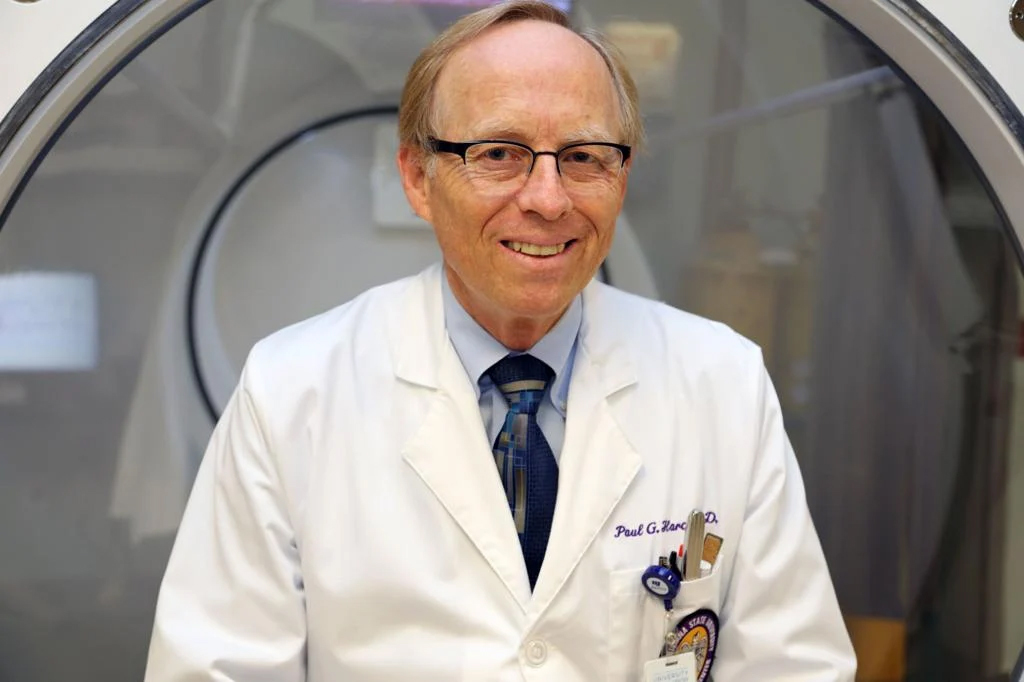
Dr. Paul G. Harch, MD
Dr. Harch initiated and continues to be a private practice that has resulted in the largest case experience in neurological hyperbaric medicine in the world. In this practice, he adapted the concepts of conventional hyperbaric oxygen therapy to wounds in the central nervous system, which spawned the subsequent academic and research practice. Harch HBOT is the best place to receive oxygen therapy treatments, and patients have traveled from more than 50 countries to be treated by Dr. Harch himself.
Harch HBOT – Hyperbaric Oxygen Therapy Clinic
5216 Lapalco Blvd.
Marrero, LA
504-309-4948
hbot@hbot.com
https://hbot.com/
Recent HBOT News
Clinical Trial – Incidence of Postoperative Delirium in Cancer Patients After Laparoscopic Surgery in Trendelenburg Position
Postoperative delirium is an acute mental syndrome that is caused by diffuse cerebral
dysfunction resulting from the action of predisposing and precipitating factors acting
together. It is associated with an increase in mortality and postoperative morbidity and
prolongs the period of hospitalization of the patient Videolaparoscopic surgery has been
increasingly used as a therapeutic and diagnostic method. In order to have a good
visualization of the anatomical structures on which it will act, it is necessary to introduce
gas into the cavity, a mandatory component known as pneumoperitoneum. This technique gives
special characteristics for the conduction of anesthesia, since the positive intra-abdominal
pressure results in changes in the patient’s physiology. Some types of laparoscopic surgery
require the position of Trendelenburg for better visualization of the operative field. Among
the changes related to this position are the increase in cardiac output and intracranial
pressure.
In order to optimize the anesthetic procedure, anesthetic blocks have been increasingly used,
especially the spinal. The association of general anesthesia with spinal anesthesia, followed
by its contraindications is advantageous, because lower doses of anesthetic agents are
necessary for the maintenance of general anesthesia. This association results in an earlier
awakening, a reduction of nausea / vomiting, postoperative pain, length of hospital stay,
cost effectiveness and greater patient satisfaction. As a disadvantage, by associating
general anesthesia with spinal anesthesia, patients become susceptible to the adverse events
of spinal anesthesia. Among these, the most common are headache, hypotension, nausea and
vomiting, pruritus, urinary retention and tremor. Performing spinal anesthesia with opioids
alone, without the use of local anesthetic is also possible, with morphine being the most
used. The benefit of this variation of technique is analgesia for a period of 12 to 24 hours,
without the cardiovascular consequences resulting from the action of the local anesthetic.
JUSTIFICATION: There are no studies in the literature evaluating The objective of this study
is to analyze if the anesthetic techniques employed, general anesthesia or general anesthesia
associated with subarachnoid block, for videolaparoscopic oncologic surgeries, in
Trendelenburg position, differ in relation to the incidence of delirium in the postoperative
period.
Incense burning smoke sensitizes lung cancer cells to EGFR TKI by inducing AREG expression.
Abstract: Incense burning is common in Asian countries due to the religious beliefs. Environmental exposure to incense burning smoke is a potential risk factor for tumor development and progression of non-small cell lung cancer (NSCLC). Eastern Asia ethnic origin is...
A diver with immersion pulmonary oedema and prolonged respiratory symptoms.
Abstract: Immersion pulmonary oedema (IPE) is particularly associated with an excessive reaction to exercise and/or cold stress. IPE usually resolves without recompression therapy within a day or two. Herein we report a diver diagnosed with IPE, in whom symptoms...