
HBOT Conversations:
Dr. Paul Harch & The Science Behind The Practice
Dr. Paul G. Harch, M.D. has used hyperbaric oxygen therapy to treat more than 100 different conditions, including stroke, dementia, autism, and traumatic brain injury. His goal is to help his patients get their lives back using hyperbaric oxygen therapy.
He is the author of The Oxygen Revolution and is considered an International expert and pioneer in the field of Hyperbaric Oxygen Therapy (HBOT). His informative, and comprehensive guide on HBOT has helped countless souls better understand what HBOT is and how it directly affects the body at the genetic level.
This episode on The Science Behind the Practice is the fourth in a nine episode series that will be released weekly with Dr. Harch.
Watch the Podcast
di Girolamo asks Dr. Harch to explain his background, and the road he had to take to get to where he is today.
In Episode 4, Dr. Harch tells a miraculous story of how his medical journey with Hyperbaric Oxygen Therapy fell into his lap during his surgical residency. It was during this internship when Dr, Harch was in a horrendous vehicle accident and nearly killed. This led to more than one medical leave of absence. While out on his second leave of absence after yet another surgery, his perspective changed; and he started to wonder what he wanted to do with his life.
After not finding fulfilment in an emergency medicine practice, Dr. Harch decided that he needed to follow his true passion and interest if he was going to have any chance of feeling accomplished, and changing lives.
Dr. Harch had a high level of interest in Navy divers and the extreme cases of brain decompression sickness. He started asking questions about how they were being treated for decompression sickness and why they were not getting better. Dr, Harch refers to the unbelievable cases that landed in his lap as his “Manna from Heaven”. Other doctors tossed these cases to the side, but Dr. Harch decided to try something different with these patients – he treated using lower doses of hyperbaric oxygen therapy. It totally reversed what was going on with these patients!
Even though his results were clinically astonishing, the Medical Societies were surprisingly not impressed or welcoming; forcing Dr. Harch to create more research documentation and do more clinical work to prove his success with hyperbaric oxygen therapy to treat chronic brain issues. During his journey to prove the results, he was implemental in successfully being able to show brain decompression illness on imaging. The imaging results were so dramatic after hyperbaric oxygen therapy that the radiologists didn’t even know how to read it! This is about the time when Dr. Harch’s road to patient care took a straight-shot towards healing a larger variety of indications with HBOT.
His goal today is the same as it was back then…. prove to everyone that Hyperbaric Oxygen Therapy WORKS! Dr. Harch has no plans to retire and stresses that he wants to see this all over the finish line.
Dr. Harch has used HBOT to change the lives of children and adults; but it was his own life that was also greatly changed by the power of hyperbarics. Hyperbaric Oxygen Therapy has allowed Dr. Harch to take the elements of oxygen and pressure, & implement them into healing protocols that have now saved countless lives.
Subscribe Now, It’s Free !
Guest
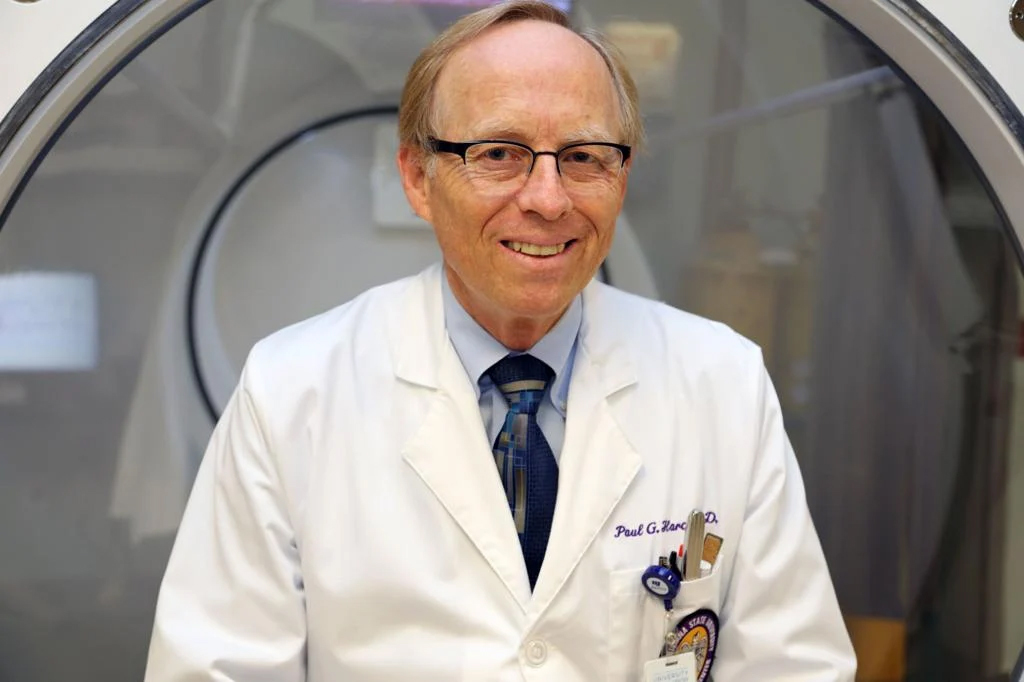
Dr. Paul G. Harch, MD
Dr. Harch initiated and continues to be a private practice that has resulted in the largest case experience in neurological hyperbaric medicine in the world. In this practice, he adapted the concepts of conventional hyperbaric oxygen therapy to wounds in the central nervous system, which spawned the subsequent academic and research practice. Harch HBOT is the best place to receive oxygen therapy treatments, and patients have traveled from more than 50 countries to be treated by Dr. Harch himself.
Harch HBOT – Hyperbaric Oxygen Therapy Clinic
5216 Lapalco Blvd.
Marrero, LA
504-309-4948
hbot@hbot.com
https://hbot.com/
Recent HBOT News
International Survey Regarding the Use of Rehabilitation Modalities in Horses.
Abstract: To define which biologic, electrophysical and other modalities are used in horses for injury or performance issues, a questionnaire regarding 38 modalities was distributed to eight veterinary groups. A total of 305 complete or partial responses were obtained...
Clinical Trial – Effects of Repetitive Hyperbaric Oxygen Therapy in Patients With Acute Ischaemic Stroke
Background and Rationale:
Cerebrovascular disease is always ranked at the top causes of death and most of hospitalized
acute stroke patients have ischemic stroke [1].
Although the mortality rate of acute ischemic stroke is less than that of hemorrhagic stroke
[1], it still results in patient disabilities and complications that often lead to
significant costs to individuals, families, and society.
Traditional treatment for acute ischemic stroke includes thrombolytic therapy by injecting
tissue plasminogen activator (t-PA) within three hours after onset of symptoms [2],
antiplatelets and/or anticoagulant agents administered within the first 48 hours. Clinically,
the narrow time window of thrombolytic therapy and coexisting contraindications limit the use
of t-PA [2]. Thus, searching for an effective supplemental treatment for acute ischemic
stroke is imperative.
Hyperbaric oxygen therapy (HBOT) is valuable in treating acute carbon monoxide poisoning
[3,4], air or gas embolism [5], facilitating wound healing [6] and has been used as an
adjuvant treatment for many neurological disorders that need further study as concussion [7]
, stroke [8,9], cerebral palsy [ 10],traumatic brain injury [ 11], cerebral air embolism
[12], Autism [13] and multiple sclerosis [14].
Indications of hyperbaric oxygen therapy recommended by undersea and hyperbaric medical
society (UHMS) [15] are 1.air or gas embolism [5], 2.carbon monoxide poisoning [3,4],
3.clostridial myositis and myonecrosis [16], 4.crush injury, compartment syndrome and other
acute traumatic ischemias [17], 5.decompression sickness [18], 6.arterial insufficiencies
[19], 7.severe anemia [20], 8.intracranial abscess [21], 9.necrotizing soft tissue infections
[22],10. refractory osteomyelitis [23], 11.delayed radiation injury [24], 12.compromised
grafts and flaps [25], 13.acute thermal burn injury [26] and 14.idiopathic sudden
sensorineural hearing loss [27].
Known mechanisms of HBOT-induced neuroprotection include enhancing neuronal viability via
increased tissue oxygen delivery to the area of diminished blood flow, reducing brain edema,
and improving metabolism after ischemia [28,29]. Furthermore, a recent study performed on a
rat suggested that upregulation of the expression of glial derived neurotrophic factor (GDNF)
and nerve growth factor (NGF) might underlie the effect of HBOT [30].
The effectiveness of use of Hyperbaric oxygen therapy in human ischemic stroke is still
controversial that need further evaluation.
Clinical Trial – Effect of Adjuvant Hyperbaric Oxygen Therapy on Bells Palsy Outcome
This is a randomized, single blinded, non-placebo controlled that will compare one group of
Bells Palsy patients receiving the current standard of care including oral corticosteroids
and oral antivirals against an experimental group receiving the current standard of care in
addition to hyperbaric oxygen therapy. Outcome assessment will be based on both objective
analyses of facial movements as well as subjective quality of life scales.