
HBOT Conversations:
Dr. Paul Harch & The Science Behind The Practice
Dr. Paul G. Harch, M.D. has used hyperbaric oxygen therapy to treat more than 100 different conditions, including stroke, dementia, autism, and traumatic brain injury. His goal is to help his patients get their lives back using hyperbaric oxygen therapy.
He is the author of The Oxygen Revolution and is considered an International expert and pioneer in the field of Hyperbaric Oxygen Therapy (HBOT). His informative, and comprehensive guide on HBOT has helped countless souls better understand what HBOT is and how it directly affects the body at the genetic level.
This episode on The Science Behind the Practice is the fourth in a nine episode series that will be released weekly with Dr. Harch.
Watch the Podcast
di Girolamo asks Dr. Harch to explain his background, and the road he had to take to get to where he is today.
In Episode 4, Dr. Harch tells a miraculous story of how his medical journey with Hyperbaric Oxygen Therapy fell into his lap during his surgical residency. It was during this internship when Dr, Harch was in a horrendous vehicle accident and nearly killed. This led to more than one medical leave of absence. While out on his second leave of absence after yet another surgery, his perspective changed; and he started to wonder what he wanted to do with his life.
After not finding fulfilment in an emergency medicine practice, Dr. Harch decided that he needed to follow his true passion and interest if he was going to have any chance of feeling accomplished, and changing lives.
Dr. Harch had a high level of interest in Navy divers and the extreme cases of brain decompression sickness. He started asking questions about how they were being treated for decompression sickness and why they were not getting better. Dr, Harch refers to the unbelievable cases that landed in his lap as his “Manna from Heaven”. Other doctors tossed these cases to the side, but Dr. Harch decided to try something different with these patients – he treated using lower doses of hyperbaric oxygen therapy. It totally reversed what was going on with these patients!
Even though his results were clinically astonishing, the Medical Societies were surprisingly not impressed or welcoming; forcing Dr. Harch to create more research documentation and do more clinical work to prove his success with hyperbaric oxygen therapy to treat chronic brain issues. During his journey to prove the results, he was implemental in successfully being able to show brain decompression illness on imaging. The imaging results were so dramatic after hyperbaric oxygen therapy that the radiologists didn’t even know how to read it! This is about the time when Dr. Harch’s road to patient care took a straight-shot towards healing a larger variety of indications with HBOT.
His goal today is the same as it was back then…. prove to everyone that Hyperbaric Oxygen Therapy WORKS! Dr. Harch has no plans to retire and stresses that he wants to see this all over the finish line.
Dr. Harch has used HBOT to change the lives of children and adults; but it was his own life that was also greatly changed by the power of hyperbarics. Hyperbaric Oxygen Therapy has allowed Dr. Harch to take the elements of oxygen and pressure, & implement them into healing protocols that have now saved countless lives.
Subscribe Now, It’s Free !
Guest
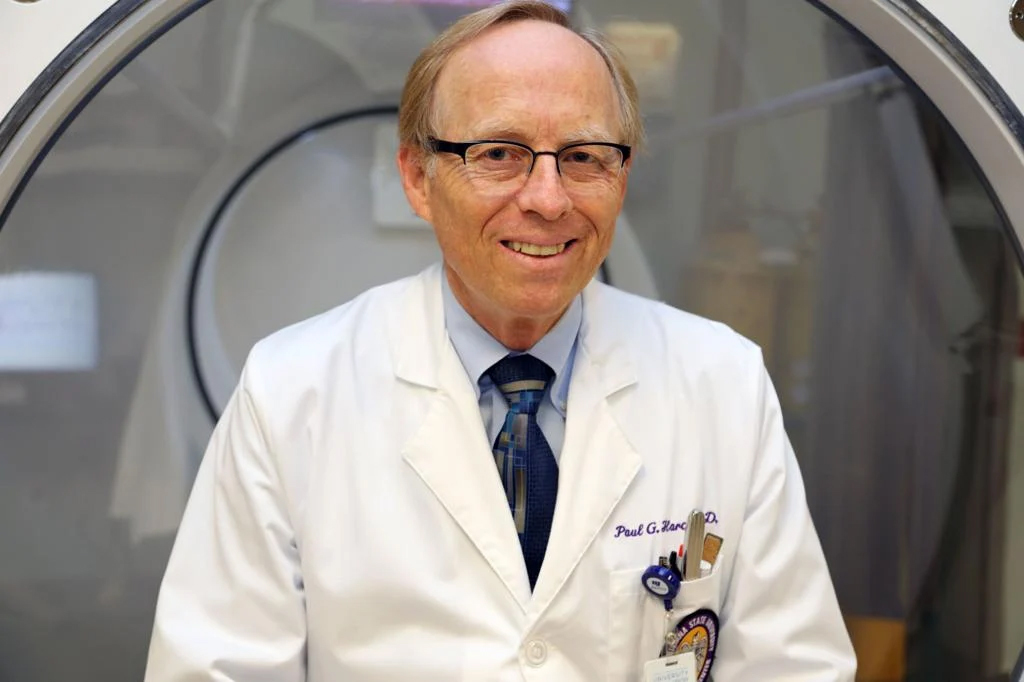
Dr. Paul G. Harch, MD
Dr. Harch initiated and continues to be a private practice that has resulted in the largest case experience in neurological hyperbaric medicine in the world. In this practice, he adapted the concepts of conventional hyperbaric oxygen therapy to wounds in the central nervous system, which spawned the subsequent academic and research practice. Harch HBOT is the best place to receive oxygen therapy treatments, and patients have traveled from more than 50 countries to be treated by Dr. Harch himself.
Harch HBOT – Hyperbaric Oxygen Therapy Clinic
5216 Lapalco Blvd.
Marrero, LA
504-309-4948
hbot@hbot.com
https://hbot.com/
Recent HBOT News
Clinical Trial – Hyperbaric Oxygen Therapy Effect on Post Concussion Syndrome in Children
Due its high incidence, mTBI and its consequences of PPCS are a major public health issue.
There is no consensus regarding the treatment of PPCS in pediatrics. Relying on its results
in adults, HBOT offers a promising new direction of treatment, which targets the basic
pathological processes responsible for post-concussion symptoms.
The effect of hyperbaric oxygen therapy in pediatric TBI has never been evaluated.
The aim of the current study is to evaluate in a prospective cross-over, randomized study,
the effect of HBOT on children with PPCS due to mild TBI.
Clinical Trial – Observational Follow-up to ST-001 Calciphylaxis Pain Treatment With Intravenous Sodium Thiosulfate
This is an 8-week observational follow-up study of patients who participated in the ST-001
CALISTA study (A Phase 3, Intravenous Sodium Thiosulfate for Acute Calciphylaxis Treatment: A
Multicenter, Randomized, Double-blind, Placebo-controlled Clinical Trial).
Hyperbaric oxygen ameliorated the lesion scope and nerve function in acute spinal cord injury patients: A retrospective study.
This is a retrospective study to assess the therapeutic effect of hyperbaric oxygen (HBO) in early treatment of acute spinal cord injury (SCI) using magnetic resonance imaging (MRI) and electrophysiology in diagnosing. Forty acute SCI patients from Sun Yat-Sen Memorial Hospital who were assigned into HBO treatment were included during August 2013 to October 2014.The patients with adverse reactions or contraindications for HBO were assigned as controls. Both of two groups (HBO and Control) received medicine treatment with Urbason, GM-1 and mecobalamine after surgery. ASIA and the Frankel scores were used to evaluate the therapeutic effect of HBO at the 15th and 30th day after HBO treatment by using MRI and electrophysiology features. Significant therapeutic effect of HBO treatment on acute SCI patients was observed compared with the control group (P<0.05). Comparison for ASIA and Frankel scores showed that motor and neurological functions were significantly improved in HBO group at day 15 and day 30 post treatment. MRI images showed that the grade III injury in HBO group was significant lower than the control group. In comparison with the control, the peak of somatosensory evoked potential (SEP) and motor evoked potential (MEP) amplitude increased, the latency was shortened, and the conduction velocity of sensory nerve (SCV) and motor nerve (MCV) was significantly increased in the HBO group (P<0.05). HBO treatment has a great efficacy in acute SCI patients. HBO therapy at early stage of acute SCI is beneficiary to the recovery.