
HBOT Conversations:
Dr. Paul Harch & The Science Behind The Practice
Dr. Paul G. Harch, M.D. has used hyperbaric oxygen therapy to treat more than 100 different conditions, including stroke, dementia, autism, and traumatic brain injury. His goal is to help his patients get their lives back using hyperbaric oxygen therapy.
He is the author of The Oxygen Revolution and is considered an International expert and pioneer in the field of Hyperbaric Oxygen Therapy (HBOT). His informative, and comprehensive guide on HBOT has helped countless souls better understand what HBOT is and how it directly affects the body at the genetic level.
This episode on The Science Behind the Practice is the fourth in a nine episode series that will be released weekly with Dr. Harch.
Watch the Podcast
di Girolamo asks Dr. Harch to explain his background, and the road he had to take to get to where he is today.
In Episode 4, Dr. Harch tells a miraculous story of how his medical journey with Hyperbaric Oxygen Therapy fell into his lap during his surgical residency. It was during this internship when Dr, Harch was in a horrendous vehicle accident and nearly killed. This led to more than one medical leave of absence. While out on his second leave of absence after yet another surgery, his perspective changed; and he started to wonder what he wanted to do with his life.
After not finding fulfilment in an emergency medicine practice, Dr. Harch decided that he needed to follow his true passion and interest if he was going to have any chance of feeling accomplished, and changing lives.
Dr. Harch had a high level of interest in Navy divers and the extreme cases of brain decompression sickness. He started asking questions about how they were being treated for decompression sickness and why they were not getting better. Dr, Harch refers to the unbelievable cases that landed in his lap as his “Manna from Heaven”. Other doctors tossed these cases to the side, but Dr. Harch decided to try something different with these patients – he treated using lower doses of hyperbaric oxygen therapy. It totally reversed what was going on with these patients!
Even though his results were clinically astonishing, the Medical Societies were surprisingly not impressed or welcoming; forcing Dr. Harch to create more research documentation and do more clinical work to prove his success with hyperbaric oxygen therapy to treat chronic brain issues. During his journey to prove the results, he was implemental in successfully being able to show brain decompression illness on imaging. The imaging results were so dramatic after hyperbaric oxygen therapy that the radiologists didn’t even know how to read it! This is about the time when Dr. Harch’s road to patient care took a straight-shot towards healing a larger variety of indications with HBOT.
His goal today is the same as it was back then…. prove to everyone that Hyperbaric Oxygen Therapy WORKS! Dr. Harch has no plans to retire and stresses that he wants to see this all over the finish line.
Dr. Harch has used HBOT to change the lives of children and adults; but it was his own life that was also greatly changed by the power of hyperbarics. Hyperbaric Oxygen Therapy has allowed Dr. Harch to take the elements of oxygen and pressure, & implement them into healing protocols that have now saved countless lives.
Subscribe Now, It’s Free !
Guest
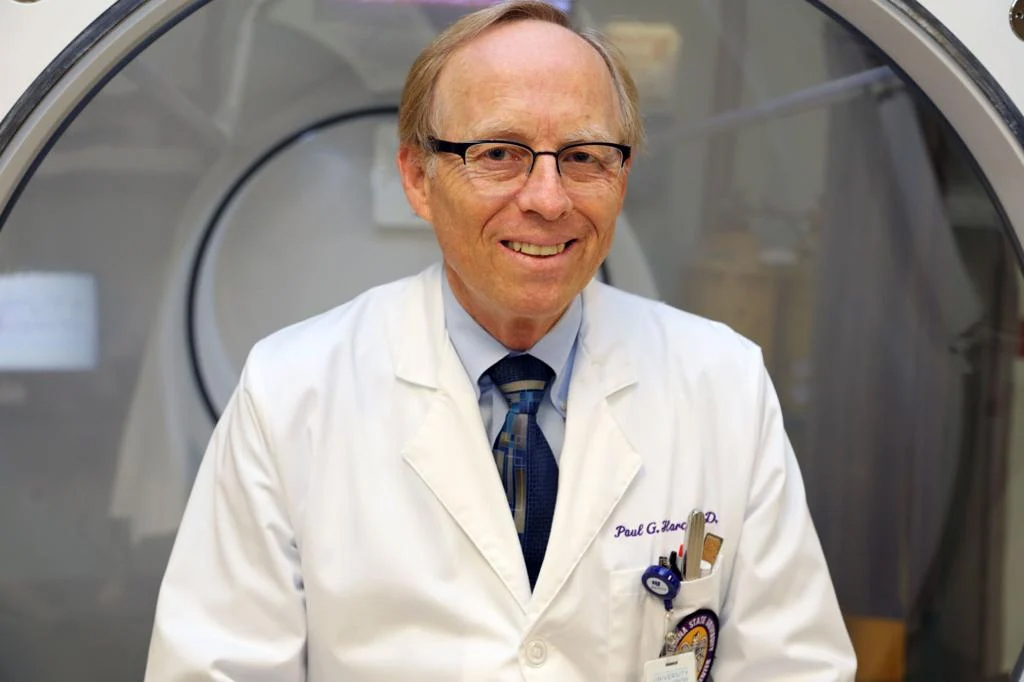
Dr. Paul G. Harch, MD
Dr. Harch initiated and continues to be a private practice that has resulted in the largest case experience in neurological hyperbaric medicine in the world. In this practice, he adapted the concepts of conventional hyperbaric oxygen therapy to wounds in the central nervous system, which spawned the subsequent academic and research practice. Harch HBOT is the best place to receive oxygen therapy treatments, and patients have traveled from more than 50 countries to be treated by Dr. Harch himself.
Harch HBOT – Hyperbaric Oxygen Therapy Clinic
5216 Lapalco Blvd.
Marrero, LA
504-309-4948
hbot@hbot.com
https://hbot.com/
Recent HBOT News
Clinical Trial – Comparative Study of the Analgesic Effect of Spinal Anesthesia or Infiltration Anesthesia for Hemorrhoidectomy
Background and Objectives: Postoperative analgesia and early recovery are relevant for
hospital discharge after hemorrhoidectomy. This study investigated the postoperative
analgesic effect with local infiltration compared with spinal block.
Methods: This randomized study included 40 patients aged 18 to 60 years old. Local group (LG)
received local infiltration under general anaesthesia; spinal group (SG) received a
subarachnoid block. LG received general anaesthesia with propofol, atracurium and propofol
infusion as well as a local infiltration of 20 ml 0.75% ropivacaine. SG received 2 ml of 0.5%
hyperbaric bupivacaine. Analgesic supplementation was with 50µg of fentanyl for LG and 1%
lidocaine for SG. There were assessed: postoperative pain intensity, sphincter relaxation,
motor blockade of lower limbs, time to discharge, analgesic dose over 1 week and adverse
effects.
Clinical Trial – Spinal Anesthesia Associated With General Anesthesia in Coronary Artery Bypass
CONTEXT: In patients eligible for coronary artery bypass surgery, anesthesia should provide a
number of conditions that exceed the limits of cardiovascular stability, myocardial
protection and other organs. Moreover, the combination of general anesthesia and spinal
anesthesia lessens the homeostatic, metabolic, hormonal and immunosuppressive changes. The
goal of this research was to evaluate the consumption of fentanyl citrate in intra-operative
in Coronary Artery Bypass Grafting (CABG) surgery with cardiopulmonary bypass under spinal
anesthesia associated with general anesthesia.
METHODS: Clinical, prospective, randomized and double covered study, approved by the Research
Ethics Committee. Fifty-six patients candidates for CABG with CPB, after signing the Terms of
consent, were randomized and divided into two groups: GI – General and GII – General +
subarachnoid. General anesthesia was induced according to the weight of each patient and
maintenance with isoflurane and fentanyl. Spinal anesthesia was induced with 20 mg of 0.5%
hyperbaric bupivacaine and 200 mcg of morphine, the patient is placed in cephalo-position
slope of 45 degrees for 10 minutes in Group II. In the statistical study was performed using
the Mann-Whitney test; the level of statistical significance was set at 5%.
Deep tissue biopsy vs. superficial swab culture, including microbial loading determination, in the microbiological assessment of Skin and Soft Tissue Infections (SSTIs).
Abstract: Thirty-two patients affected by SSTIs including DFIs were enrolled between 2013 and 2014. Superficial swab was obtained before and after cleansing with sterile saline, and after ultrasonic debridement; deep tissue biopsy was obtained from ulcer base. Samples...