
HBOT Conversations:
Dr. Paul Harch & Viral / Bacterial Infections
Dr. Paul G. Harch, M.D. has used hyperbaric oxygen therapy to treat more than 100 different conditions, including stroke, dementia, autism, and traumatic brain injury. His goal is to help his patients get their lives back using hyperbaric oxygen therapy.
He is the author of The Oxygen Revolution and is considered an International expert and pioneer in the field of Hyperbaric Oxygen Therapy (HBOT). His informative, and comprehensive guide on HBOT has helped countless souls better understand what HBOT is and how it directly affects the body at the genetic level.
This episode on a variety of viral & bacterial infections, combined with a few inflammatory conditions is the final episode in our nine episode series that has been released weekly with Dr. Harch.
Watch the Podcast
In this final episode of HBOT News Conversations with Dr. Harch, host Edward di Girolamo takes this time to review a handful of indications we have yet to discuss.
This episode will touch on using Hyperbaric Oxygen Therapy for viral illnesses of AIDS and long-haul COVID, the bacterial illness of Lyme Disease, and the Inflammatory conditions of Migraines, Chronic Fatigue Syndrome, Vaccine Injuries, and Asthma.
AIDS — HBOT does not have, that we know of, much direct antiviral effect. In general, it is not necessarily toxic to the virus. AIDS is an immunosuppressive disease and the virus is only part of the story; AIDS patients have a dysregulated immune system and there is damage that results from that. Dr. Harch specifically discusses a HBOT and AIDS report on some scuba divers; lobster fisherman in Puerto Rico who had AIDS, with the results showing improvement in their blood counts and overall health. There hasn’t been much follow-up on this or any study referencing AIDS and HBOT, but Dr. Harch would still encourage AIDS patients to try Hyperbaric Oxygen Therapy to improve their quality of life since HBOT has a direct positive response on an immune system’s inflammatory reaction.
ASTHMA — Asthma is an inflammatory condition of the lung. Since HBOT upregulates the anti-inflammatory gene and downregulates the inflammatory gene, it definitely makes sense to treat Asthma with HBOT. Dr. Harch references the famous HBOT case of Mici Teller, Dr. Edward Teller’s wife. She was a tobacco addict, terrible smoker, and had destroyed her lungs. She was on supplemental oxygen and had dementia from both the effects of the tobacco, cigarettes, and hypoxia. Dr. Teller had a stroke and Dr. Richard Neubauer sent a hyperbaric chamber out to him to treat him for his stroke. Mici was also placed in the HBOT chamber to treat her pulmonary disease. Not only did she get off oxygen (and she was dying at the time); it rejuvenator her. She lived another five years! Her dementia was ameliorated, and she had a fairly noticeable and dramatic improvement. In this case, HBOT was purely treating the original lung disease, but they found it was also benefiting her brain, so they continued HBOT treatments. Dr. Teller became a vocal advocate for HBOT, and did over 3,000 dives until he died in his 90s. He contributed his long life to Hyperbaric Oxygen Therapy and voiced that this is a treatment that requires more focus and study.
LYME DISEASE — Dr. Harch explains that he does not treat Lyme Disease patients with Hyperbaric Oxygen unless they’re receiving treatment for an active Lyme infection, or there’s certainty that the patient is no longer actively infected and now they have a residual neurological injury. Reason being, it’s too difficult to dose them properly. But HBOT does have potential to benefit a Lyme Disease patient, especially in conjunction with some anti-Lyme therapy for residual injury. Many Lyme patients have received HBOT and swear by the healing effects of it.
MIGRAINES — Migraines appear to occur when a reactivity enters a sensitivity of cerebral blood vessels and there is contraction and dilation in response to various stimuli; such as chemicals, hormones, trauma. If you’re getting migraines from trauma, there are many reliable and fascinating studies available referencing the use of Hyperbaric Oxygen Therapy to gain migraine relief from post-concussive syndrome. Dr. Harch also clarifies that reactive blood vessel migraine headaches and cluster headaches do also typically respond to HBOT, and about 93% of his patients have experienced headache relief almost instantly. He references Bill Duncan, who had complete cessation of his headaches after two treatments (back in 2001) and to this day they have still not returned thanks to the power of Hyperbaric Oxygen Therapy.
CHRONIC FATIGUE SYNDROME — Dr. Harch believes that most Chronic Fatigue patients are experiencing brain-based symptoms. While he has had great success in treating Chronic Fatigue Syndrome in his patients, he clarified that he does make a significant effort to identify the cause of CFS. Chronic Fatigue can be secondary to carbon monoxide poisoning or other forms of toxicities — chemical toxicities or mold, for instance. So, he stresses that yes, HBOT tends to work wonders for CFS but it’s just as important to identify the “why”, because then you can be a little more specific in the treatment protocol within the realm of that certain pathology. In many cases, the “why” is never identified, but Dr. Harch again stresses to at least try to find out why the patient is suffering from CFS. Even if you can’t, Hyperbaric Oxygen Therapy has been very beneficial to relieving the debilitating symptoms of Chronic Fatigue Syndrome.
LONG-HAUL COVID — Dr. Harch discusses how a person’s reaction to the viral infection of COVID is different for everyone. Overall, it is our individual immune system reaction that determines the severity of the disease. In some people their immune systems are dysfunctional and they can have a greater abnormal immune response that results in their death or severe problems in the long run. The biggest problem is the persistent inflammation post-COVID creates in Long-Haul COVID patients. It’s different with each person what part or organ system in their body has the dominant inflammation. However, one of HBOT’s dominant effects on disease pathophysiology is it’s affect on inflammation in a dysfunctional immune system. HBOT just makes sense to treat the lingering inflammation in Long-Haul COVID patients, and the response rate for bringing patients back to their baseline has been phenomenal. For some patients it only takes a few treatments, and for some it takes 40 – but overall, yes…. Hyperbaric Oxygen Therapy absolutely is showing great promise in treating Long-Haul COVID patients.
VACCINE INJURIES — Dr. Harch explains that viewers should take time to watch the FLCCC weekly webinar where he and other doctors in the hyperbaric world specifically discusses the use of Hyperbaric Oxygen Therapy to treat vaccine injuries. Vaccines stimulate the immune system, and the problem with some vaccines and especially with the COVID vaccines, is that the COVID vaccines stimulate an immune response and they never underwent long-term testing. The documented side effects of vaccines are underreported, but Dr. Harch did bring to our attention that the documented side effects through the government’s Vaccine Adverse Events Reporting System, VAERS, is greater for the COVID vaccine than the sum of all vaccine adversity events reported through that system in the past three or four decades! HBOT is a treatment for immune dysfunction and inflammation, so Dr. Harch urges anyone who has experienced a COVID vaccine injury, or any vaccine injury, to seek out Hyperbaric Oxygen Therapy.
Dr. Harch sums up his time at HBOT News Network by reminding everyone how Hyperbaric Oxygen Therapy started, in relationship to treating many ill patients at once. It was during the Spanish Flu pandemic, which is essentially a relative of the coronavirus pandemic, when Dr. Cunningham created a large hyperbaric chamber from spare parts of an old boiler. People started flocking to him for treatment because it was literally saving the lives of Spanish Flu victims who were on their last breath. The pressure alone was enough to save the lives of many, but imagine if they had antibiotics then to treat the secondary pneumonia that came from the viral infection — so many more lives could have been saved. Dr. Harch recommends Vance Trimble’s book, “The Uncertain Miracle” to learn more about the use of Hyperbaric Oxygen Therapy during that time period. He stresses that today the medical industry isn’t reinventing the wheel with HBOT, they’ve just studied it longer, figured it out better, and witnessed the miraculous effects of healing with HBOT for a large variety of indications.
di Girolamo ends the segment asking Dr. Harch, “If God could give you one miracle related to Hyperbaric Oxygen that you could request and get. What would that miracle be?” Dr. Harch responds that he wishes for the mass distribution and access of Hyperbaric Oxygen Therapy. He wishes for the day that HBOT could be readily accessed and available to anyone with no barriers to receive it.
Please share Dr. Harch’s HBOT News Conversation segments. Maybe together we can all make that miracle a reality.
Subscribe Now, It’s Free!
Guest
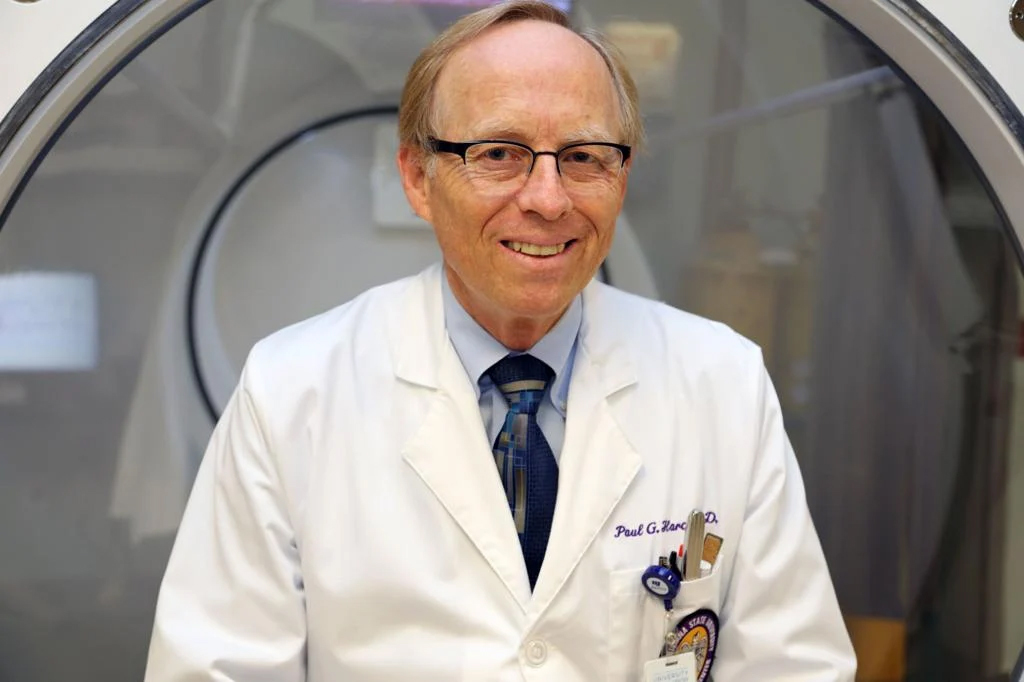
Dr. Paul G. Harch, MD
Dr. Harch initiated and continues to be a private practice that has resulted in the largest case experience in neurological hyperbaric medicine in the world. In this practice, he adapted the concepts of conventional hyperbaric oxygen therapy to wounds in the central nervous system, which spawned the subsequent academic and research practice. Harch HBOT is the best place to receive oxygen therapy treatments, and patients have traveled from more than 50 countries to be treated by Dr. Harch himself.
Harch HBOT – Hyperbaric Oxygen Therapy Clinic
5216 Lapalco Blvd.
Marrero, LA
504-309-4948
hbot@hbot.com
https://hbot.com/
Recent HBOT News
Combining infliximab, anti-MAP and hyperbaric oxygen therapy for resistant fistulizing Crohn’s disease.
Fistulizing Crohn’s disease (CD) presents a therapeutic challenge as fistulae are notoriously difficult to heal. Mycobacterium avium ss paratuberculosis (MAP) treatment in CD is gaining attention. We evaluated healing of CD fistula(e) using a novel combination therapy. Nine consecutive patients who failed to heal fistulae on conventional treatment including anti-TNF, were treated with at least three doses of infliximab, 18-30 courses of hyperbaric oxygen therapy and anti-MAP antibiotics comprising rifabutin, clarithromycin and clofazimine. All patients achieved complete healing of fistulae by 6-28 weeks and follow-up for mean 18 months.
Clinical Trial – Dexmedetomidine Versus Magnesium Sulphate for Caesarean Delivery
Regional anesthesia has become more popular in cesarean deliveries because most of the
parturients prefer being awake during the birth process. In addition, regional anesthesia may
be a safer method than general. In spinal anesthesia local anesthetics alone may not be
enough for an effective postoperative analgesia and hemodynamic stability of the patient wich
is crucial during cesarean section. So far many adjuvants have been used to augment the
analgesia produced by intrathecal local anesthetics and to reduce their adverse effects .
Various intrathecal adjuvants to local anaesthetics have found to improve the quality and
extend duration of spinal block. Prolongation of duration of spinal block is desirable both
for long procedures and for postoperative pain relief. Efficacy and safty of intrathecal
magnesium as analgesic adjuvant has been tested by several clinical trails in recent
years.Antinociceptive effect of magnesium appears to be relevant for the management of
chronic and post operative pain. These effects are primarily based on regulation of calcium
influx in to the cell. Magnesium blocks calcium influx and non competitively antagonizes NMDA
channels. NMDA receptor signelling plays an impartent in determining the duration of acute
pain3).) addition of magnesium to spinal anaesthesia improved postoperative analgesia in
orthopedic setting. addition of intrathecal magnesium sulfate to 10 mg bupivacaine plus 25µg
fentanyl prolonged spinal anaesthesia in patients undergoing lower extremity surgery.
Dexmedetomidine is a highly selective 2-adrenergic agonist which has been used as
pre-medication and as an adjuvant to general anesthesia.Dexmedetomidine have several
beneficial actions during perioperative period. They decrease sympathetic tone with
attenuation of the neuroendocrine and haemodynamic response to anaesthesia and surgery,
reduce anaesthetic and opiod requirement, cause sedation and analgesia. Dexmedetomidine was
first introduced into clinical practice as a short term intravenous sedative in intensive
care. Like any other adjuvant dexmedetomidine is not free from adverse effects. Use of
dexmedetomidine is often associated with a decrease in heart rate and blood
pressure.Dexmedetomidine was used to enhance the analgesic property of local anaesthetics
like lidocaine bupivacaine and ropivacaine. In vivo and in vitro studies indicated that these
local anaesthetics had significant neurotoxicity. Dexmedetomidine showed protective or growth
promoting properties in tissues, including nerve cells from cortex. Intrathecal
dexmedetomidine has a neuroprotective effect similar to methylprednisolone.
The mechanism by which intrathecal alpha 2-adrenergic agonists prolong the motor and sensory
block of local anesthetics is not clear. It may be an additive or synergistic effect
secondary to the different mechanisms of action of local anesthetic and alpha 2 adrenergic
agonist. The local anesthetics act by blocking sodium channels, whereas the alpha 2
adrenergic agonist acts by binding to pre synapyic C fibre and post synaptic dorsal horn
neurons. Intrathecal alpha 2 adrenergic agonist produce analgesia by depressing the realease
of C fibre transmission by hyperpolarization of post synaptic dorsal horn neurons. Li et al
observed that Glutamate is involved in excitatory neurotransmission nociception and plays an
essential role in relaying noxious stimuli in the spinal cord. Intrathecal injection of alpha
2 adrenergic agonists produces potent antinociceptive effects by altering spinal
neurotransmitter release and effectively treats acute pain.
Efficacy of hyperbaric oxygen therapy combined with mild hyperthermia for improving the anti-tumour effects of carboplatin.
Abstract: The aim of this study was to evaluate the effects of hyperbaric oxygen therapy (HBO) on the enhancement of hyperthermic chemosensitisation to carboplatin at mild temperatures in experimental tumours. SCCVII carcinoma in C3H/He mice was used to assess tumour...